


Get Advanced Insights on Any Topic
Discover Trends 12+ Months Before Everyone Else
How We Find Trends Before They Take Off
Exploding Topics’ advanced algorithm monitors millions of unstructured data points to spot trends early on.
Keyword Research
Performance Tracking
Competitor Intelligence
Fix Your Site’s SEO Issues in 30 Seconds
Find technical issues blocking search visibility. Get prioritized, actionable fixes in seconds.
Powered by data from
Latest Blog Posts
Featured Case Studies
See what's trending before everyone else
Each week, we'll send you our best Exploding Topics. Plus, expert insight and analysis.
Average Screen Time for Teens (2026)

 Add Exploding Topics on GoogleAdd Exploding Topics as your preferred source to see more of our stories on Google.
Screen time among teenagers has been on the rise since 2015.
Recent studies indicate that this trend is unlikely to completely reverse in 2026 and beyond. But there is a growing awareness of potentially negative effects of screen time among both teens and parents.
Below, we’ll dive into the numbers behind rising screen time.
Teen Screen Time Statistics
- The average teen spends 7 hours and 22 minutes looking at screens each day
- US teens spend 4.8 hours per day on social media alone
- American teens’ screen time has increased by around 2 hours since 2015
- 58% of US parents limit their teens' screen time
- Among teenagers and young adults, females average 2 hours and 45 minutes more screen time per week than males
- Teenagers spend more than 3 hours per day watching TV/videos
Daily Average Screen Time for Teens in 2026
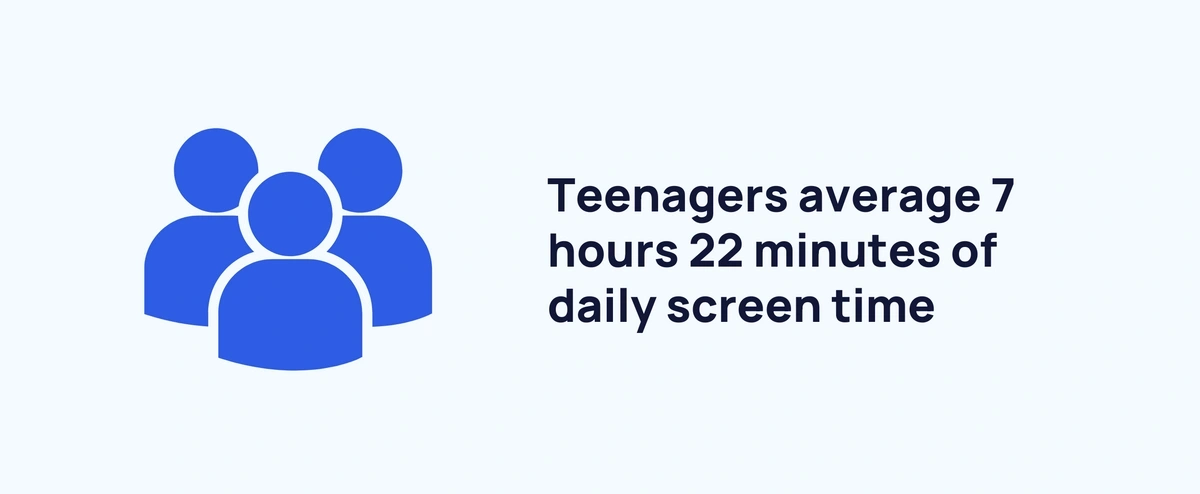
According to the latest available global data, teenagers spend 7 hours and 22 minutes per day in front of screens. That equates to 43% of a teen’s waking hours.
Data Reportal has not published exact figures for global teen screen time in its most recent publications. But in its Digital 2026 Report, it did reveal that internet users aged 16-24 spend more than 41 hours per week consuming online media.
That's almost 6 hours per day, and doesn't include any offline screen time.
The most recent available data also suggests that US teens spend 4.8 hours per day just on social media.
A recent survey reveals that 58% of US parents limit their teen's screen time. That's significantly lower than 84.5% of parents who limit the screen time of their 3-11-year-olds, but higher than in previous years; in 2020, only 50% of all parents limited screen time.
And there is also a growing awareness among teenagers that their screen time is too much.
A survey from late 2024 shows that 52% of the most prolific smartphone users aged 11-18 want to reduce their reliance on their devices. However, 46% feel that they don't know how.
Sources: DataReportal, New York Times, CivicScience, OnSide/YouGov
Average Screen Time for Teens Over Time
Entertainment screen time among US teens has increased significantly in recent years.
In 2015, American 13-to-18-year-olds averaged 6 hours 40 minutes of screen time each day.
That figure rose to 7 hours 22 minutes in 2019.
And jumped to 8 hours 39 minutes at the latest count.
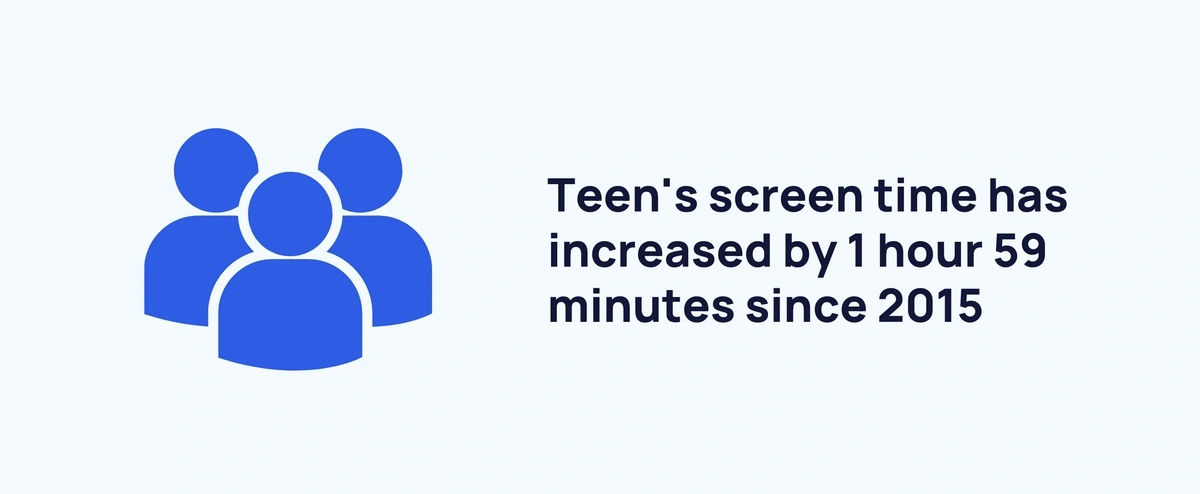
That means that since 2015, average screen time among teens has increased by 1 hour 59 minutes.
Here’s how those figures compare to American tweens (8 to 12-year-olds):
|
Average Daily Screen Time | ||||
|
Age Group |
2015 |
2019 |
Latest available figure |
Change Since 2015 |
|
Teens (13-18) |
6 hrs 40 mins |
7 hrs 22 mins |
8 hrs 39 mins |
↑ 29.75% |
|
Tweens (8-12) |
4 hrs 36 mins |
4 hrs 44 mins |
5 hrs 33 mins |
↑ 20.65% |
As of 2025, 95% of all US teenagers have smartphone. That's up from 73% a decade ago.
47% of US teens report being online "almost constantly", up from 24% in 2015. But that figure has more or less plateaued since 2022 (46%).
Sources: Common Sense Media, Pew Research
Teen Screen Time by Gender
The best recent figures (2026) for screen time by gender focus on the 16-24 age group, as opposed to exclusively teens.
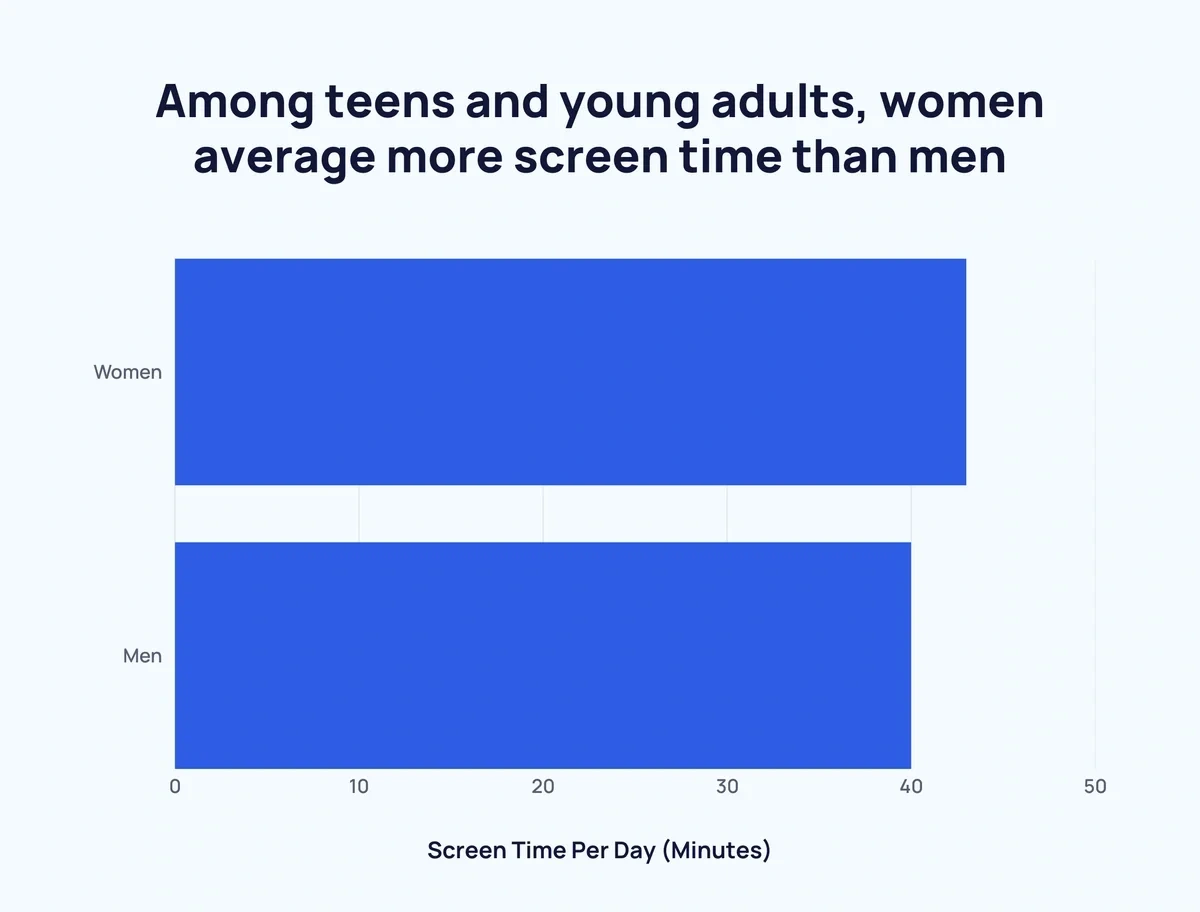
However, they tell us that average internet-connected screen time is higher for females than males.
Young men spend an average of 40 hours per week consuming online media. Young women spend 42 hours and 46 minutes.
Previous surveys looking specifically at teens have found that girls are particularly active on social media compared to boys.
US teenage boys average 4.4 hours per day on social media, compared to 5.3 hours per day for teenage girls.
Sources: Data Reportal, Gallup
Teen Screen Time by Activity
Social networking is the most common type of screen time for teenagers and young adults. Globally 97.4% of young internet users have visited social media in the past month.
Chat/messaging services are also effectively ubiquitous. Search engines, email, and shopping all feature prominently as well.
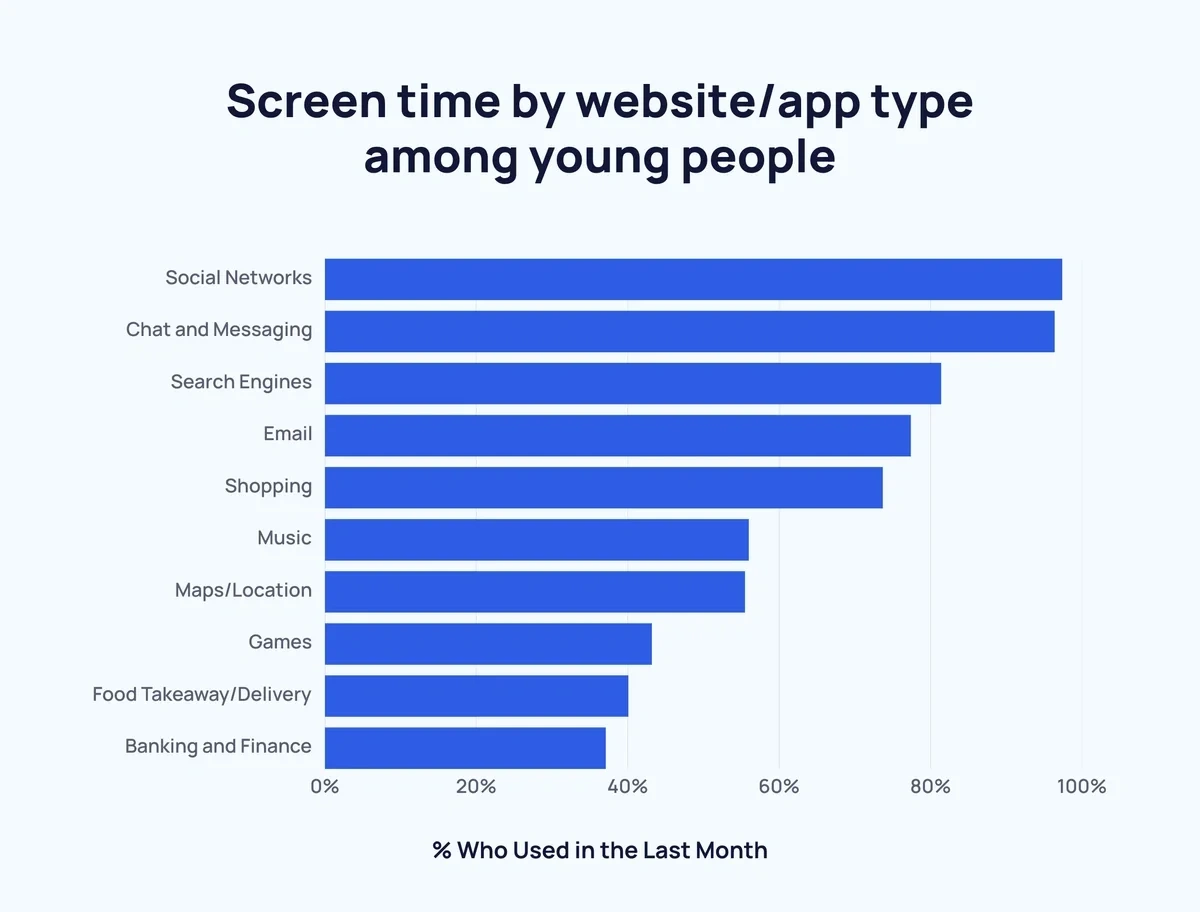
Here’s a full breakdown of screen time split by the proportion of young people accessing it within the last month:
|
Screen Time Activity |
% of internet users aged 16-24 |
|
Social networks |
97.4% |
|
Chat/messaging |
96.4% |
|
Search engines |
81.4% |
|
|
77.4% |
|
Shopping |
73.7% |
|
Music |
56% |
|
Maps/location |
55.5% |
|
Games |
43.2% |
|
Food takeaway/delivery |
40.1% |
|
Banking and finance |
37.1% |
Looking specifically at social media, people under the age of 18 spend an average of 1 hour 47 minutes on TikTok every day.
Snapchat isn’t too far behind with an average of 1 hour 12 minutes.
Here’s the full list of daily social media use among children and teens:
|
Social Media Platform |
Average Daily Use (Global) |
Average Daily Use (US) |
|
TikTok |
1 hour 47 minutes |
1 hour 53 minutes |
|
Snapchat |
1 hour 12 minutes |
1 hour 30 minutes |
|
|
45 minutes |
- * |
|
|
20 minutes |
18 minutes |
|
|
16 minutes |
20 minutes |
|
|
10 minutes |
10 minutes |
|
|
- * |
13 minutes |
Figures from the UK in 2025 show that YouTube, WhatsApp, and TikTok are all used by at least 80% of teenagers. Among 16-17-year-olds specifically, Snapchat and Instagram usage also rises above 80%.
Australia has reacted to the prevalence of social media among teens by issuing a blanket ban. Under-16s in the country are no longer able to access any social platforms, and companies face major fines for failure to comply with the requirement to verify age.
Sources: Data Reportal, Qustodio, Ofcom, CNBC
Want to Spy on Your Competition?
Explore competitors’ website traffic stats, discover growth points, and expand your market share.
Effects of Teen Screen Time
Screens are a part of daily life, and they are not inherently damaging. Among adults, only 23% view screens as a net negative.
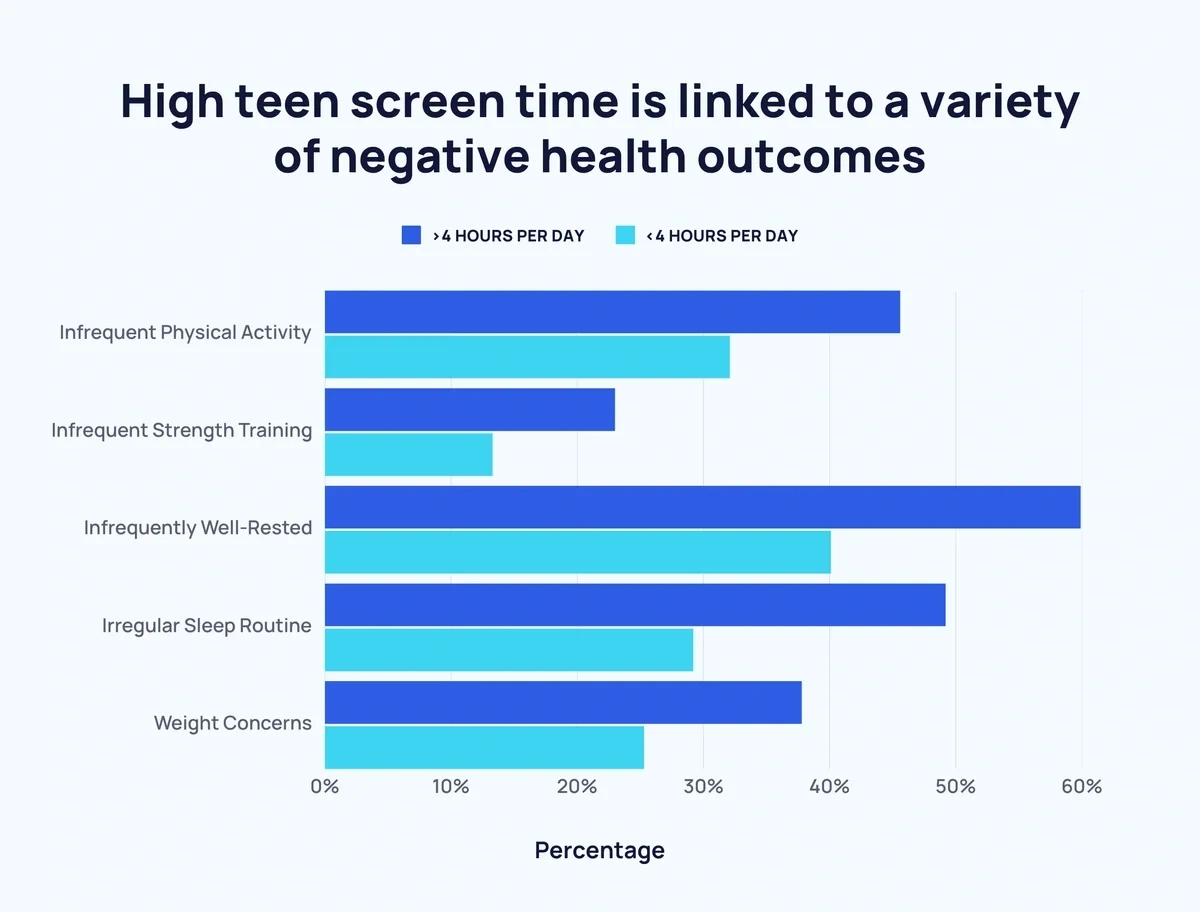
However, studies have repeatedly linked excessive screen time to negative health outcomes. In July 2025, the CDC published a study focused specifically on teens.
59.9% of teens with 4+ hours of screen time per day reported being infrequently well-rested. Among teens with fewer than 4 hours of daily screen time, just 40.1% said the same.
The pattern was even more pronounced in respect of reporting an "irregular sleep routine". 49.2% of heavy screen users said their routine was irregular, versus just 29.2% of lighter users.
Teens with more screen time were also more likely to exercise infrequently and have weight concerns.
Alarmingly, recent symptons of depression were far more prevalent among teens with high screen time (25.9%) than those with low screen time (9.5%).
Teens with more than 4 hours of screen time a day were also more likely to be anxious, and less likely to have frequent social, emotional, and peer support.
However, a different recent study found that addictive patterns of screen use was a greater indicator of negative outcomes than screen time alone.
Sources: Exploding Topics, CDC, JAMA
Conclusion
Screen time continues to increase across the population, but it’s perhaps most alarming in teenagers.
At well over 7 hours, many teens are spending almost half of their waking hours looking at screens. That's a concerning statistic, especially with well-documented negative health outcomes.
But there is an increasing awareness that something needs to change. Australia has even banned social media for under-16s.
For more data on this topic, take a look at these posts: Startling Social Media Addiction Statistics and Worldwide Daily Social Media Usage.
Stop Guessing, Start Growing 🚀
Use real-time topic data to create content that resonates and brings results.
Exploding Topics is owned by Semrush. Our mission is to provide accurate data and expert insights on emerging trends. Unless otherwise noted, this page’s content was written by either an employee or a paid contractor of Semrush Inc.
Share
Newsletter Signup
By clicking “Subscribe” you agree to Semrush Privacy Policy and consent to Semrush using your contact data for newsletter purposes
Written By


Fabio is a research associate at Exploding Topics. Since 2021, Fabio has researched, written, and edited articles for the Explo... Read more