Exploding Topics
Remineralizing Gum search volume grew from under 100 to 27,100 monthly searches between February 2024 and January 2026.
Remineralizing gum
+5100%
GLP 1 Supplement search volume grew from 5,920 to 74,000 monthly searches between February 2024 and January 2026.
GLP 1 supplement
+1150%
Soursop Bitters search volume grew from 9,900 to 110,000 monthly searches between March 2024 and February 2026.
Soursop bitters
+1011%


Get Advanced Insights on Any Topic
Discover Trends 12+ Months Before Everyone Else
How We Find Trends Before They Take Off
Exploding Topics’ advanced algorithm monitors millions of unstructured data points to spot trends early on.
Keyword Research
Performance Tracking
Competitor Intelligence
Fix Your Site’s SEO Issues in 30 Seconds
Find technical issues blocking search visibility. Get prioritized, actionable fixes in seconds.
Powered by data from
Latest Blog Posts
Featured Case Studies
See what's trending before everyone else
Each week, we'll send you our best Exploding Topics. Plus, expert insight and analysis.
Semrush AI Visibility Toolkit vs Ahrefs Brand Radar for AI Tracking

 Add Exploding Topics on GoogleAdd Exploding Topics as your preferred source to see more of our stories on Google.
Whether you’re an agency juggling multiple SEO and marketing clients or an in-house team focused on growth, you already know how much the right tracking tools can help you make big wins happen.
But marketing strategies are shifting dramatically—away from a focus on traditional SEO and organic traffic and toward AI-driven visibility.
As a result, those SEO tools that rely primarily on keyword tracking don’t cut it anymore. Today, teams need to also understand how and where their brand shows up in AI mentions and citations.
According to a 2025 global survey, 62% of consumers now trust AI tools to guide their brand discovery and decision-making. Yet most marketing teams have limited visibility into how AI platforms like ChatGPT, Perplexity, or Google's AI Overviews portray them.
To fix that visibility problem, you’ll need a tool you can trust.
Get More Search Traffic
Use trending keywords to create content your audience craves.
Two AI visibility tracking tools have emerged as leading options: Semrush AI Visibility Toolkit and Ahrefs Brand Radar.
I’m a Semrush user, but for the sake of this article, I also tested Ahrefs Brand Radar and their ChatGPT platform connection. I’ve been on a few agency teams and an in-house SaaS marketing team, so I tested with both use cases in mind.
In this article, I’ll show you the differences, similarities, and preferences I found when working with Semrush AI Visibility Toolkit vs. Ahrefs Brand Radar.
Let’s start with a quick look at the features.
Quick Comparison: Semrush vs Ahrefs Brand Radar
| Feature | Semrush AI Visibility Toolkit | Ahrefs Brand Radar |
| AI Visibility Tracking | AI visibility score, share of voice, mentions, average position, monthly audience, cited pages and sources with monthly trend analysis | Mentions, citations, impressions, and AI Share of Voice, cited pages and domains |
| Competitor Analysis | Gap analysis for topic and prompt opportunities and LLM-visible source domains with side-by-side charts | Competitive share filtering and topic-level positioning with "Others only" reports |
| Prompt Research | Questions report with topic clustering, volume metrics, and intent mapping, plus prompt research around any topic with brand and source data | Topics report with volumes, responses, and citations with powerful filtering and search options |
| Sentiment Analysis | Advanced perception tracking with sentiment drivers, strengths/weaknesses analysis, and feature-level scoring | Not currently available |
| Custom Prompt Tracking | Up to 25 custom tracked prompts with the Base plan, 50 prompts at the Starter level, 100 at Pro+ and 200 at Advanced | Depends on your plan. If tracking individual AI platforms, add on custom prompt tracking starting at $50/month. |
| AI Platforms Covered | ChatGPT, Perplexity, Gemini, SearchGPT, Google AI Overviews | ChatGPT, Perplexity, Gemini, Google AI Overviews, AI Mode, Microsoft Copilot |
| Starting Price | $99/month standalone, $199/month with Semrush One (includes SEO tools, site audit and more) | $199/month per AI platform or $699/month for all platforms + 2,500 checks per month on custom prompts |
AI Search Presence Overview
Semrush AI Visibility Toolkit automatically discovers thousands of industry-relevant prompts and benchmarks your visibility against industry averages. No manual setup required.
The Visibility Overview dashboard shows your AI visibility gauge compared to the industry average. You see total mentions, citations, and monthly audience in one view. Visibility charts update monthly so you can track trends over time.
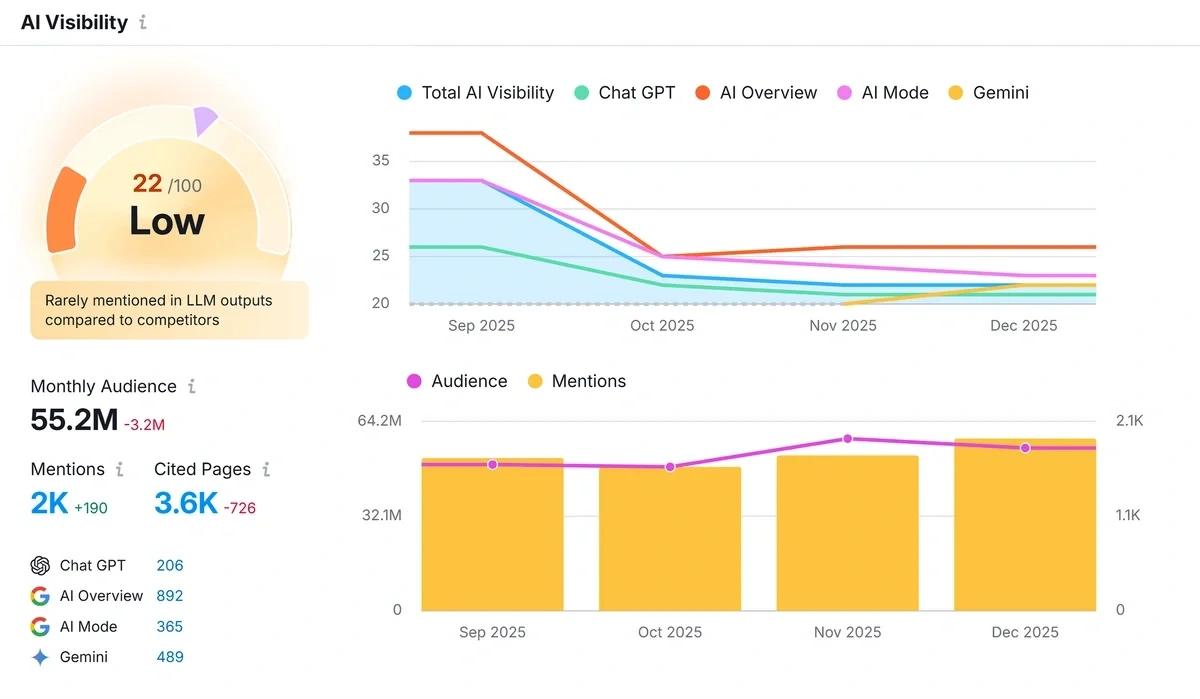
You can filter the data by region and AI platform, so you can really dig into your visibility in different circumstances. The default view shows aggregate stats across all AI platforms, but you can drill into individual models.
So you can easily see whether you're stronger in AI Overviews versus ChatGPT, for example.
The dashboard also breaks down prompts that are working for you, sources contributing to your visibility, and even opportunities you're currently missing:
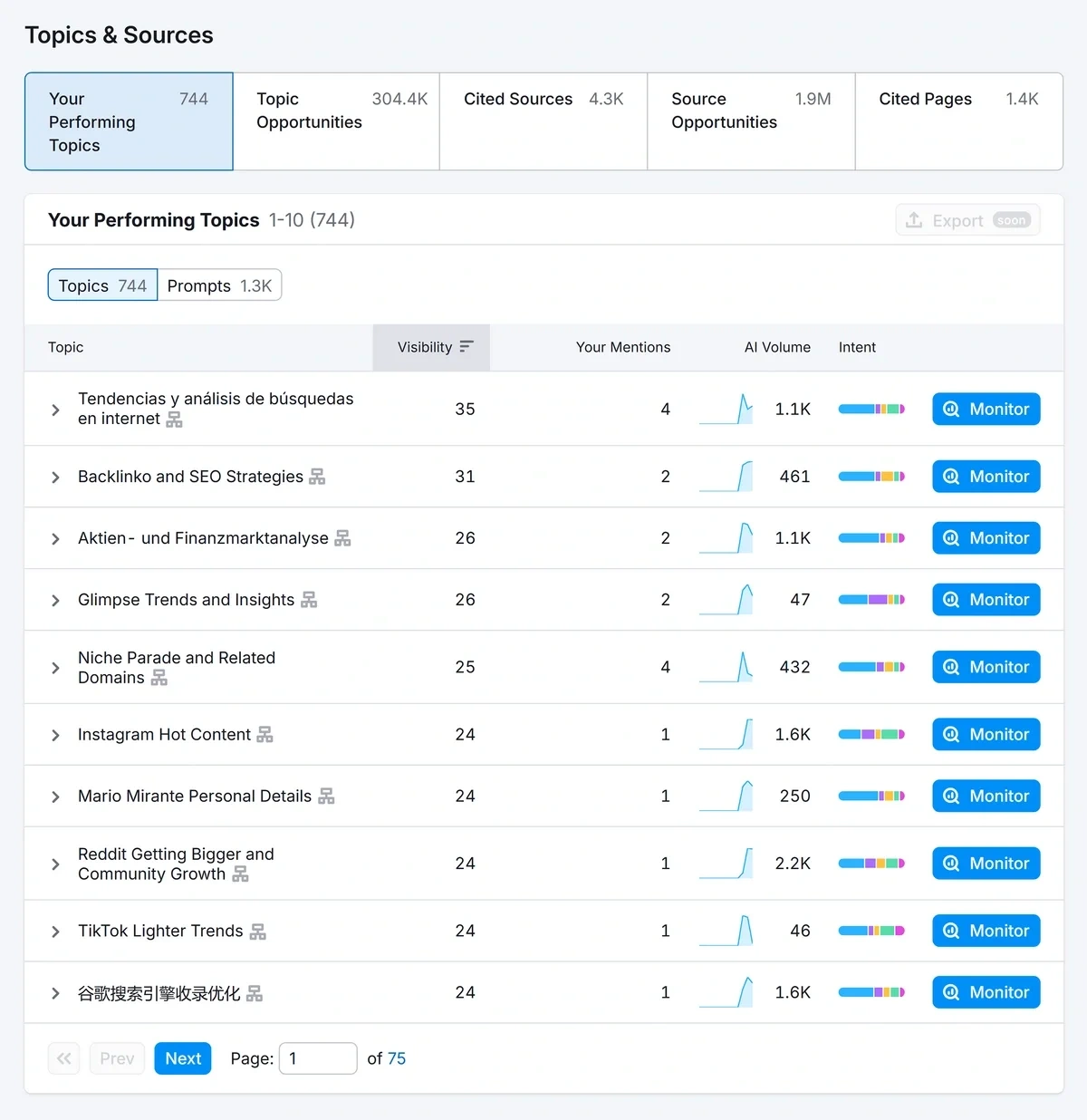
You can click into a topic to break down which specific prompts are being used, plus sources and brands mentioned in the results.
I find the Overview report easy to navigate and use, and I like that there’s a month-by-month graph at the top so I can follow my visibility trend.
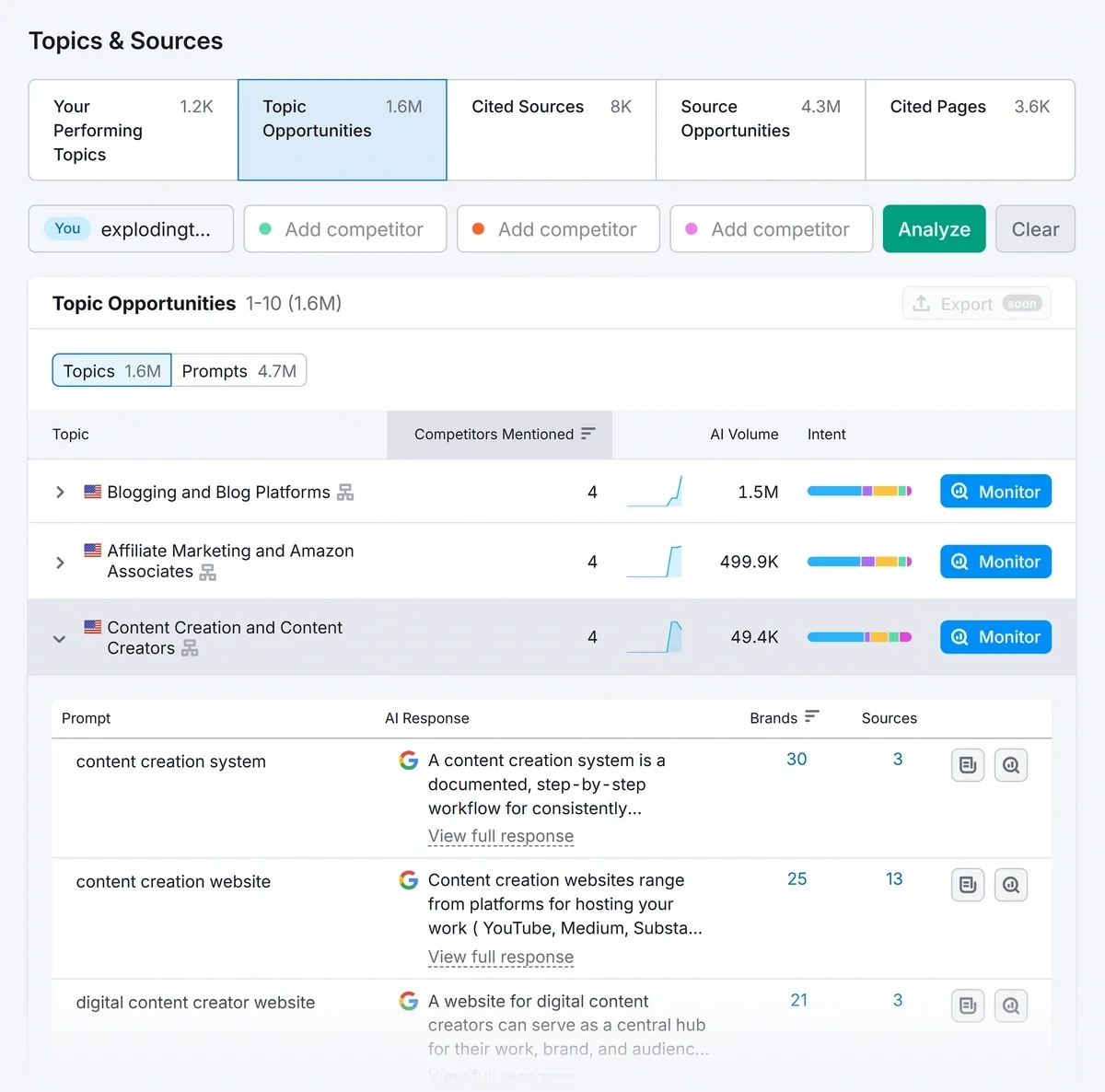
As a content strategist, what really stands out to me here is the ability to use the Topic Opportunities tab to very quickly and easily find out where I might have content gaps or content that’s not performing well. I can even click to see which sources are being mentioned so I can scope out competitor content in just a couple of clicks:
Ahrefs Brand Radar takes a different approach with a 360-degree brand view that extends beyond AI.
The Overview shows AI Share of Voice alongside the signals that drive it: search demand (branded searches), web visibility (mentions across 16.9 billion pages), and video visibility (YouTube, with TikTok coming).
However, note that search demand, web visibility, and YouTube visibility aren’t available at the Lite level—you’ll need a Standard at $249/month for those. I tested the Lite level, so you won’t see those in my screenshot:
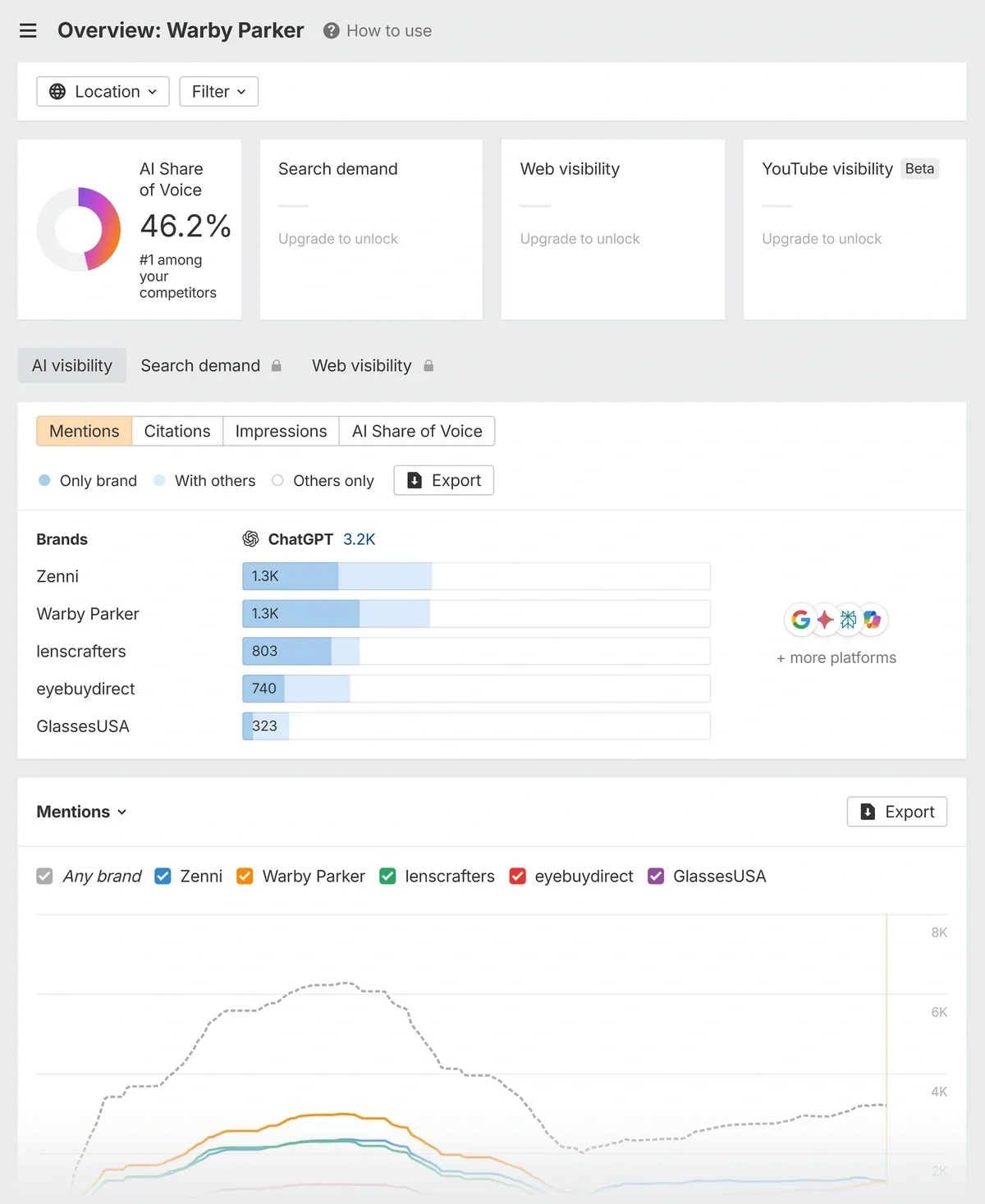
Brand Radar tracks mentions, citations, impressions, and Share of Voice across the AI platforms you pay for. Impressions are weighted with Google's search volume in mind to estimate potential exposure.
Scroll down to find the Top topics report. It segments your visibility by topic and shows you which of your top competitors are also visible there.
Although the dashboard is simpler and doesn’t include as much as Semrush’s, I do appreciate the filters that are available. Once you click into the full Topics report, you can sort by whether your brand is mentioned or not, whether you’re cited or not, and even phrase match to search for specific topics and prompts.
So if I have a specific topic idea in mind for a client, I can easily search at a granular level to find what their current visibility is and figure out what content should be published next.
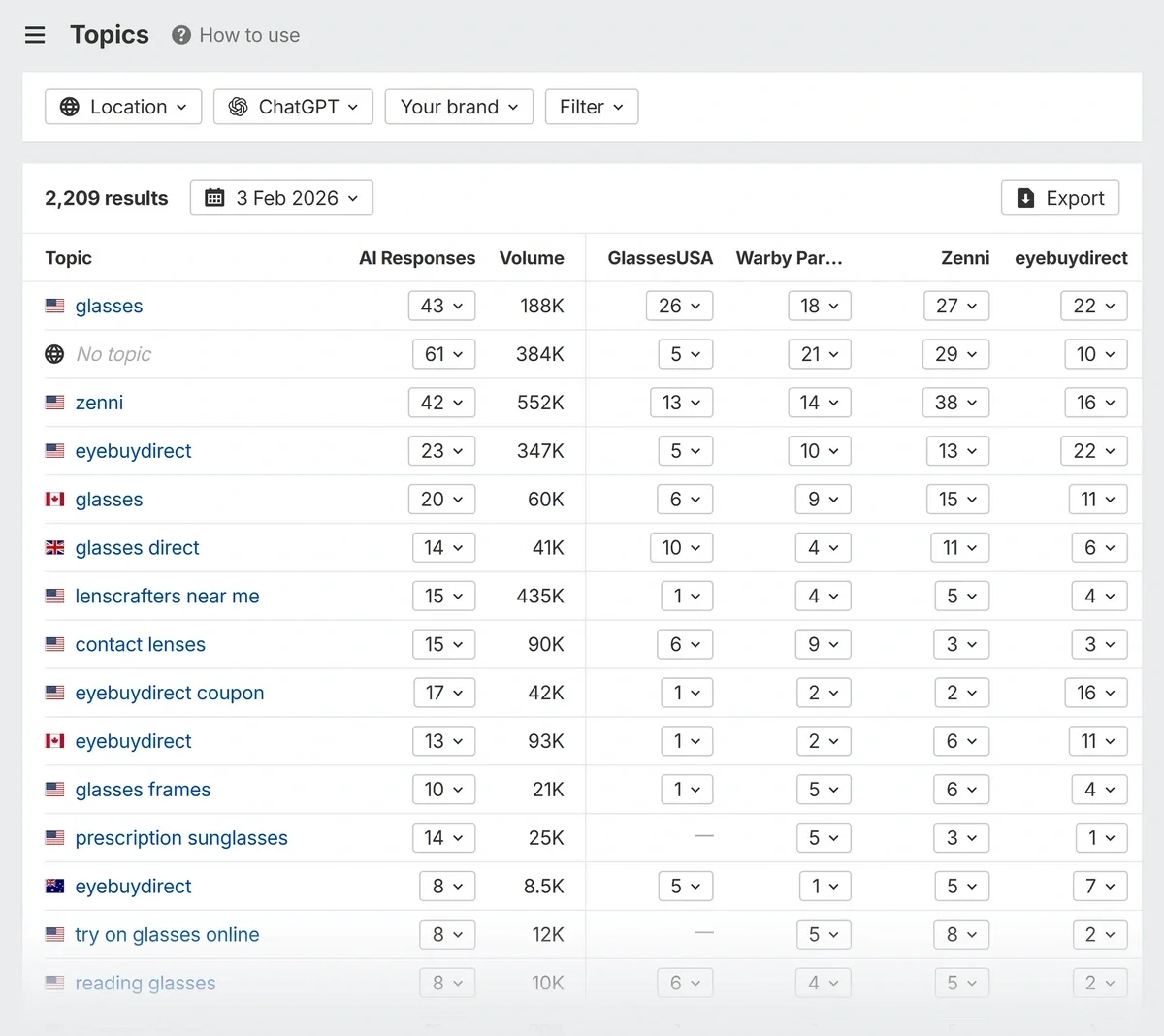
Brand Radar also pulls prompts from Ahrefs' database of 110 billion actual search queries, including real questions people ask Google. So instead of tracking synthetic AI-generated prompts, you're seeing how AI responds to real questions your potential customers actually ask.
Competitor Analysis and Gap Identification
Semrush includes a dedicated Competitor Research report that compares your audience, mentions, topics, prompts, and sources to up to 4 other competitors at once.
Use it to run a gap analysis to find topics and prompts where competitors appear but you don't. To me, this is such an easy win and a quick way to find a goldmine of content ideas. Just click on the Missing tab:
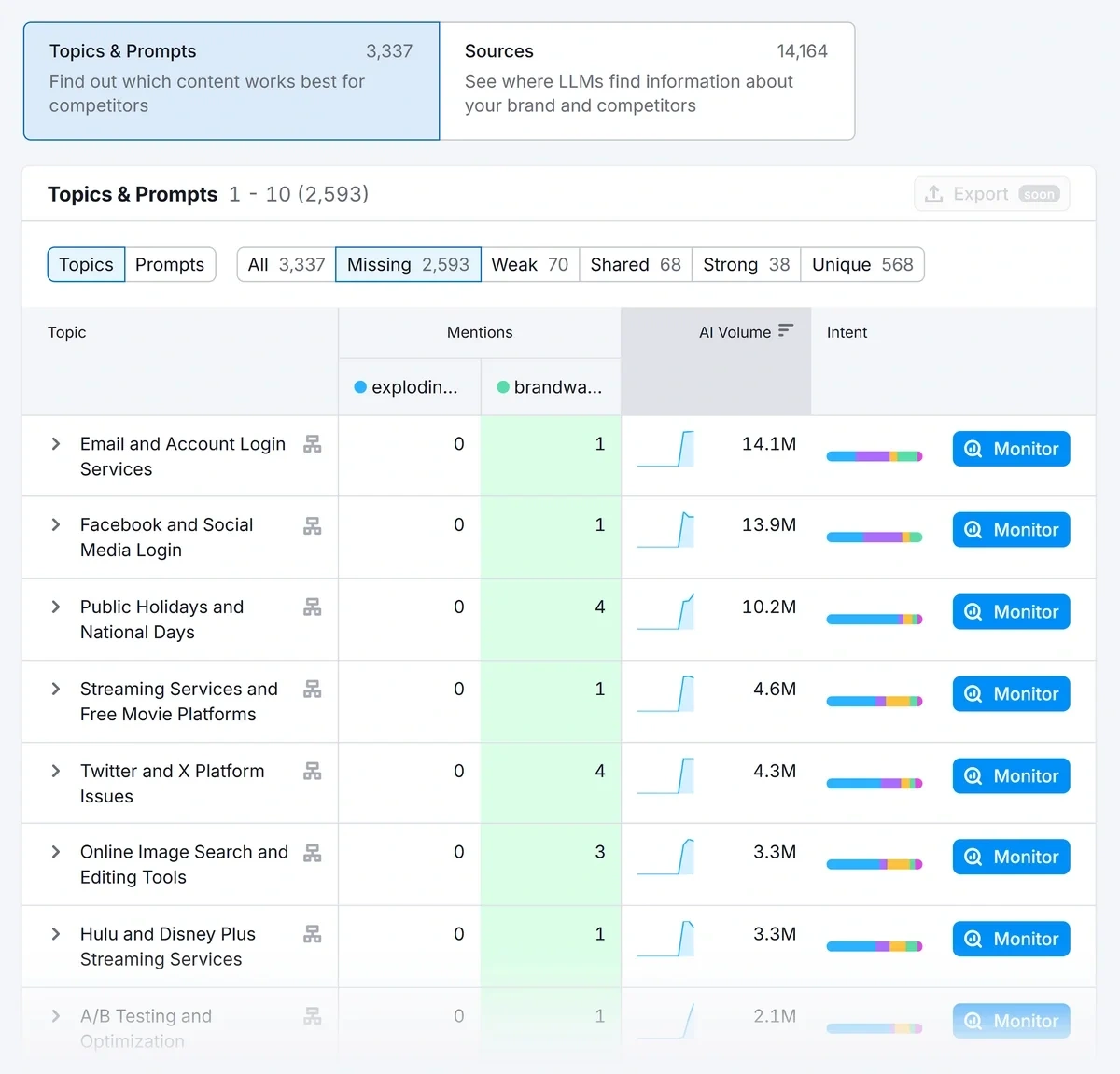
You can also use it to source domain gaps to find out which websites cite your competitors more frequently than they cite you.
Plus, head to the Brand Performance report to check on your competitors and how they compare to you in terms of share of voice. Semrush will automatically choose your top competitors and compare them with your share of voice, sentiment, and key business drivers.
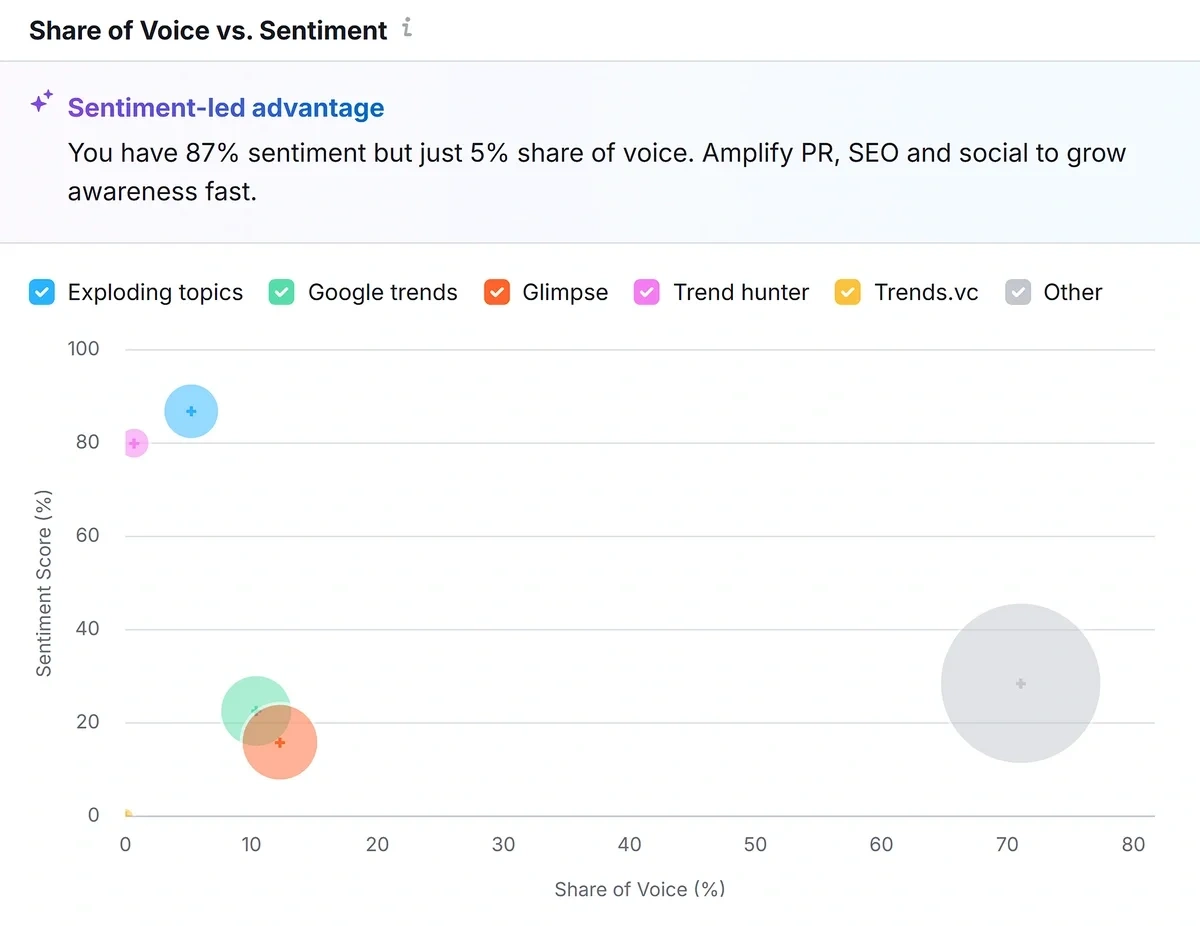
This type of competitive analysis focuses on actionable gaps rather than just showing you that competitors exist.
Ahrefs Brand Radar takes a different approach to competitor research. Instead of a dedicated competitor report, your competition can be added to all of the reports.
Its multi-brand comparison works by adding competitors directly into the search field. Brand Radar calculates Share of Voice across all brands you're tracking and shows percentage splits by AI platform.
In the Topics, Cited domains, and Cited pages reports, your competitors will be listed next to your own brand, so you can click on any of the dropdowns to see exactly where and how that competitor is mentioned:
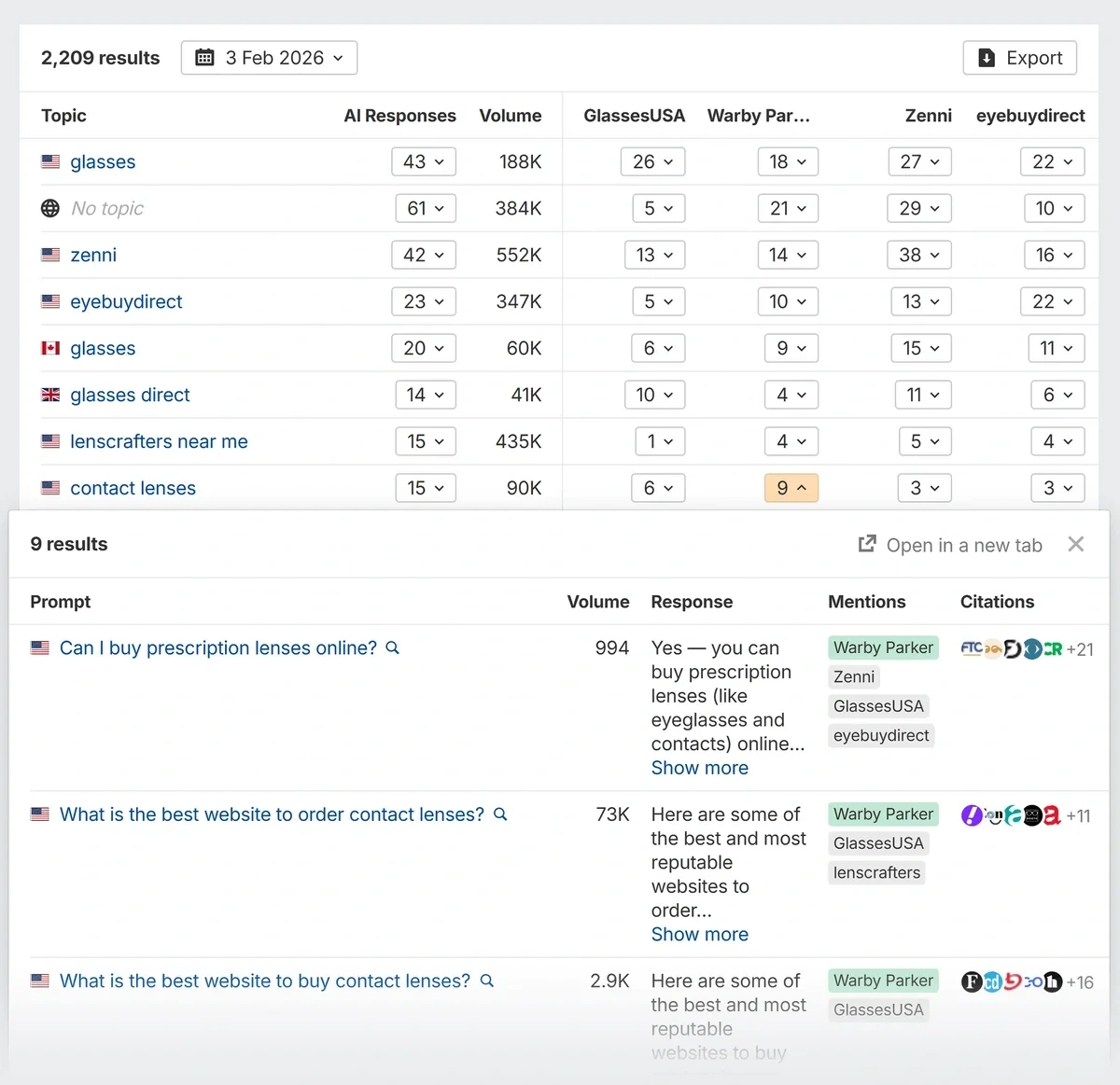
Each of the reports have that same filtering option I mentioned earlier, so that you’re always able to filter by whether or not your brand is mentioned, specific topics and prompts, and more.
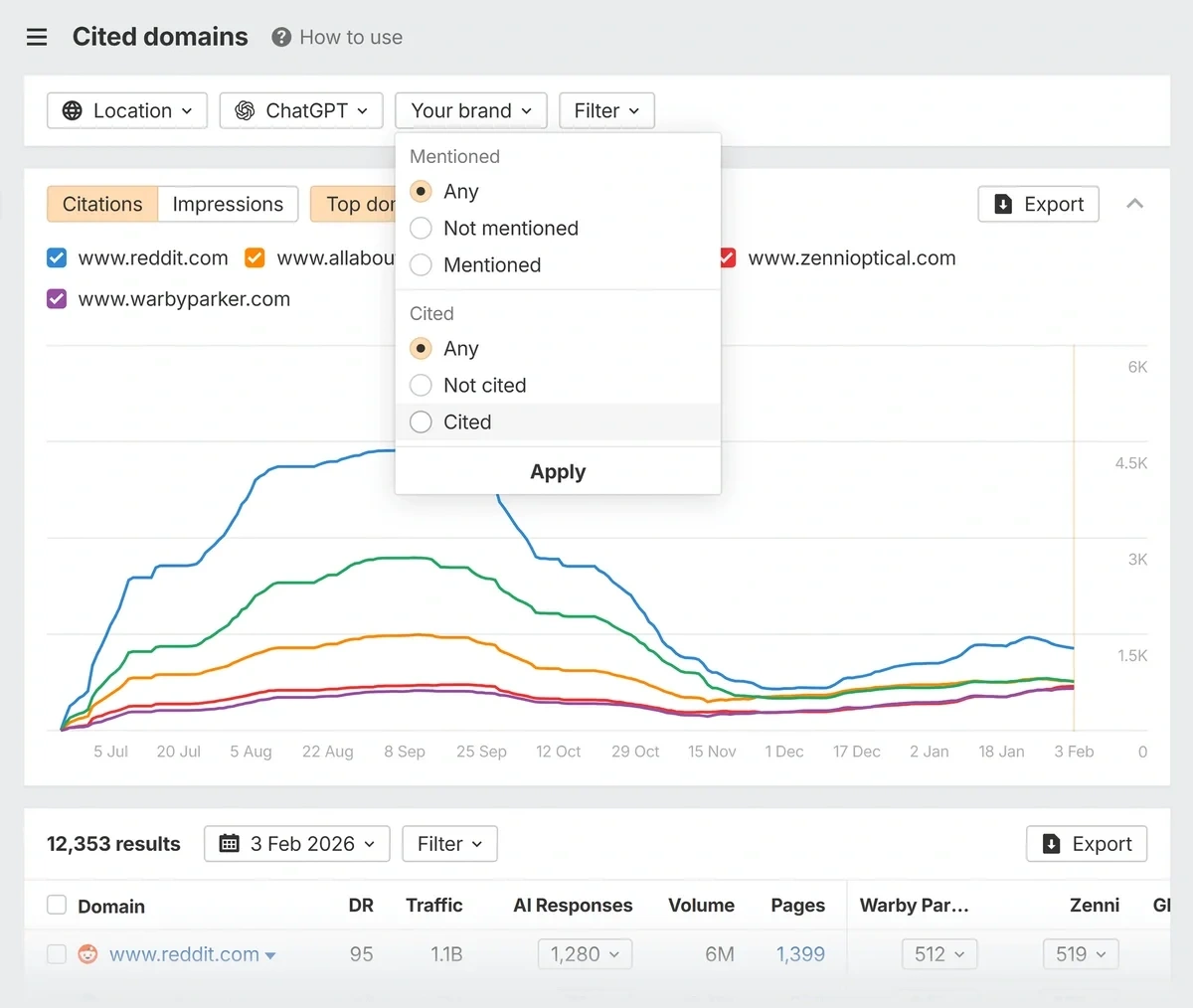
Filtering so that your own brand is “Not mentioned” is especially useful because it shows AI responses that mention competitors but not your brand. These represent clear content gaps where competitors are currently winning.
In general, both tools are going to give you a good amount of insight into how you’re performing on AI platforms compared to your competitors. However, I prefer Semrush over Brand Radar here because:
- Semrush’s layout and design are easier to navigate and read
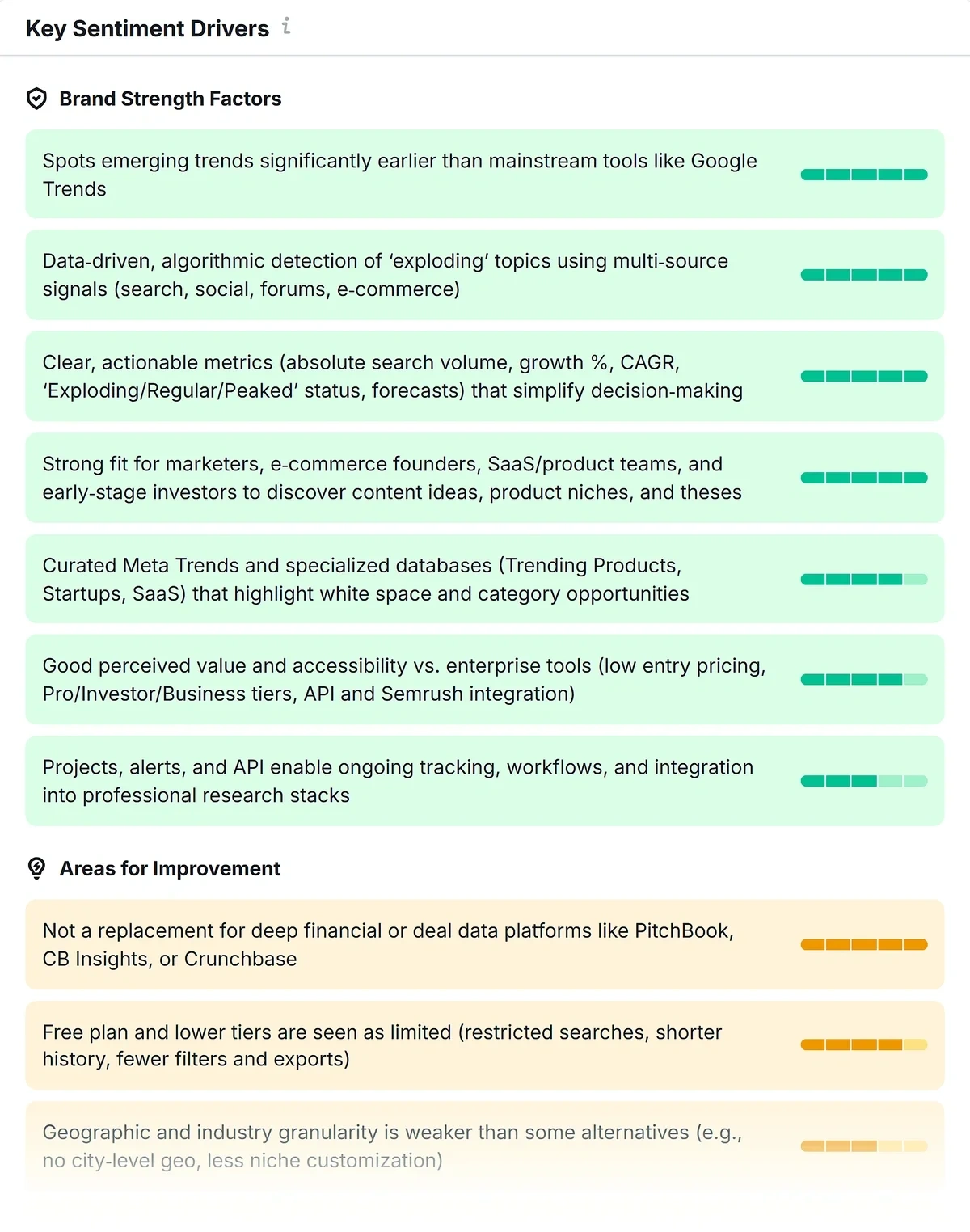
- Sentiment is an important report that’s missing from Brand Radar
- Semrush provides AI-generated insights and recommendations based on your data that jumpstart a lot of ideas
- Semrush’s Key Sentiment Drivers reports are also a huge plus, especially because they provide improvement ideas. I’ll drop a screenshot here so you can see what I mean:
Prompt and Topic Research
If you want to be highly visible on AI platforms, going beyond competitor research and diving into your own prompt and topic research is a must.
Here’s why:
- LLMs don't work like Google rankings. AI platforms can generate different responses each time someone asks a question, so you can't optimize for single queries the way you would for search. You need to address entire topic clusters instead.
- Intent matters more than keywords. Understanding whether users want information, comparisons, or buying guidance helps you create content that matches how LLMs respond to different question types.
- You see the actual questions driving visibility. Topic clustering reveals how customers phrase questions about your category and which themes appear most frequently in AI conversations.
- You can plan content systematically. Instead of guessing what to write about, you get organized themes that guide your content strategy around what LLMs actually discuss.
In Semrush, there are a few different ways you can research prompts and topics. First and foremost, the Prompt Research tool helps analyze topics, find content ideas, and figure out what type of content to create.
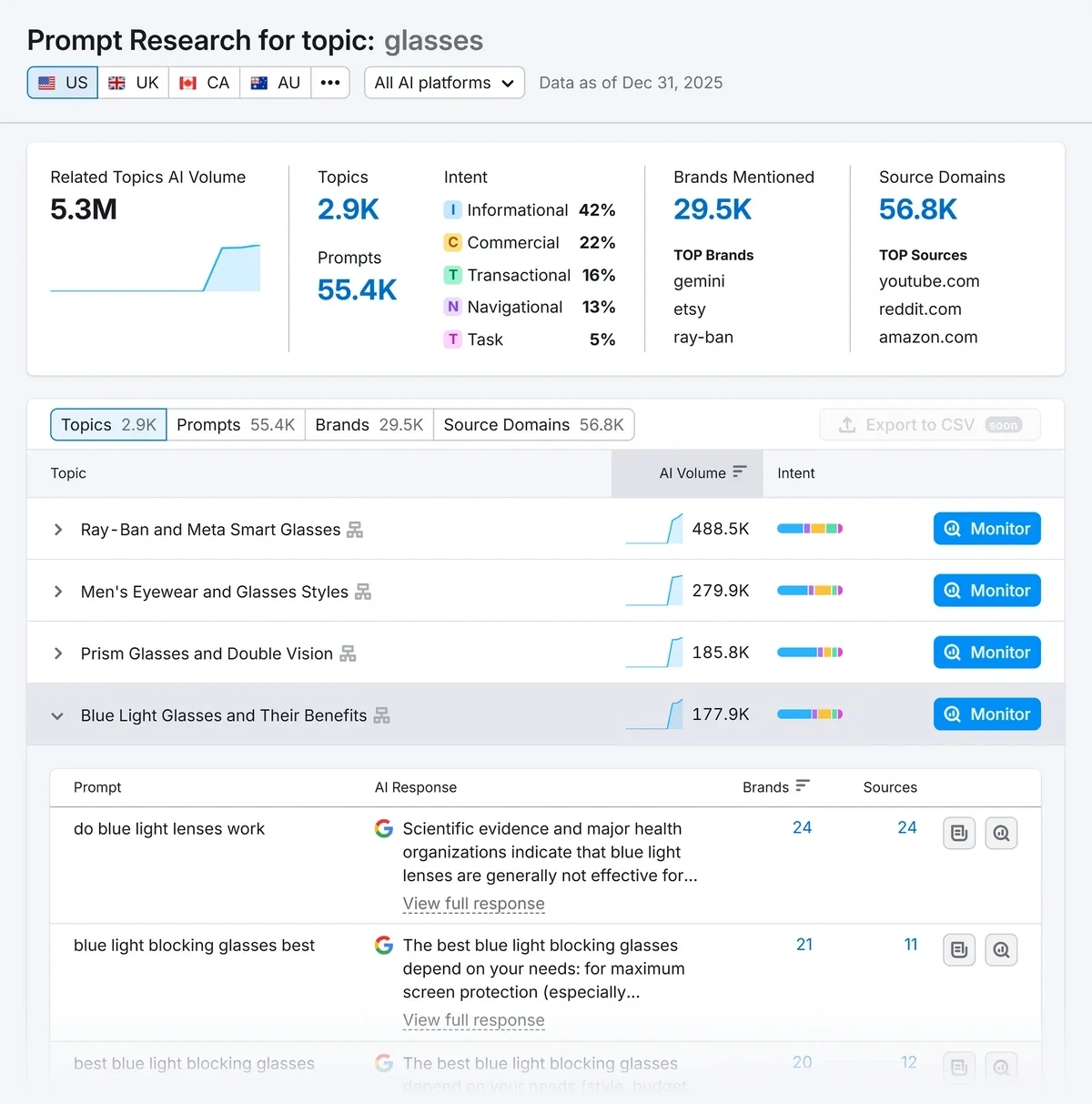
Just type in any topic (even as broad as “glasses”) to find out what people are searching for in LLMs, broken down by more niche topics and prompts. Expand any topic to see specific prompts, and click on the number of brands or sources to get a look at what’s driving those answers.
There’s also a Questions report with automatically generated questions, organized by topic, that your audience is asking about your industry. Not only does it give you even more insight into your audience on LLMs, but it also shows the intent distribution for each topic:
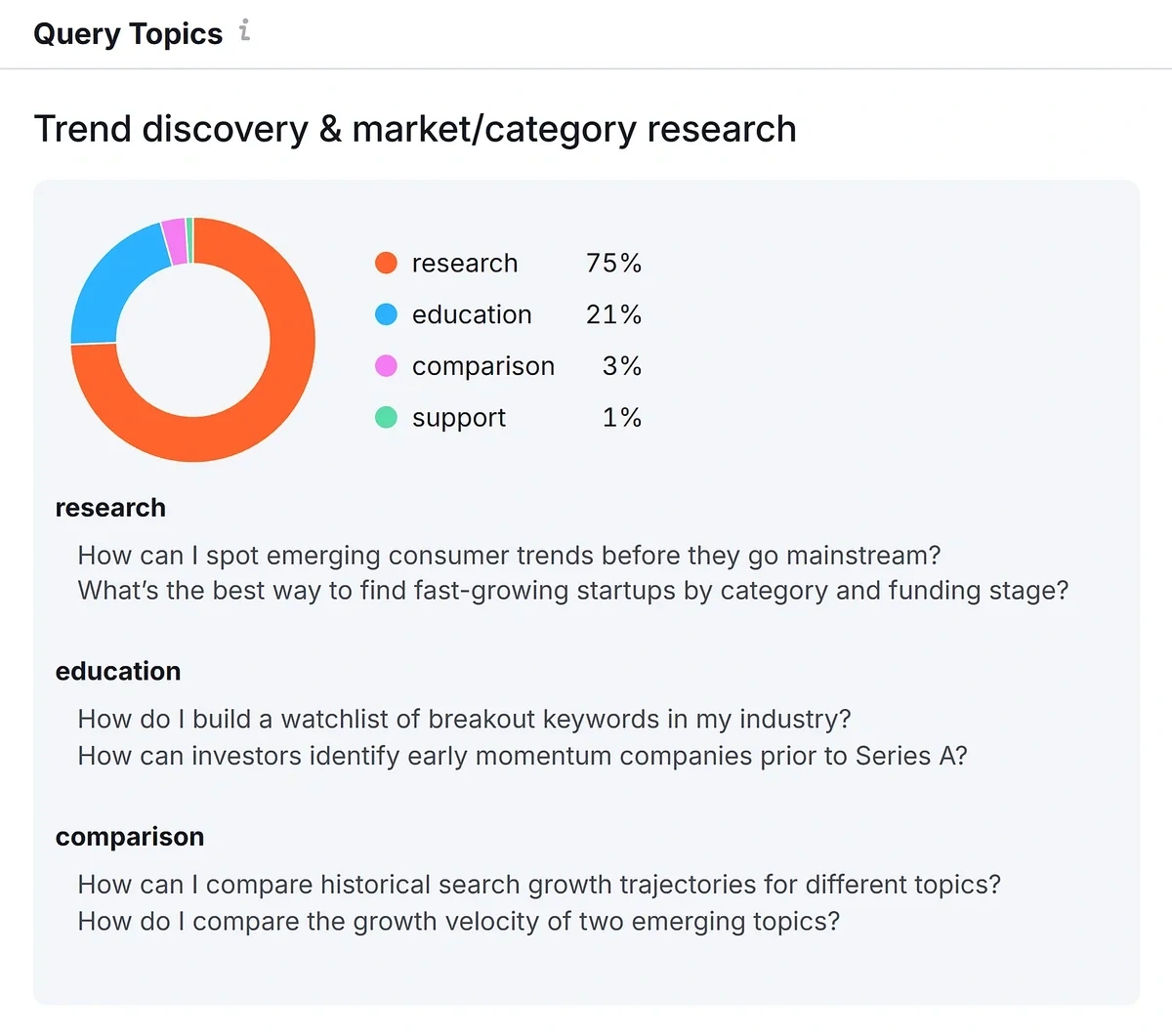
The Questions report essentially functions as keyword research for AI. You identify high-volume topic clusters, understand user intent, and build content that addresses entire themes rather than individual queries.
Ahrefs Brand Radar takes a different approach to prompt and topic research. Instead of a dedicated research tool, you use Brand Radar's filtering system to explore visibility across topics.
Start by searching for a topic relevant to your business. The Overview shows you overall metrics, then you can dive into specific reports to analyze responses.
The Topics report breaks down visibility by category, showing you which competitors appear alongside you for different subject areas. Click on any topic to see all responses, responses that mention only your brand, or responses mentioning competitors:
You can also run more exploratory searches using filters. For example, search for your industry with filters that exclude your brand to find content gaps. Or search for competitor brands to see which topics they dominate.
The workflow is less structured than Semrush but maybe a bit more flexible. Instead of following a guided research process, you're exploring a database of 100+ million prompts with powerful filters.
Beyond the Topics report, you can use the Search queries report within Brand Radar (available at the Standard level and up) to see the exact branded keywords people use when searching for your brand. This helps you see how audiences frame questions about your product and which features get attention.
The main difference I noticed: Semrush provides more structured prompt research with automatic topic clustering and intent mapping. Brand Radar gives you database access with filtering tools, making it a better fit for teams who prefer exploring data rather than following a guided workflow.
I prefer Semrush over Brand Radar for AI topic research because it’s easier for me to find topics that are going to resonate with my (and my clients’) audiences and gain AI visibility.
The way it’s structured with more detailed topics and super-relevant prompts nested inside them just makes sense to me, whereas all the different dropdowns in the Brand Radar report are more difficult for me to navigate and gain meaningful ideas from.
Of course, Brand Radar was built that way, as you’re meant to use the search and filtering functions to find specific topics, whereas Semrush lends itself a lot more to exploration. Although the ability to search and filter is definitely nice, I prefer the exploration route.
I also think Semrush’s Questions report is a huge added bonus that can quickly help me gain visibility in LLMs by showing me what my audience is asking right now.
Beyond AI: Additional Features
Each tool includes some features that go beyond AI visibility tracking.
Brand Radar
Ahrefs Brand Radar offers a 360-degree brand monitoring approach. Beyond AI visibility, it includes:
Search demand tracking shows branded keyword volume trends. You can monitor whether people are searching for your brand more or less over time, which indicates growing or declining brand awareness.
Web visibility tracks linked and unlinked mentions across 16.9 billion indexed pages. This reveals where your brand appears across the web, not just in AI responses.
Video visibility monitors brand mentions on YouTube and TikTok. It scans thumbnails, titles, descriptions, and video transcripts for brand references.
Reddit visibility looks for brand mentions in Reddit titles, descriptions, and subreddit names that appear in SERP snippets.
These additional signals matter because they're the underlying drivers of AI visibility. LLMs train on web content and search patterns. Tracking these sources helps you understand why your AI visibility is changing.
AI Visibility Toolkit
Semrush AI Visibility Toolkit focuses exclusively on AI visibility as a standalone tool, providing more reports at the base level than Brand Radar, plus AI-generated insights and practical tips for how to improve your AI visibility.
However, the Semrush One bundle combines AI visibility with the Semrush SEO platform, including tools and reports like:
- Keyword research & competitor analysis
- Backlink analysis
- Keyword rank tracking
- Site audits
This means you can check for AI crawlability issues and optimize your traditional search presence alongside AI visibility tracking.
So, Brand Radar positions itself as an all-in-one brand monitoring solution within the Ahrefs ecosystem. Semrush offers both a specialized AI-only option and a bundled SEO + AI visibility package.
Your choice depends on whether you want a tool weighted toward specialized AI tracking, comprehensive brand monitoring, or a combined SEO and AI visibility toolkit.
Pricing: Semrush AI Visibility Toolkit vs Ahrefs Brand Radar
Semrush AI Visibility Toolkit costs $99 per month as a standalone product. This makes it one of the more affordable, more feature-rich dedicated AI visibility tools on the market.
The base plan includes reports for any domain, tracking for up to 25 custom prompts, 300 daily queries in AI Analysis reports, and mention tracking in ChatGPT, Google AI, Perplexity, and Gemini. You also get AI search readiness checks, AI-powered brand visibility tracking, and a lot more.
Want the ability to monitor classic SEO signals alongside AI? Semrush One starts at $165.17 per month when billed annually. The Starter plan lets you monitor 5 websites, track 50 prompts, and monitor 500 keywords daily. Pro+ and Advanced increase those limits.
The standalone AI Visibility Toolkit makes sense if you only need AI tracking. Semrush One delivers better value if you want both SEO and AI visibility tools.
Ahrefs Brand Radar uses a completely different pricing model. Each individual AI platform index (ChatGPT, AI Overviews, Perplexity, etc.) costs $199 per month.
If you want comprehensive coverage across all AI platforms, you'll need the All Platforms bundle at $699 per month.
The trade-off is significant. Ahrefs Brand Radar gives you a lot of data and robust filtering to work with, but unlocking the complete AI visibility functionality costs substantially more than Semrush.
Should You Choose Semrush AI Visibility Toolkit or Ahrefs Brand Radar?
I recommend AI Visibility Toolkit for agencies and in-house teams who are looking for:
- Dedicated AI visibility tracking to keep tabs on your brand’s mentions, citations, and sources
- A prompt research tool to help you take visibility data and turn it into real, impactful content strategy and marketing ideas
- A competitor analysis tool to help you compare visibility with your competitors and close any gaps
- A way to keep your eye on whether LLMs are portraying you positively or negatively so you can work to fix inaccuracies quickly
- Help coming up with quick tips and ideas to gain more visibility
- Tracking across multiple LLMs without paying extra for each one
Choose Ahrefs Brand Radar if:
- You already use Ahrefs for SEO, don’t want to switch, and want to add AI visibility monitoring to your existing workflow
- You want detailed filtering of topics and AI responses so you can drill down at a granular level
- You need video visibility monitoring for YouTube and TikTok
Both Semrush AI Visibility Toolkit and Ahrefs Brand Radar solve different problems well. Semrush delivers specialized AI optimization with sentiment tracking and competitive gap analysis. Brand Radar focuses more on holistic brand monitoring that includes AI as one component alongside search demand and web visibility.
Overall, I recommend Semrush's AI visibility tools for most marketing agencies and teams. The feature set is more comprehensive for LLM-specific work, the pricing is more accessible, and the sentiment analysis provides insights you can't get elsewhere.
Start Monitoring Your AI Visibility Today
Your choice between AI Visibility Toolkit and Brand Radar depends on what you and/or your clients need most.
I've found Semrush's sentiment analysis especially valuable for understanding how LLMs actually portray brands beyond simple mention counts. The ability to identify perception gaps and address them proactively matters increasingly as more customers rely on AI for research.
For teams serious about AI visibility, start with Semrush AI Visibility Toolkit. Track your mentions, analyze competitor gaps, and build content that addresses the topic clusters LLMs care about.
The $99 monthly investment gives you the insights needed to compete effectively as AI search keeps marketers on our toes and reshapes how customers discover brands.
Stop Guessing, Start Growing 🚀
Use real-time topic data to create content that resonates and brings results.
Exploding Topics is owned by Semrush. Our mission is to provide accurate data and expert insights on emerging trends. Unless otherwise noted, this page’s content was written by either an employee or a paid contractor of Semrush Inc.
Share
Newsletter Signup
By clicking “Subscribe” you agree to Semrush Privacy Policy and consent to Semrush using your contact data for newsletter purposes
Written By


Jolissa Skow is a senior content writer and content strategist with a background in SEO, Google Analytics, and WordPress. She's be... Read more