


Get Advanced Insights on Any Topic
Discover Trends 12+ Months Before Everyone Else
How We Find Trends Before They Take Off
Exploding Topics’ advanced algorithm monitors millions of unstructured data points to spot trends early on.

Keyword Research
Performance Tracking
Competitor Intelligence
Fix Your Site’s SEO Issues in 30 Seconds
Find technical issues blocking search visibility. Get prioritized, actionable fixes in seconds.
Powered by data from
Latest Blog Posts
Featured Case Studies
See what's trending before everyone else
Each week, we'll send you our best Exploding Topics. Plus, expert insight and analysis.
Can ChatGPT Do SEO For You?

 Add Exploding Topics on GoogleAdd Exploding Topics as your preferred source to see more of our stories on Google.
ChatGPT users send 2.5 billion prompts to the artificial intelligence (AI) tool every day — but those aren't all search queries. Most people are still doing a mix of traditional searches and ChatGPT web searches every day. This means that paying attention to both regular search engine optimization (SEO) and generative engine optimization (GEO) is important for digital marketing success.
But if you're a regular ChatGPT user yourself, you might be wondering if you can start using the generative AI platform to support your SEO research, strategy, and content creation efforts.
The answer is, much like many people’s relationship to generative AI, complex. There are some ways in which ChatGPT can help you market your business or come up with an SEO plan, but the process still requires a human touch.
Why ChatGPT Isn’t a Done-For-You SEO Tool
There are two big reasons why ChatGPT can’t be a one-stop shop for your SEO and digital marketing work.
1. ChatGPT is predictive — and slightly outdated
AI tools like ChatGPT are predictive. This means that the information it gives you is influenced by how you interact with the tool. As such, different users can get different results.
The tools’ predictive technology also means that large language models (LLMs) like those found in ChatGPT can present inaccurate data, quotes, and more. These errors are called hallucinations.
Plus, companies like OpenAI train their AI tools using data from the internet. But the training process takes some time; it’s not instantaneous. This means that while ChatGPT can search the live internet, the data that makes up its predictive, response-generating algorithm is usually several months to years old.
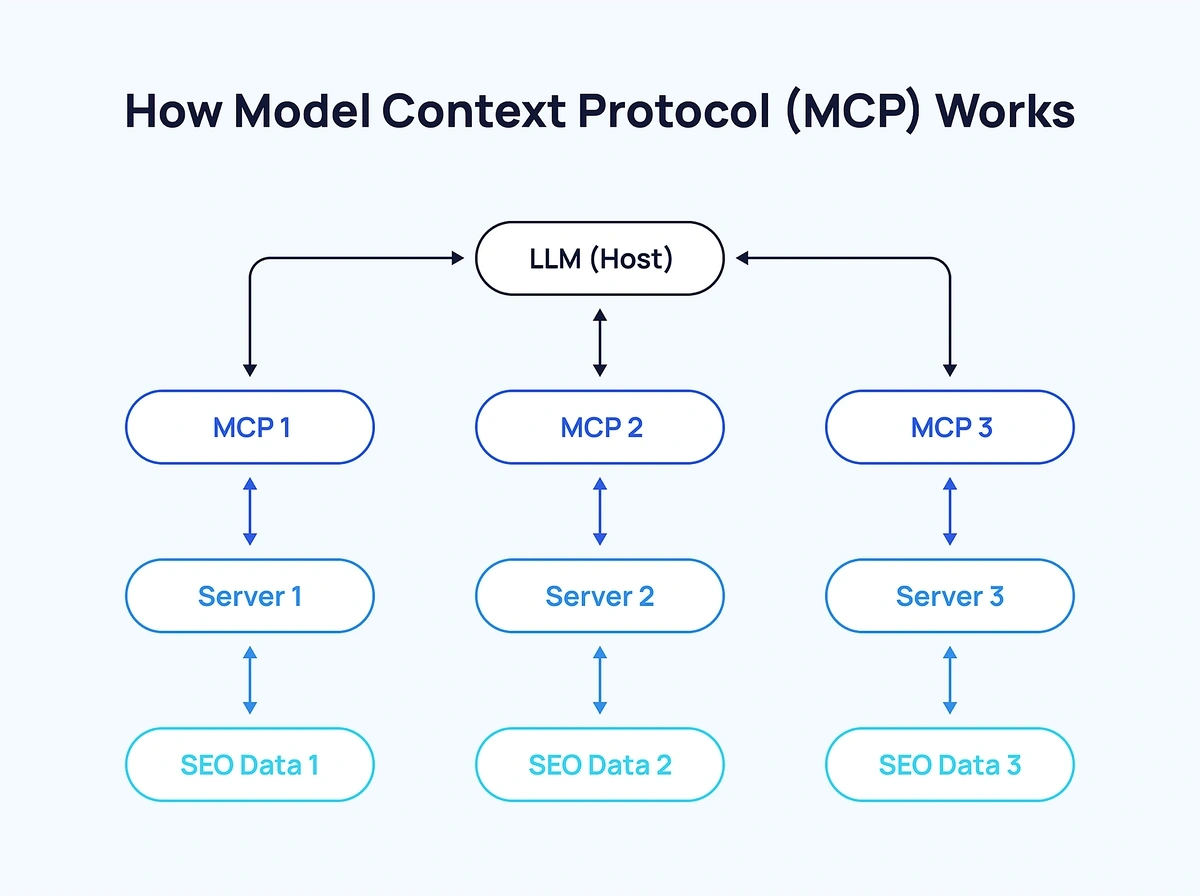
As a result, ChatGPT can’t give you accurate SEO data out of the box. You have to either upload data manually or configure a model context protocol (MCP) server to fetch SEO information from your tool of choice on demand.
Take the following chart as an example. I asked ChatGPT and Gemini — in their base configuration, not connected to any data sources — to analyze a list of seven keywords and tell me the typical monthly search volume in the U.S. ChatGPT declined my request; Gemini provided limited information.
When I compared the results to Semrush, there were some clear discrepancies.
| Keyword | Gemini result | Semrush result |
| Best tools for marketers | High volume, commercial/informational search intent | Low volume, commercial search intent |
| New marketing software for 2026 | Medium to high volume, commercial/informational search intent | Low volume, commercial/informational search intent |
| New books on marketing in 2026 | Low to medium volume, informational search intent | Low volume, commercial search intent |
| Best books for marketers | Medium to high volume, informational/commercial search intent | Low volume, commercial search intent |
| Best AI training courses for marketers | Medium to high volume, commercial/transactional search intent | Low volume, commercial search intent |
| How to use AI as a marketer | High volume, informational search intent | Low volume, informational search intent |
| Pros and cons of AI in marketing | Medium volume, search informational intent | Low volume, informational search intent |
If you relied on the AI keyword analysis alone, you might waste your time creating strategies and content that don’t align with searchers’ needs.
I could set up an SEO MCP server to fetch data from Semrush and do all of my work in one place, but I’d still ultimately be relying on Semrush for the data, not the ChatGPT or Gemini algorithm. (But it's important to note that with an AI acting as the intermediary, I could still run into problems with hallucinations. I wouldn't have this issue if I pulled the data directly from Semrush myself manually.)
2. E-E-A-T Still Matters for SEO
The second reason: in order to rank well in both traditional and AI-driven search results pages, it’s still important that your content displays experience, expertise, authoritativeness, and trustworthiness (E-E-A-T).
That’s right — AI tools like ChatGPT prioritize human expertise when deciding what content to display in AI search results and summaries. If you’re fully relying on AI to plan, strategize, and execute your SEO work, you run the risk of not imbuing your webpages and content with enough E-E-A-T.
In fact, these AI search algorithms are so favorable toward real human content that they tend to rank community-generated content higher than official marketing blog content.
And remember, ChatGPT and similar tools are operating with data that’s slightly older than what’s currently on the live internet. This makes them a decent tool for revising and editing, but not so great for coming up with brand new concepts and strategies.
5 SEO Tasks That ChatGPT Can Do Well
If you do want to use ChatGPT in your SEO workflow, try experimenting in the following five areas.
1. Data organization
It’s easy to wind up with a nearly overwhelming amount of data when conducting in-depth SEO research. If you use a tool like Semrush, you can create lists of keywords and export all of the data to a spreadsheet file. By uploading these files into ChatGPT, you can then use the AI to quickly sort, group, and categorize content.
This is another situation where you could use an MCP server to directly communicate with your Semrush or Google Search Console account. You’d then be able to ask ChatGPT questions and chat “with” your data.
2. Competitor content analysis
ChatGPT can also be useful when finding new competitors and understanding their strategies. You can use ChatGPT’s regular chat and deep research functions to to:
- Search the web for companies similar to yours
- Get summaries of each competitor‘s industry and audience
- Evaluate each competitor’s primary digital marketing channels and tactics
- Dig deep into a specific keyword and better understand the search landscape
If your competitors have a blog or social media account, you can also directly upload examples of their content into ChatGPT and request an analysis of common themes or topics that aren’t covered well. This requires no special server configuration — just copy and paste competitor content or save it as a PDF and upload it to ChatGPT.
Want to Spy on Your Competition?
Explore competitors’ website traffic stats, discover growth points, and expand your market share.
3. Style guide review
While ChatGPT’s hallucination tendencies do mean that it can sometimes miss mistakes or errors, you can use the tool as a first pass at checking new content against your style guide.
To do this, you’ll need to provide your style guide as part of the chat — or you can create a custom GPT that retains this information in its memory. You can then start a new chat with the custom GPT any time you want to get a “second opinion” on how well your work adheres to your intended tone, style, and more.
4. Internal link evaluation
Because ChatGPT crawls the internet similarly to Google, and can process any list of links that you might provide it with, it’s a good tool for identifying internal link opportunities.
After uploading your landing page or blog post copy to ChatGPT, you can ask it to suggest specific links to add from your own domain. ChatGPT sometimes misses the mark here if you have it run a general internet search; instead, upload a copy of your sitemap or create a custom GPT that’s only allowed to search for URLs that match your domain — or even a specific subfolder.
Want to Beat Your Competition?
Find out who’s linking to them and build a better backlink strategy.
5. SEO performance analysis
If you go the route of setting up an MCP server, you can also connect your ChatGPT account to Google Analytics and get regular updates on how your site is performing. Yes, you could look up this information yourself, but Google Analytics 4 (GA4) can be confusing. If you’re new to working with SEO (or simply don’t like GA4!), you might prefer interacting with your data via a conversational chat.
Are There Better AI SEO Tools Than ChatGPT?
ChatGPT is a general tool — GPT actually stands for general purpose transformer — that’s good for broad tasks. To effectively use AI for SEO, you’ll want to look for a purpose-built tool. Luckily, there are several options, including:
| AI-powered SEO Tool | Useful for |
| Semrush One | Short and long-tail keyword research, SEO content optimization and generation, link-building strategy analysis, SEO and GEO audits, traditional and AI position tracking, content gap discovery, and more |
| Clearscope | SEO content optimization and generation |
| Frase | SEO content optimization and generation |
| Otterly.ai | AI prompt research and AI search engine rank tracking |
| Peec | AI prompt research |
Get Every AI SEO Tool You Need With Semrush One and Exploding Topics
While many AI-powered SEO tools do one thing well, it’s important that you have access to tools for all parts of SEO: from keyword discovery and content creation to local optimization and link analysis. Semrush One is a great choice, as it includes toolkits for every aspect of SEO and lets you expand its functionality with apps like Exploding Topics.
When you combine Semrush One and Exploding Topics, you can do things like:
- Use Exploding Topics to identify trending topics
- Fire up the Keyword Magic Tool to find keywords driving traffic around each topic
- Identify and analyze competitors
- Track your rank in traditional and AI search results with the AI visibility toolkit
- Use the Keyword Overview tool to find out which search terms trigger an AI Overview
- Co-write content with AI
- Find semantically related keywords with the SEO Writing Assistant
My advice for starting to experiment with AI SEO tools
If you're totally new to the world of AI SEO tools, starting with Semrush One is going to give you access to not just the tools you need, but resources and guides too (the Semrush blog is a great place to learn new techniques). I suggest you sign up for Exploding Topics Pro to get a free seven-day trial of any plan, then add on an extended free trial of Semrush using our exclusive coupon code. I recommend trying both at the same time — you’ll get to see exactly how well the two tools work together and provide the right mix of AI automation and SEO data.
Stop Guessing, Start Growing 🚀
Use real-time topic data to create content that resonates and brings results.
Exploding Topics is owned by Semrush. Our mission is to provide accurate data and expert insights on emerging trends. Unless otherwise noted, this page’s content was written by either an employee or a paid contractor of Semrush Inc.
Share
Newsletter Signup
By clicking “Subscribe” you agree to Semrush Privacy Policy and consent to Semrush using your contact data for newsletter purposes
Written By


Emily is a freelance content writer at Exploding Topics. A former news correspondent, she has over 15 years' experience creati... Read more