


Get Advanced Insights on Any Topic
Discover Trends 12+ Months Before Everyone Else
How We Find Trends Before They Take Off
Exploding Topics’ advanced algorithm monitors millions of unstructured data points to spot trends early on.
Keyword Research
Performance Tracking
Competitor Intelligence
Fix Your Site’s SEO Issues in 30 Seconds
Find technical issues blocking search visibility. Get prioritized, actionable fixes in seconds.
Powered by data from
Latest Blog Posts
Featured Case Studies
See what's trending before everyone else
Each week, we'll send you our best Exploding Topics. Plus, expert insight and analysis.
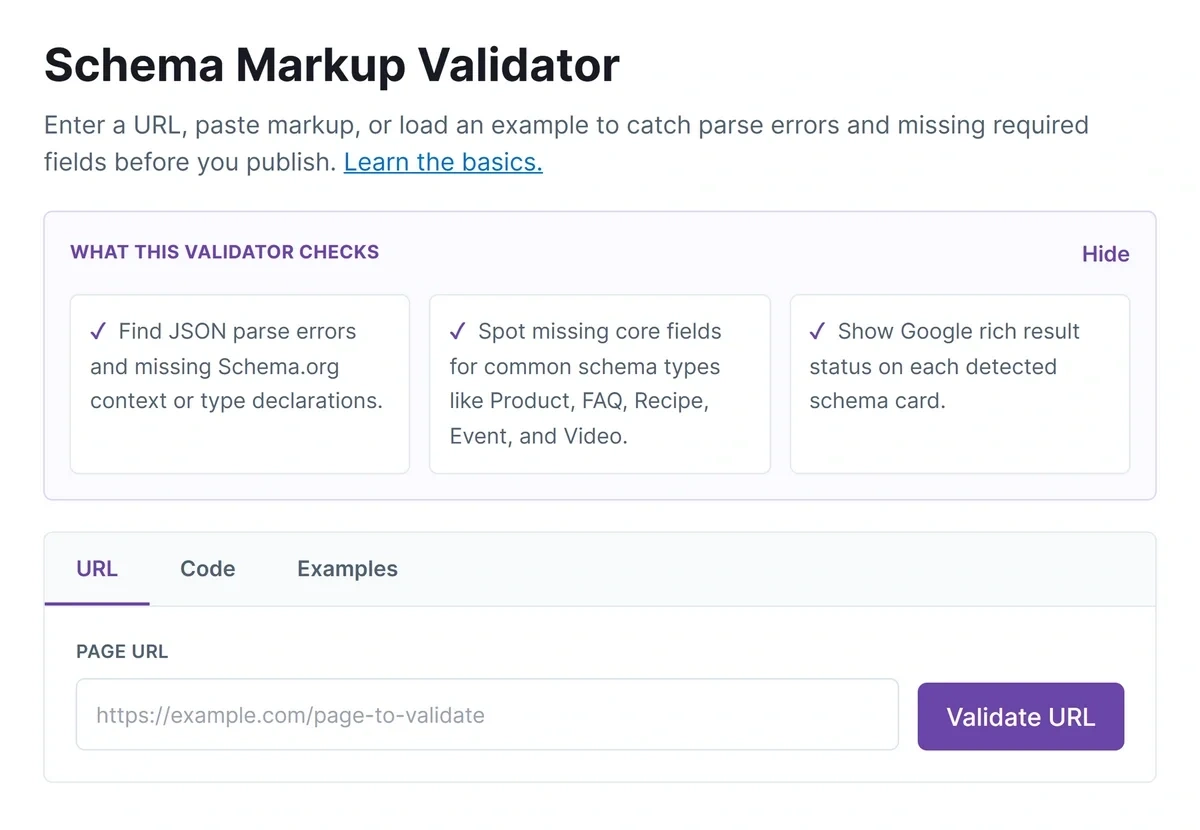
What Is The Schema Markup Validator?
The Schema Markup Validator is a free, real-time testing tool built to ensure your structured data is optimized for search engine crawlers.
The analyzer identifies critical formatting gaps in your JSON-LD or microdata, pointing out exact lines with syntax errors or missing fields.
With this tool, you get a clear snapshot of how easily search engines can crawl, parse, and showcase your content with rich search elements.
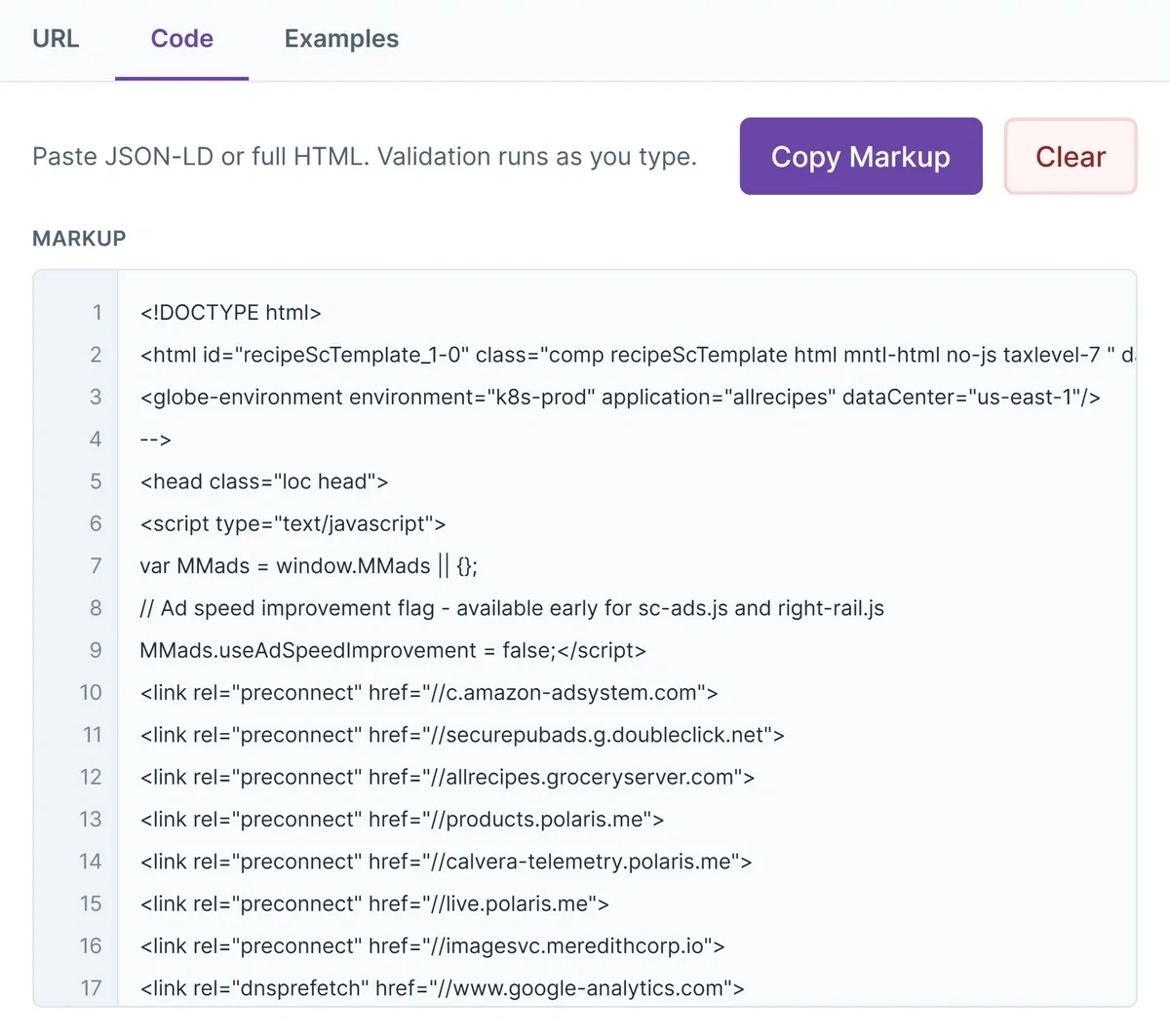
Our tool accepts a page URL or manually copy-pasted structured data code as inputs to scan your structured data implementation.
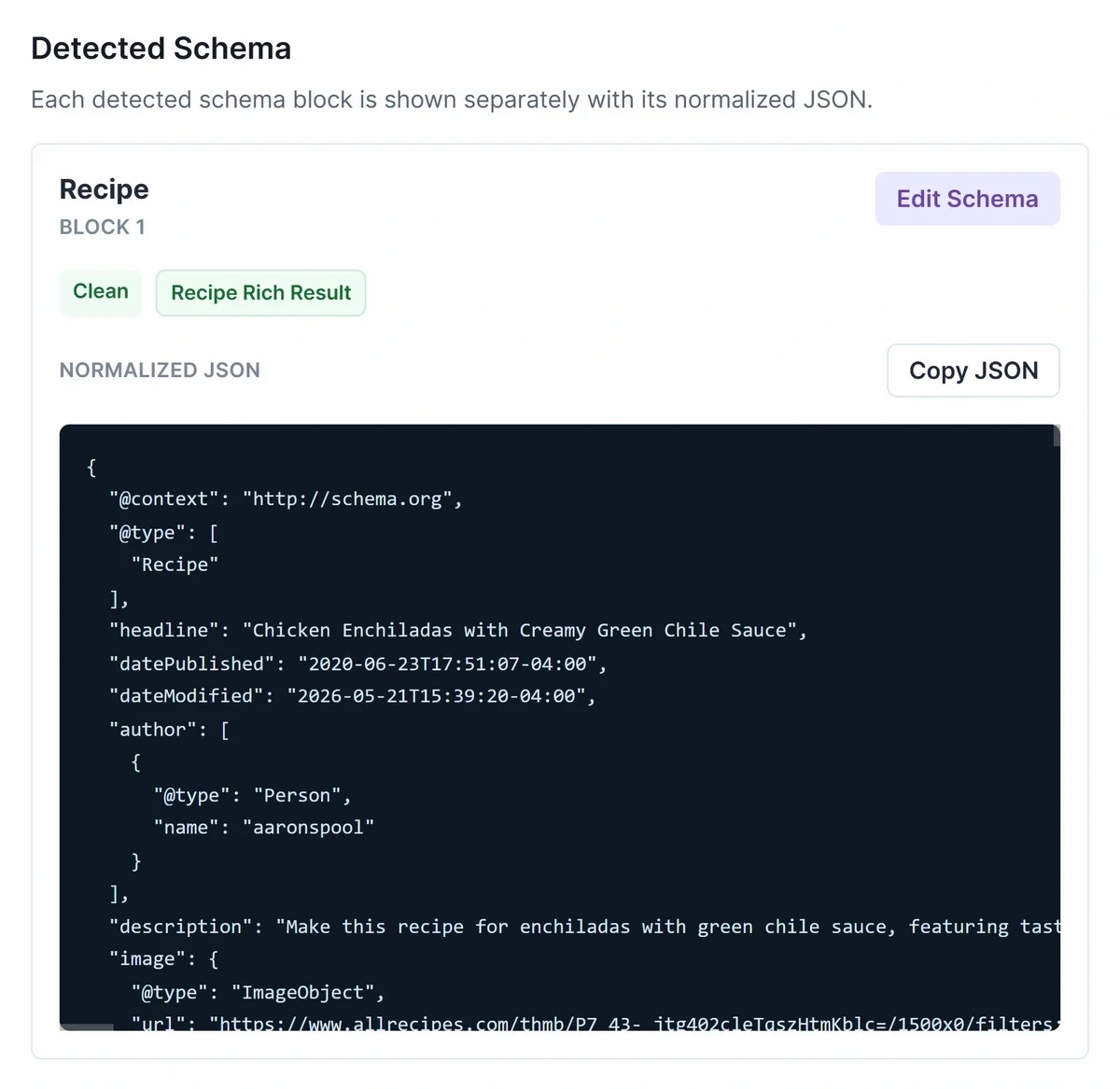
Find Technical Flaws Killing Your Rich Snippets
The validator evaluates your code’s underlying architecture to report on your structured data health:
- Syntax & Format Validation: Instantly catches JSON-LD parse errors, unclosed brackets, nesting mistakes, and invalid characters before they break your page.
- Schema.org Context Verification: Confirms that your @context and @type declarations are accurate and meet correct formatting standards.
- Missing Required Fields: Spots omissions in key data fields for highly competitive schema types like Products, FAQs, Recipes, Events, and Videos.
- HTML Extraction: Pulls and tests nested JSON-LD or microdata directly from raw page code, saving you from manually copying scripts.
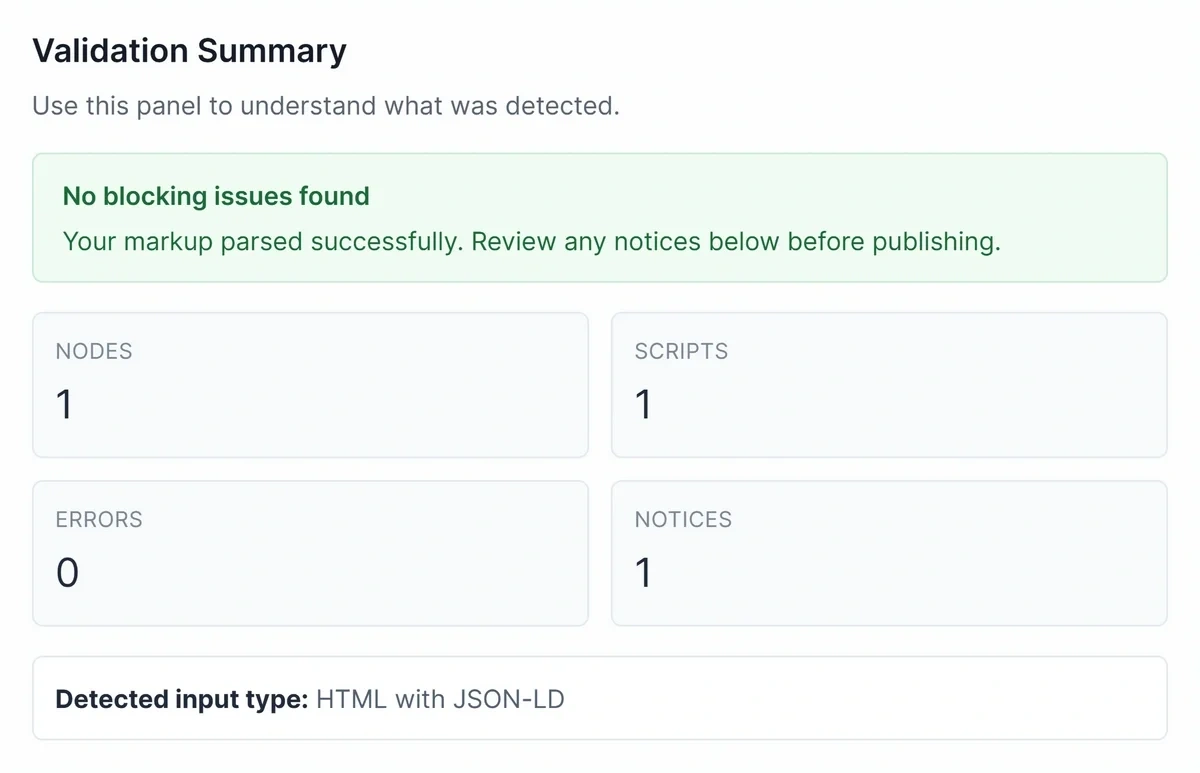
Verify Your Google Rich Result Status
Our real-time checks reveal:
- Rich Result Eligibility: Automatically scans your code patterns to confirm whether your schema meets the minimum requirements to trigger interactive Google search features.
- Warning vs. Error Flagging: Separates critical errors from optional recommendations, which simply make your search listings more detailed and likely to be picked up.
- Nested Entity Integrity: Verifies that secondary schemas like reviews or aggregate ratings nested inside a product are correctly linked and readable.
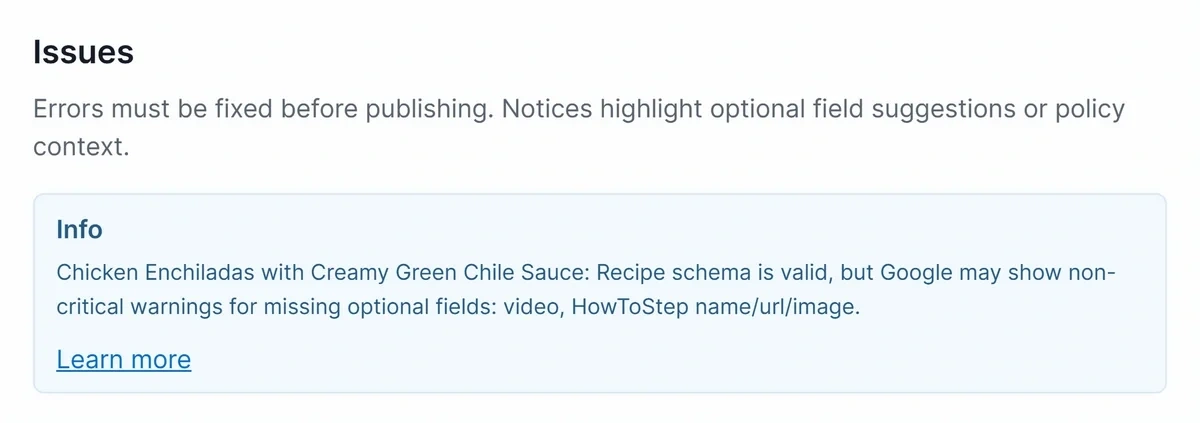
What Do Your Validation Results Mean?
- Nodes & Scripts: Shows you the total number of structured data blocks and script tags detected on your page.
- Errors: Critical issues that must be fixed. If this is above 0, search engines will likely fail to parse your schema, and you won't get rich results.
- Notices: Non-critical alerts highlighting missing optional fields (like shipping details or return policies) or policy context.
- Clean: Confirms that the specific block of schema has zero errors and is fully readable.
- Rich Result Eligibility (e.g., "Product Rich Result"): Confirms that your code successfully meets Google’s requirements to trigger interactive search snippets.
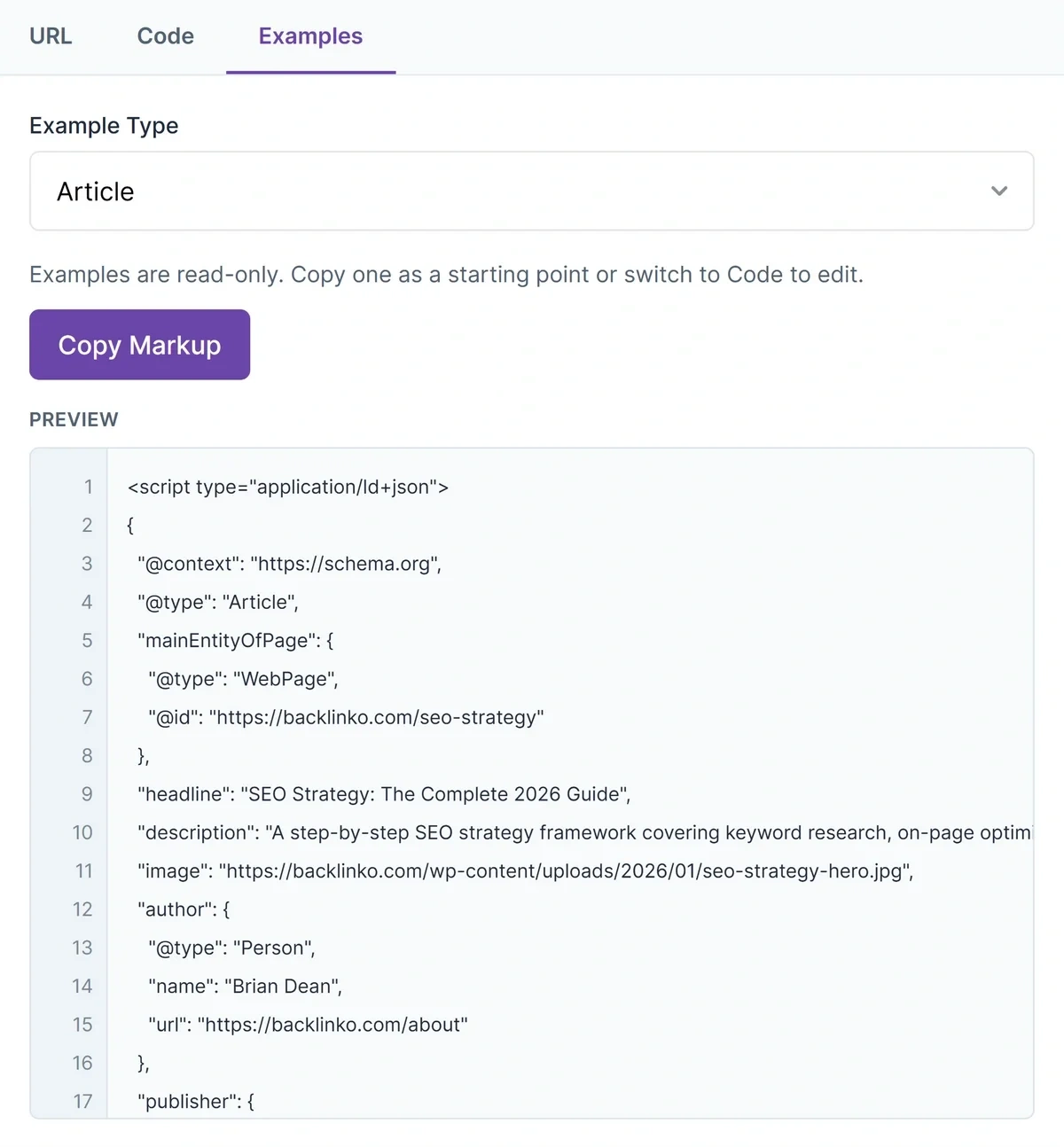
Use Built-In Schema Examples to Get a Quick Start
If you are new to structured data or trying to add a particular type of schema, you can use built-in examples to help you learn and build faster.
The examples include pre-configured, syntactically accurate templates for popular structured data types that often trigger rich search snippets like Products, FAQs, Recipes, Events, and Videos.
Copy the example structured data code for format and syntax and edit the details to quickly preview and verify schema for your pages before pushing live changes.
Who Is The Free Schema Markup Validator For?
- SEO Professionals & Marketers: Quickly draft, test, and debug JSON-LD markup for key pages to ensure rich feature eligibility.
- Web Developers: Validate code scripts on the fly as you build page templates, ensuring perfect execution before shipping code to production.
- Bloggers & Publishers: Improve your organic visibility by verifying that Recipe, FAQ, and Video schemas are clean and readable.
- E-Commerce Managers: Keep product listings, pricing updates, and stock availability schema perfectly synced to capture snippets like search carousels and AI visibility for product queries.
Exploding Topics Pro is trusted by 1,200+ teams worldwide.
How We Find Trends
We track topics across the internet to identify under-the-radar trends before they go mainstream.
Analyze
Our trend identification process begins with a comprehensive data collection from a variety of online sources.
- Social media platforms
- Search engines
- Online forums and communities
- News articles and blogs
- E-commerce websites
- Podcasts
Identify
Our proprietary machine learning models are designed to detect the absolute earliest signs of an emerging trend.
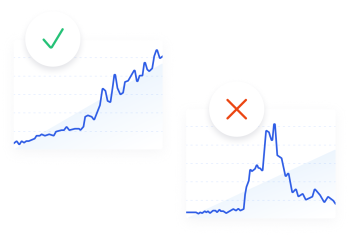
- Analyze historical data to identify growth patterns
- Predict future trends based on current data trajectories
- Detect sudden spikes in interest or activity around specific topics
Curate
While our algorithms are powerful, human expertise is crucial for contextual understanding, ensuring quality topics.
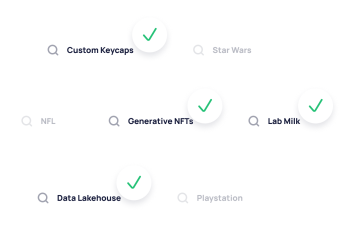
- Review the top-scoring trends identified by our models
- Validate the authenticity and relevance of these trends
- Filter out fads (movies, TV shows, celebrity gossip, etc.)
- Provide qualitative insights to complement quantitative data
Get Exclusive Access to Emerging Trends
Stay ahead of the competition with a 7-day free trial of Exploding Topics Pro.
1.1M+ trends in our growing database. Pro plans starts at $1.29/day.
Powered by
FAQ
Everything you need to know about using our features and getting the most out of them.
What is schema markup, and why is it important?
Schema markup (also called structured data) is a standardized code you add to your website to help search engines understand your content. Think of it like explicit clues about a page that provide meaning to search engines, allowing them to feature your pages with rich, eye-catching visual features on SERPs.
Some common types of rich snippets on organic search include review stars, prices, and shopping carousels, which can significantly improve your click-through rate (CTR).
Is this Schema Markup Validator free to use?
Yes, the Schema Markup Validator is 100% free. You can test as many individual URLs, raw code scripts, or built-in example templates as you need without creating an account or entering a credit card.
If you want to move beyond checking one page at a time, you can also sign up for a free Semrush account to run a comprehensive site audit and automatically catch schema issues across your entire website.
How does the Schema Markup Validator work?
The Schema Markup Validator analyzes live URLs or raw code (JSON-LD or HTML) in real time. It parses the data as you type or load a page, instantly flagging formatting issues, pointing out missing fields, and showing you exactly how search engines read your structured data.
What is the difference between an "Error" and a "Notice" in the results?
Errors are critical issues like broken code syntax or missing required fields that prevent search engines from parsing your schema entirely. If you have errors, you won't qualify for rich results.
Notices are recommendations for optional fields (like a product's SKU or return policy) that make your search listings more detailed, but theywon't block your rich snippets from showing up.
Prioritize fixing the errors first to ensure you’re not losing visibility in organic search.
Why is my schema valid, but Google still isn't showing rich snippets?
Validation is the first step, but Google ultimately decides whether to display rich results based on site quality, content relevance, and searcher intent. Additionally, it can take anywhere from a few days to a couple of weeks for search crawlers to index and display your newly updated code.
How do I fix a "JSON parse error" in my code?
JSON parse errors usually mean there is a formatting slip-up in your code. Look for missing commas between lines, unclosed curly brackets {} or square brackets [], or unescaped quotation marks inside your text. The line numbers in the tool's editor will help you pinpoint the exact location of the break.
Does adding schema markup directly boost my Google rankings?
Schema markup is not a direct ranking factor, but it can contribute to rankings indirectly. For instance, rich results on the SERP are naturally eye-catching and attract higher clicks than simple organic listings, which can boost your traffic and, in return, your Google rankings.
Does schema markup help with AI search engines and LLM crawlers?
While AI agents and Large Language Models (LLMs) are good at reading unstructured data, schema markup makes it easier for AI to map entities and pull accurate answers for user queries. It’s especially helpful in product and e-commerce contexts, since an updated product feed and structured data allow AI to recommend your brand with greater confidence.