Exploding Topics
Remineralizing Gum search volume grew from under 100 to 27,100 monthly searches between February 2024 and January 2026.
Remineralizing gum
+5100%
GLP 1 Supplement search volume grew from 5,920 to 74,000 monthly searches between February 2024 and January 2026.
GLP 1 supplement
+1150%
Soursop Bitters search volume grew from 9,900 to 110,000 monthly searches between March 2024 and February 2026.
Soursop bitters
+1011%



Get Advanced Insights on Any Topic
Discover Trends 12+ Months Before Everyone Else
How We Find Trends Before They Take Off
Exploding Topics’ advanced algorithm monitors millions of unstructured data points to spot trends early on.
Keyword Research
Performance Tracking
Competitor Intelligence
Fix Your Site’s SEO Issues in 30 Seconds
Find technical issues blocking search visibility. Get prioritized, actionable fixes in seconds.
Powered by data from
Latest Blog Posts
Featured Case Studies
See what's trending before everyone else
Each week, we'll send you our best Exploding Topics. Plus, expert insight and analysis.
7 Best Answer Engine Optimization Tools for AI Search

 Add Exploding Topics on GoogleAdd Exploding Topics as your preferred source to see more of our stories on Google.
When you type a query into an AI answer engine, it cites content that it retrieves and determines is authoritative, relevant, and easy to extract and understand.
If you’re trying to create content that gets mentioned, poorly structured content, pages that don’t answer common questions directly, or a page blocked from AI crawlers can cost you.
Answer Engine Optimization (AEO) is all about making sure your content, website, and brand are structured so AI systems can discover, understand, and confidently cite them.
And to help you do that, you can use an AEO tool.
Some AEO tools, though, will tell you that a gap exists between you and your competitors, but won’t help you figure out how to fix it. I picked these seven AEO tools because each one gets you from "here's your gap" to an actual fix.
Whatever your budget, there’s an AEO tool on this list for your and your team. Let’s take a look at each one, its pricing, benefits, main features, and more.
What Makes a Good AEO Tool?
Not every tool that promises to help you optimize your AI visibility actually helps you get from data to a real fix. Before you commit to one, here are a few important AEO tool features to watch for:
- Action, not just alerts: A tool that tells you "you're missing from this AI answer" gives you less than one that tells you what to publish or fix to close that gap. Look for actually actionable insights, a built-in content editor, an automated workflow, or a direct technical deployment rather than a backlog of flagged issues you have to solve on your own.
- Technical AI crawlability: AI engines can only cite what their crawlers can actually read. A great AEO tool checks whether your pages are blocked from AI bots, whether your content carries the schema and FAQ structure these models parse well, and flags the specific issues stopping a page from being parsed in the first place.
- Integration with your existing workflow: You’ll implement the fastest fixes when your AEO tool lives or integrates with the same platform(s) you already use, not a brand-new tool with its own login and its own data. Look for AEO features built into a platform you're already running for the convenience factor.
7 Best Answer Engine Optimization Tools
Here's a quick comparison before I go deeper into each tool:
| Tool | Best For | Starting Price | Key Feature |
| Semrush AI Visibility Toolkit | Most marketing teams/users wanting AI + SEO in one login | $99/mo | AI Search Site Audit + Narrative Drivers |
| Surfer AI Tracker | Teams optimizing content while they track | $99/mo | Tracking built into the Content Editor |
| Writesonic | High-volume content production | $79/mo | Action Center (content + technical fixes) |
| AirOps | Automated multi-step content pipelines | $199/mo | Playbooks from gap to published draft |
| HubSpot AEO | Marketing teams on HubSpot Marketing Hub | $50/mo | CRM-informed prompts, publish without leaving HubSpot |
| Scrunch AI | Enterprise brands serving AI crawlers directly | $250/mo | Agent Experience Platform (AXP) |
| Adobe LLM Optimizer | Adobe Experience Cloud enterprises | Custom (~$115K/yr) | One-click CDN-level content deployment |
Alright, let’s start with my favorite AEO tool: Semrush.
1. Semrush AI Visibility Toolkit
Best for: SEO teams who want AI visibility built into a platform they already run
I'm starting this list with Semrush because of the way it combines AI and SEO features. If you’re already using Semrush for SEO (or you sign up for Semrush One), the AI Visibility Toolkit sits inside the same dashboard as your keyword research, site audits, and rank tracking, so you can so easily connect how your site is doing in AI search with data about its SEO performance.
The AI Search Health report is one of the features that puts Semrush at the top of this AEO tools list. It sits inside Semrush's existing SEO Site Audit tool and flags specific technical issues (like blocked AI crawlers, missing schema, and thin content) that stop an answer engine from citing a page in the first place.

Another Semrush feature that stands out in the AEO tool space is the Narrative Drivers report. This report takes a massive step forward by taking a look at your visibility versus your competitors, shows you your share of voice (including lists of exactly which questions you’re showing up as an answer for), and tells you how to improve it.
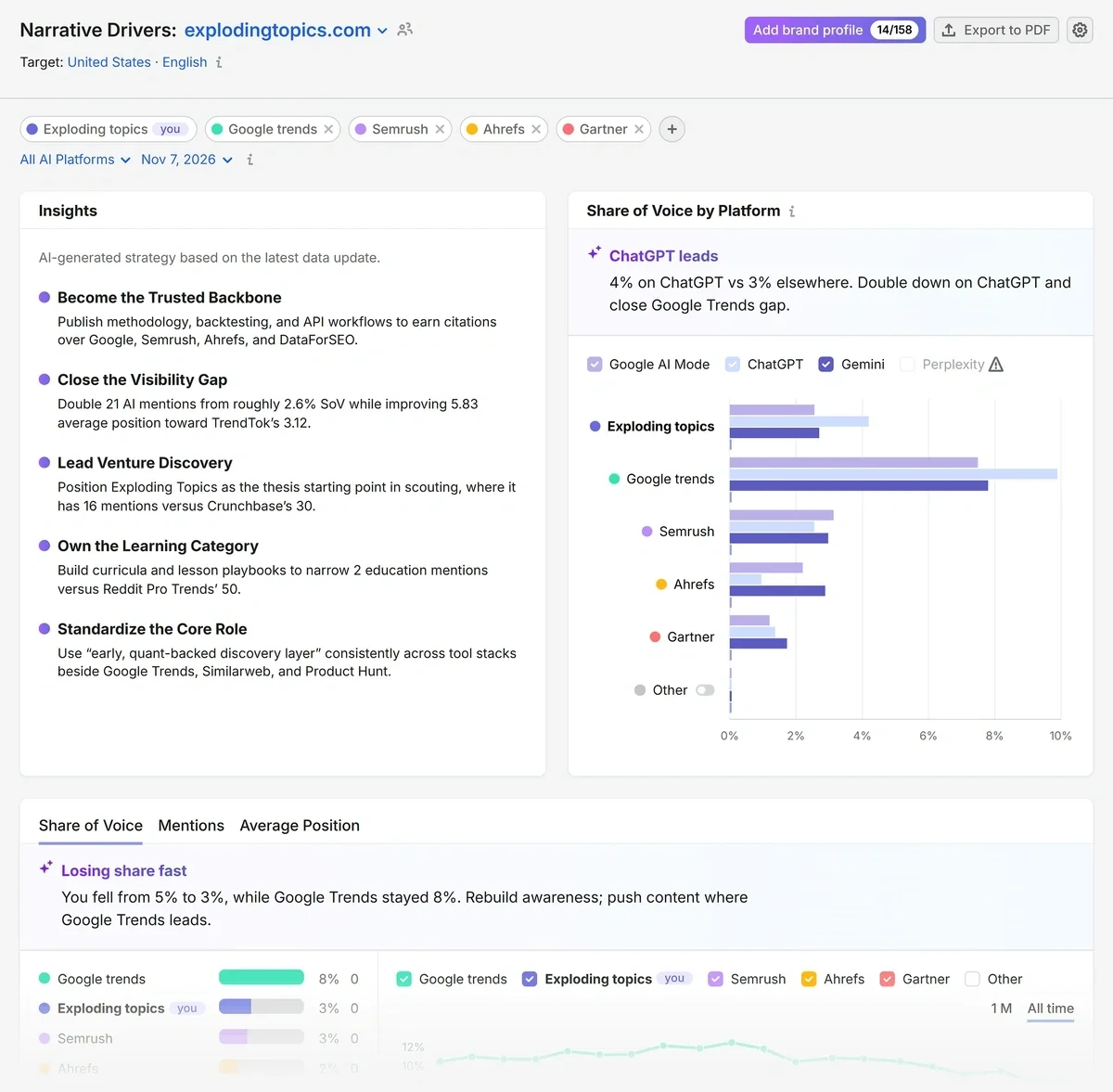
The report’s Insights list combines your visibility and citation data into a ranked list of strategic moves, like a competitor's share of voice in a topic you haven't claimed, a content format that's earning mentions in your category, or a gap between your ranking and your actual citation volume. Instead of leaving you to interpret a dashboard, it hands you prioritized moves in plain language, each backed by the data point that justifies it.
If you want to compose new content within Semrush based on those insights, you’ll need Semrush's Content Toolkit, a separate $60/month add-on. It generates unlimited standard articles and five SEO-boosted articles a month, builds SEO briefs from the same keyword data Semrush already has on your site, and optimizes existing pages for search intent and readability.
Although it’s worth the extra $60 per month in my opinion, you could certainly go without it and just focus on the AI Visibility Toolkit (combined with SEO tools, if you’d like). It’s valuable enough without a content editor.
AI platforms tracked: ChatGPT, Google AI Mode, Perplexity, and Gemini
Starting price: $99/month standalone (1 domain, 25 prompts, 300 daily queries). Bundled into Semrush One from $165/month (Starter: 5 websites, 50 prompts, 500 keywords).
Get More Search Traffic
Use trending keywords to create content your audience craves.
2. Surfer
Best for: Content teams who want tracking and optimization in the same dashboard
I picked Surfer for this list because the AI Tracker tool lives in the same dashboard as Surfer's Content Editor, so when a prompt shows you're missing from an AI answer, you can draft new content that answers it without switching tools.
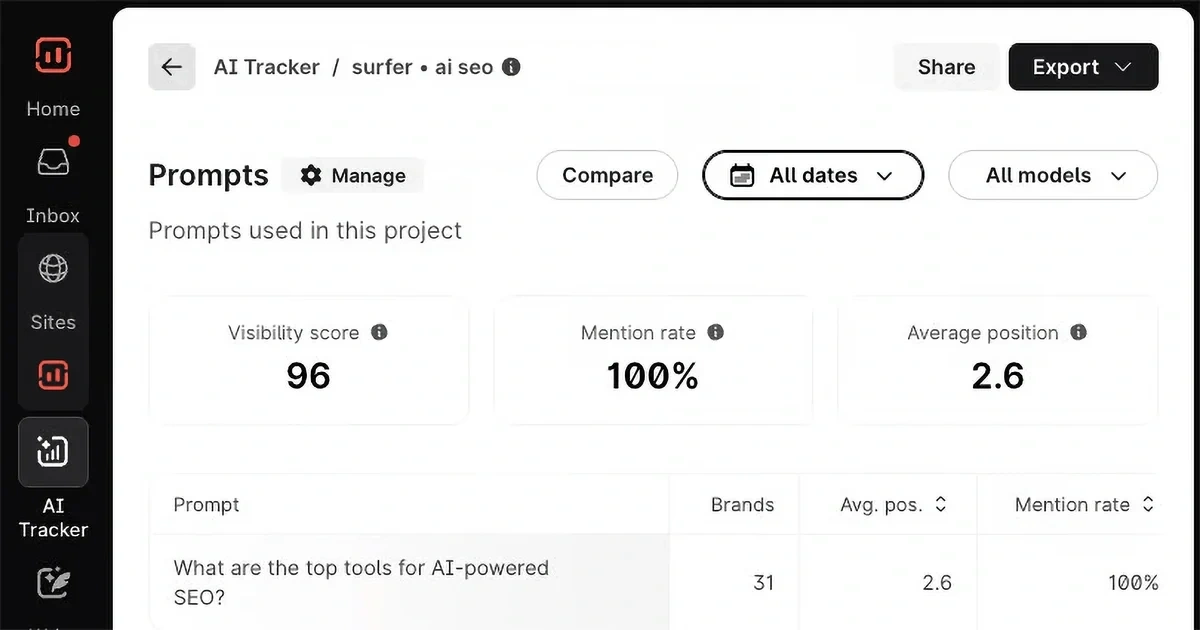
Another cool Surfer feature is their Topical Map because it’s focused on helping you easily turn a visibility gap into a content plan. It connects to Google Search Console, clusters your existing topics against your competitors', and shows the areas where you're missing in a visual map instead of a spreadsheet.
From there, you can use the Content Editor to turn a flagged topic into a live draft with real-time optimization guidance, and then Content Audit tracks that page after it publishes, flagging ranking drops and pointing out which older articles are worth refreshing rather than replacing.

AI Tracker refreshes weekly and covers only ChatGPT on the entry-level plan. If you want to be able to catch a citation drop the same week it happens and track more platforms, you’ll need the Pro plan.
AI platforms tracked: ChatGPT only (Standard); ChatGPT, Perplexity, Google AI Mode, Google AI Overview, and Gemini (Pro and above)
Starting price: $99/month (Standard: ChatGPT only, 25 prompts, weekly refresh). Pro at $182/month adds all 5 platforms with daily refresh.
3. Writesonic
Best for: Teams that want AI writing and AI visibility tracking in one platform
Writesonic's Action Center is one of the primary reasons the tool is on this list. It sorts every visibility problem into three buckets: Technical Issues, which are barriers stopping AI crawlers from reading your site at all; External Mentions, opportunities to earn citations on third-party sites that already influence AI answers; and Content Visibility, gaps in your own content that AI models can't currently cite you for.
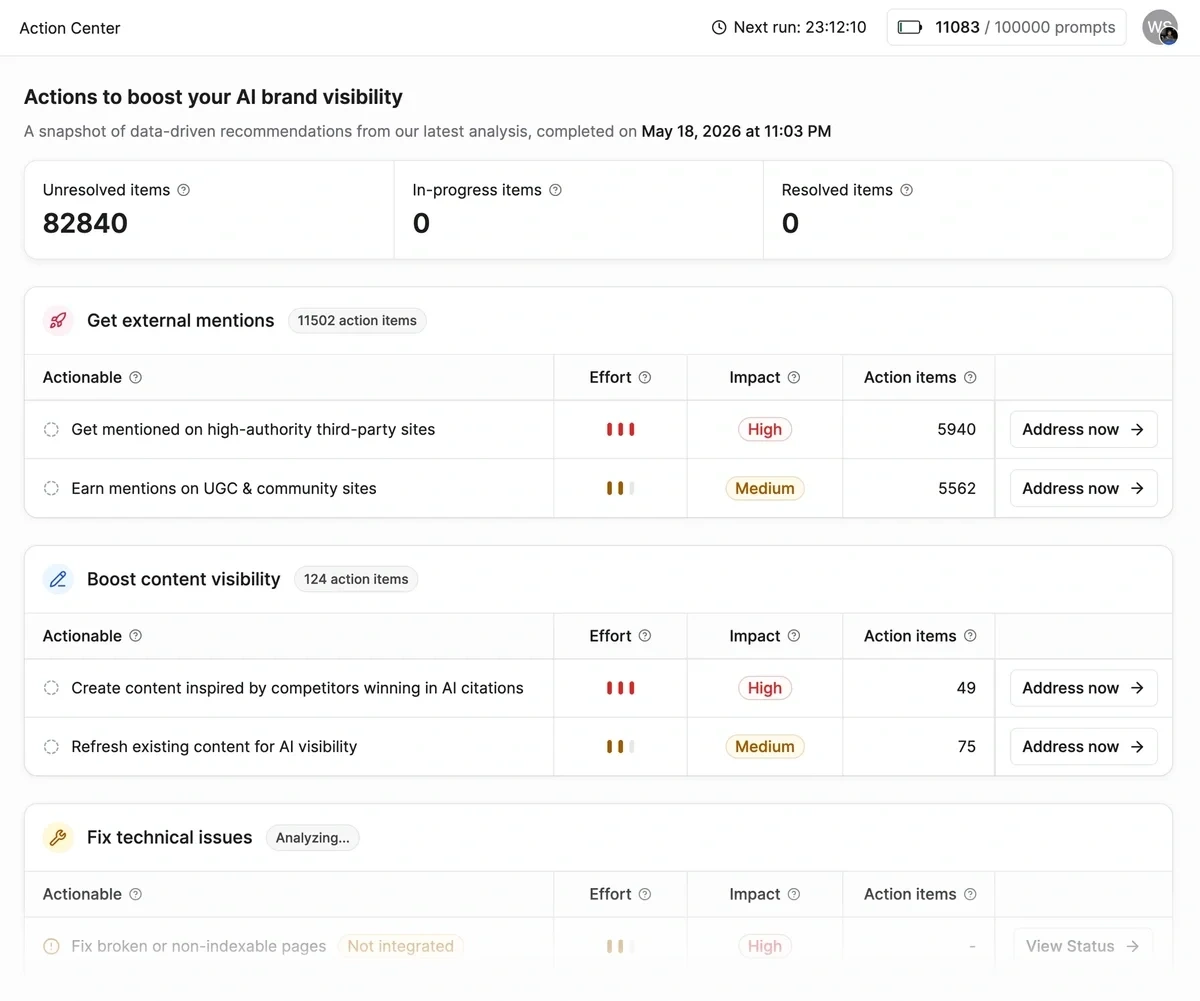
I also really like the way Writesonic finds AI citation opportunities for you. It points out gaps between you and your competitors, tells you which pages and domains are opportunities for you, and gives you the exact sources getting cited.
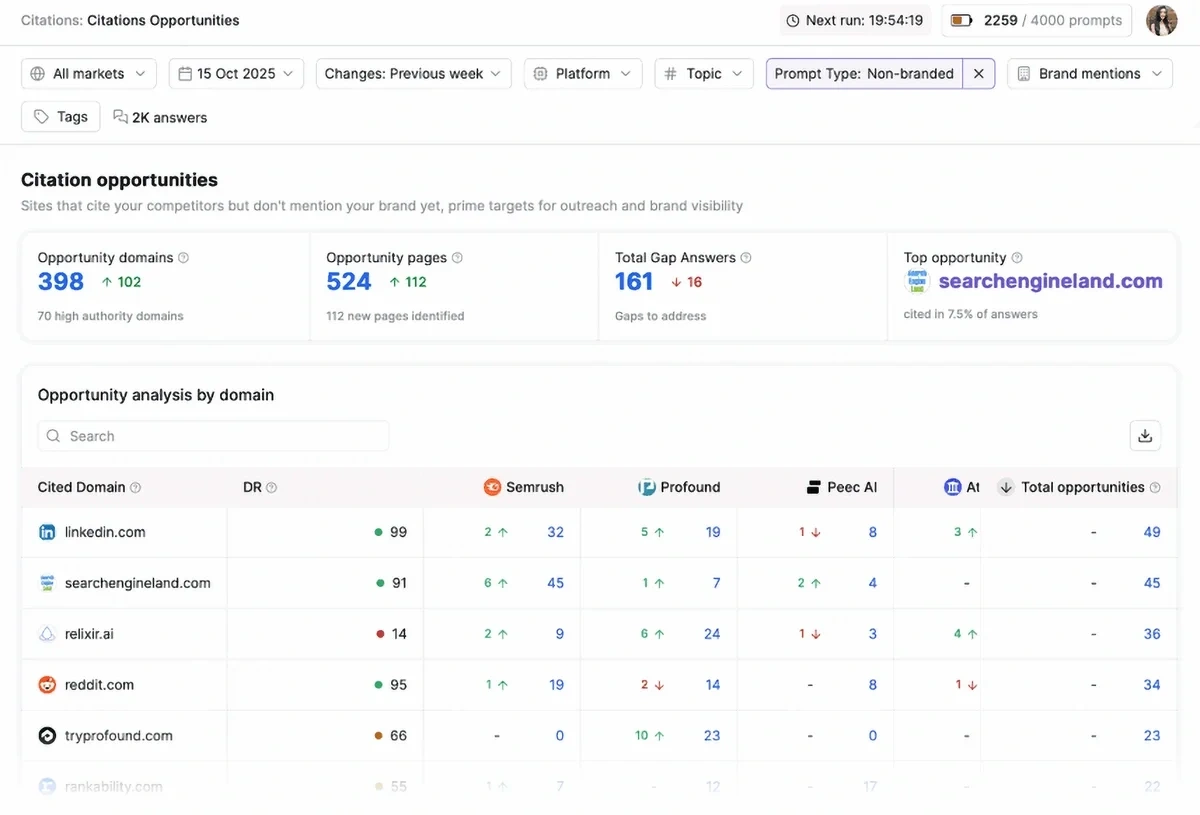
Also, the AI Article Writer (available at the Growth level and up) helps you handle your content gaps, drafting AI-ready articles with FAQ blocks and comparison tables built in, the formats Writesonic says AI engines cite most often. It starts by scraping every page currently ranking or cited for the topic, then drafts section by section using that research plus your own brand voice profile, so the output doesn't read like a generic AI draft.
Writesonic's plans start at $79/month, which covers content generation and AI visibility tracking across ChatGPT, Gemini, and Google AI Overviews, but leaves the Action Center and Sentiment Analysis out entirely. Action Center access begins on the $399/month Growth plan, capped at five external mention and five content visibility actions a month.
AI platforms tracked: ChatGPT, Gemini, and Google AI Overviews on self-serve plans; all 10 platforms (adding Perplexity, Claude, Grok, and others) on Enterprise
Starting price: $79/month, with Action Center access starting on the $399/month Growth plan
4. AirOps
Best for: Teams that want AEO fixes to run on their own instead of managing them manually
AirOps takes a different approach than the other tools on this list. Instead of a dashboard you check and act on, Quill (AirOps' AI agent) tracks your content’s performance and proposes the fix itself, then routes it through human review before anything is published.
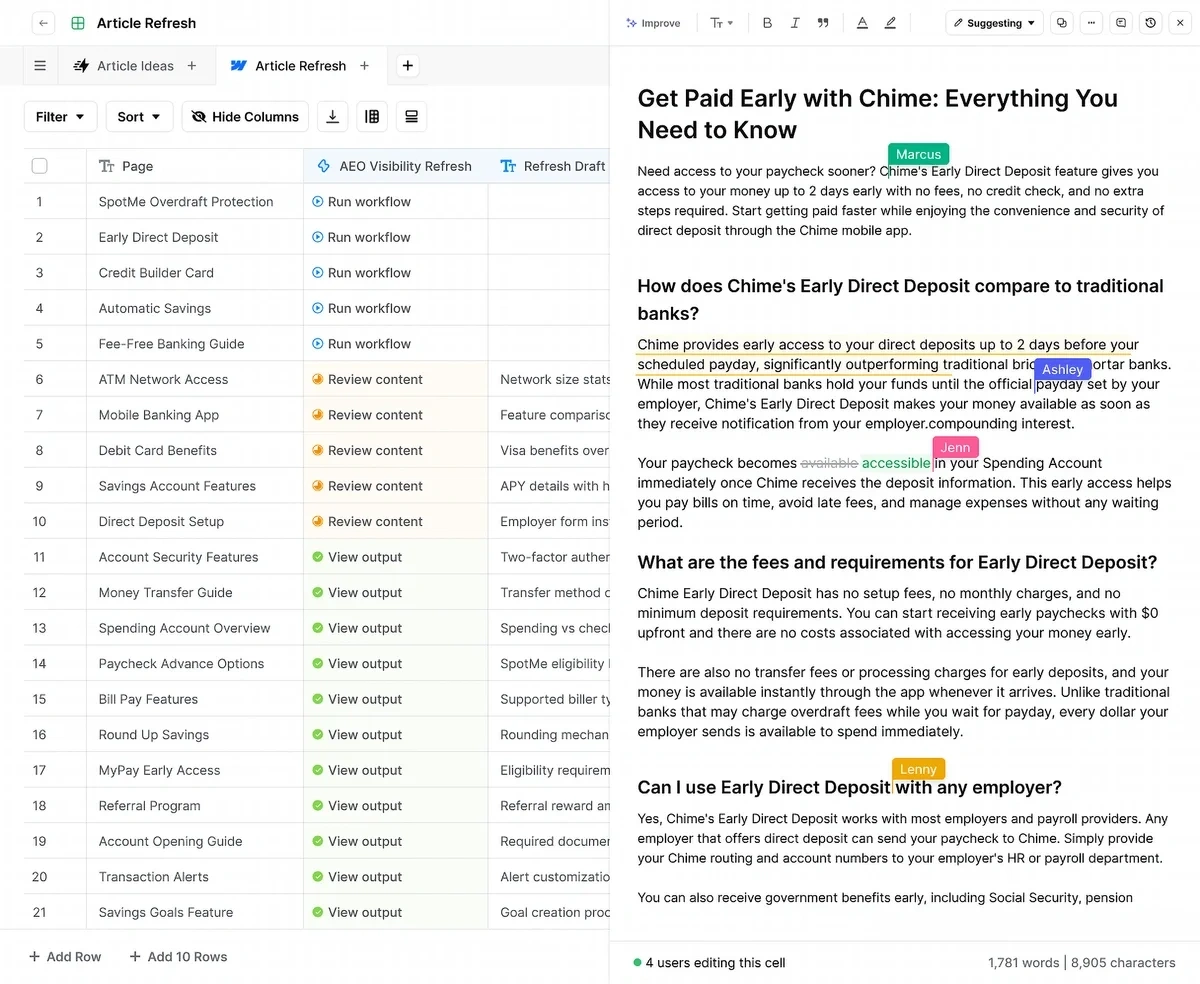
That tracking runs through AirOps Insights. It runs sets of real user questions against ChatGPT, Perplexity, Google AI, and Gemini, then tracks citation rate, mention rate, share of voice, and average position for each one over time.
With AirOps, your content library is continuously scanned for pages losing AI citations, dropping in search performance, or pages that have become stale according to AirOps’ monitoring.
When a page is flagged, Quill proposes a fix.
All of this is made possible by what AirOps calls “Playbooks.”
Each playbook is a plain-English set of instructions you build once, telling Quill what to research, what rules to follow, and what to produce. The AEO Playbook is one of AirOps' pre-built templates, and it researches how AI platforms are currently answering a target prompt, including who's getting cited and why, then generates a content brief or draft structured around the claims and formatting that tend to earn citations. Everything it drafts pulls from your Brand Kit, so the output reflects your actual voice and positioning instead of reading like generic AI copy. A human reviews the draft before it goes anywhere, and once it's live, AirOps tracks that update against future citation and traffic changes automatically.
While that all sounds amazing, the tradeoff is setup. Getting real value out of AirOps means someone on your team owns Playbook design rather than expecting results out of the box, which suits a larger team with a set content process more than one still figuring out what to publish.
AI platforms tracked: ChatGPT on the Solo plan; ChatGPT, Google AI Mode, Perplexity, and Gemini on Pro and above
Starting price: $200/month (Solo plan) with a 14-day free trial
5. HubSpot AEO
Best for: Marketing teams already running HubSpot’s Marketing Hub who want AEO tied to CRM data
HubSpot AEO’s recommendations are often some of the best, and they get even better the deeper you're already in the HubSpot ecosystem. On the standalone tool, recommendations come from the same types of visibility and citation signals as the other tools on this list. But inside HubSpot’s Marketing Hub Pro or Enterprise, they're informed by your actual CRM data instead, so a suggested topic reflects your real buyer segments and product lines rather than generic industry prompts.
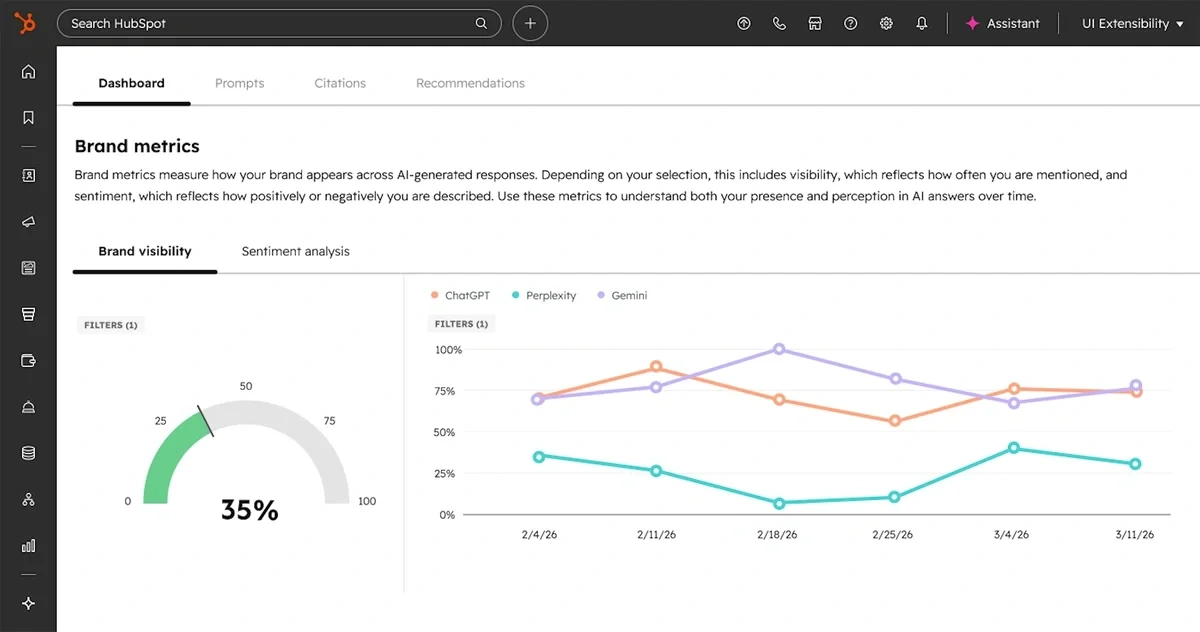
The dashboard tracks brand visibility, share of voice, and citations across ChatGPT, Gemini, and Perplexity. Prompt tracking goes down to the individual response level, letting you filter by engine or buyer's journey stage and read the exact answer that was returned. Citation analysis then breaks down which domains and content types are earning those mentions, including competitor pages and third-party sites like Reddit or review sites, so you know where to focus your outreach.
HubSpot’s recommendations turn that into a prioritized list of specific actions, like publishing a new post or updating an existing page. Inside Marketing Hub Pro or Enterprise, you can act on a recommendation directly through HubSpot's content and social tools without leaving the platform.
AI platforms tracked: ChatGPT, Gemini, and Perplexity
Starting price: $50/month ($45/month billed annually), free for 28 days. Included with Marketing Hub Professional and Enterprise.
6. Scrunch AI
Best for: Enterprise brands that want AI-facing content served separately from their human site
Scrunch was acquired by Sitecore in June 2026 and is now billed as "Scrunch, a Sitecore Company." That matters here because Sitecore's stated plan is to connect Scrunch's insights and AXP directly into its own content platform, so a flagged gap can eventually route straight into a Sitecore publishing workflow instead of sitting in a report.
The Agent Experience Platform (AXP) is the feature that separates Scrunch from a standard AI monitoring tool. It detects when an AI agent, rather than a human, is requesting a page, then can serve that agent a separate, restructured, compressed version of the content optimized for how LLMs parse text, while your actual site stays untouched for human visitors.
It also provides AI insights, tracking share of voice, sentiment, and citations, and surfacing recommendations on what's driving or hurting your visibility. Site Maps and Agent Traffic reporting round it out, showing which of your pages AI bots can actually access and how their behavior on your site has changed over time.
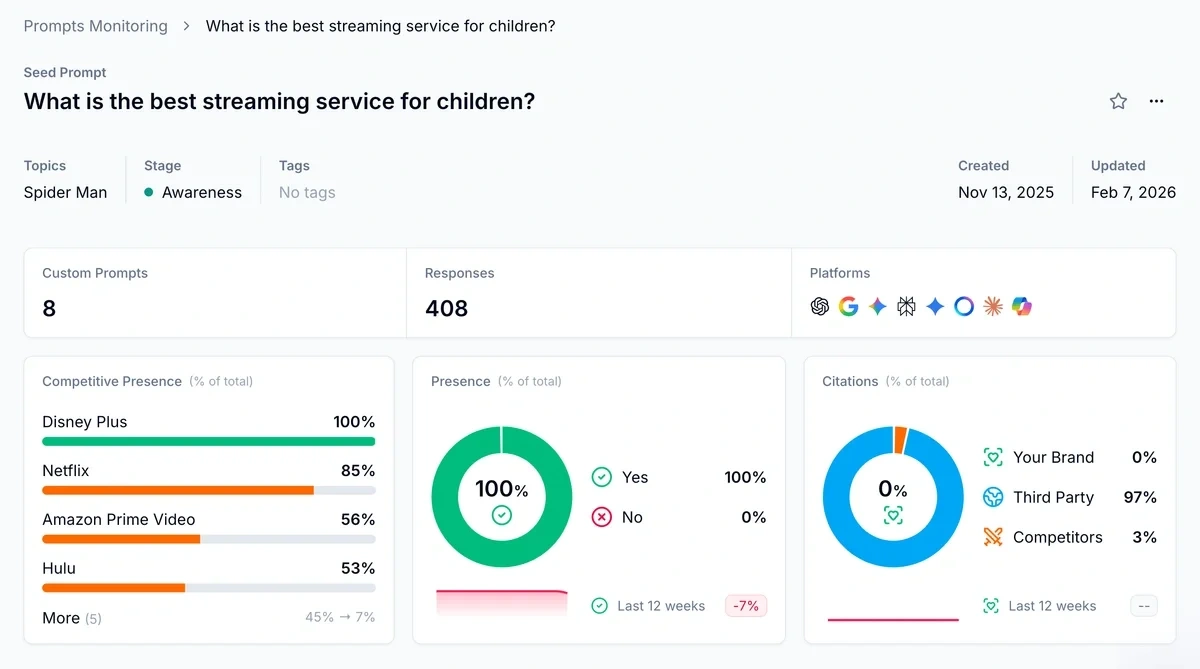
The catch is AXP itself. It's an Enterprise-only feature, not included on Scrunch's $250/month Core plan, so the tool that does the actual execution work here requires a custom-priced conversation with Scrunch's sales team.
AI platforms tracked: ChatGPT, Perplexity, Google AI Overviews, and Microsoft Copilot (Core plan); adds Claude, Gemini, Meta AI, Google AI Mode, and Grok (Enterprise)
Starting price: $250/month (Core). AXP and full platform coverage require Enterprise (custom pricing).
7. Adobe LLM Optimizer
Best for: Enterprise brands on Adobe's ecosystem who want fixes deployed without an engineering ticket
Adobe LLM Optimizer draws on Semrush's clickstream data and prompt database to model how LLMs are likely to answer a given prompt, so it uses the same underlying data feeding Semrush's own AI Visibility Toolkit at #1 on this list.
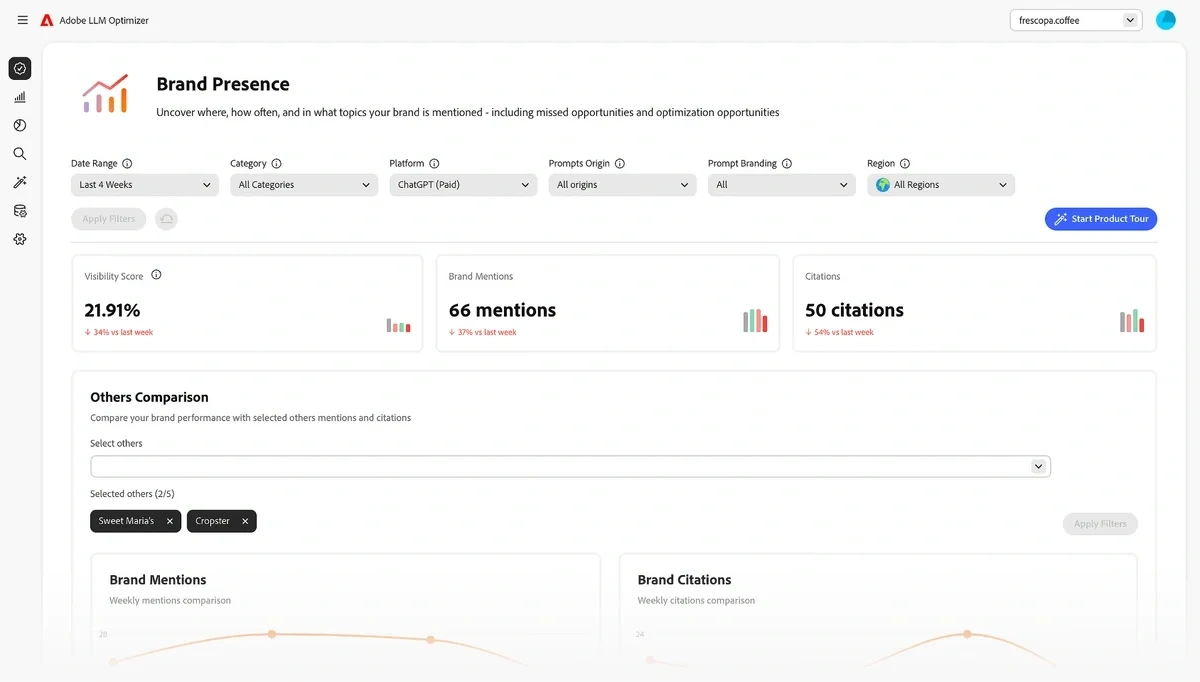
In the Opportunities dashboard, you get a long list of concrete issues: broken links and server errors returned to AI bots, dense copy sitting below AI readability thresholds, pages missing FAQ content structured around your tracked prompts, video content with no machine-readable transcript, and even gaps in your company's Wikipedia page compared to competitors'.
Optimize at Edge is what really makes Adobe LLM Optimizer unique. It deploys your fix at the CDN layer, serving the optimized version only to AI agents while your human-facing site and SEO stay untouched, no CMS change or engineering sprint required, and it's reversible with one click. It's currently in Early Access mode for select opportunity types, so not every fix on the list can be pushed live yet.
Access and pricing are real constraints, though. There's no public pricing. Adobe licenses by tracked prompt volume with a 1,000-prompt minimum on an annual contract, and a free trial is only available to existing AEM Cloud or Adobe Analytics customers.
AI platforms tracked: ChatGPT, Google AI Overviews, Google AI Mode, Microsoft Copilot, Gemini, and Perplexity
Starting price: Custom (no public pricing; licensed by tracked prompt volume, 1,000-prompt minimum).
My Recommendation
The Semrush AI Visibility Toolkit is the best fit for many different kinds of marketing teams. In my opinion, it has the best balance of data, reports, and concrete insights for the price.
Plus, you get even more with a Semrush One subscription, because the AI Visibility Toolkit sits alongside the classic SEO tools you still need to grow your business. AI tracking, site audits, and keyword research all live in one place.
And if you add the Content Toolkit for $60/month, you've got a path from citation gap to published page without really having to leave Semrush. I find that combination hard to beat for a team that wants to take AEO seriously without adding a third or fourth subscription to the stack. You can grab our exclusive coupon code to get an extended 14-day free trial of Semrush One and try the AI Visibility Toolkit for yourself.
Stop Guessing, Start Growing 🚀
Use real-time topic data to create content that resonates and brings results.
Exploding Topics is owned by Semrush. Our mission is to provide accurate data and expert insights on emerging trends. Unless otherwise noted, this page’s content was written by either an employee or a paid contractor of Semrush Inc.
Share
Newsletter Signup
By clicking “Subscribe” you agree to Semrush Privacy Policy and consent to Semrush using your contact data for newsletter purposes
Written By


Jolissa Skow is a senior content writer and content strategist with a background in SEO, Google Analytics, and WordPress. She's be... Read more