Exploding Topics
Remineralizing Gum search volume grew from under 100 to 27,100 monthly searches between February 2024 and January 2026.
Remineralizing gum
+5100%
GLP 1 Supplement search volume grew from 5,920 to 74,000 monthly searches between February 2024 and January 2026.
GLP 1 supplement
+1150%
Soursop Bitters search volume grew from 9,900 to 110,000 monthly searches between March 2024 and February 2026.
Soursop bitters
+1011%



Get Advanced Insights on Any Topic
Discover Trends 12+ Months Before Everyone Else
How We Find Trends Before They Take Off
Exploding Topics’ advanced algorithm monitors millions of unstructured data points to spot trends early on.

Keyword Research
Performance Tracking
Competitor Intelligence
Fix Your Site’s SEO Issues in 30 Seconds
Find technical issues blocking search visibility. Get prioritized, actionable fixes in seconds.
Powered by data from
Latest Blog Posts
Featured Case Studies
See what's trending before everyone else
Each week, we'll send you our best Exploding Topics. Plus, expert insight and analysis.
The AI Myths Marketers Believed and What the Data Actually Shows

 Add Exploding Topics on GoogleAdd Exploding Topics as your preferred source to see more of our stories on Google.
What are real marketing departments doing with their budgets in the era of AI? Exploding Topics decided to find out.
We surveyed over 1000 marketing budget decision-makers, and the answers we received completely rewrite some of the prevailing AI narratives.
We found AI adoption at a massive scale. But we also found that the biggest AI adopters are also increasing their hiring the most: marketing tools might be getting replaced, but marketers are not.
Yet in other ways, the responses still painted a picture of huge flux in marketing department budgets. The rise of AI optimization, massive lurches between social platforms, and evolving attitudes to attribution all emerged as key themes.
Fast facts
- 68.55% of decision-makers are scaling up their AI content
- 94.2% of marketing departments with the biggest budgets have replaced some of their existing tools with AI
- Around 6 in 10 marketing stacks have increased in size over the past year
- 82.36% of marketing teams “doubling down” on AI are also increasing their hiring
- 71.52% of marketing departments are actively trying to influence AI responses
- 36.61% of decision-makers are dedicating the biggest budget increases to AI optimization (AIO)
- More than 95% of marketers redistributed investment to different platforms last year, with influence on AI search the top reason for doing so
- 53.87% of marketing departments are assigning more budget to TikTok, but 35.52% are assigning less, making it the biggest mover in both directions
- Almost 60% of decision-makers are assigning more budget to marketing experiments and pilot projects
- Only 3.26% of AIO prioritizers are skeptical about their attribution models, versus 47.66% of those not planning to invest in AIO
The rise of “majority AI” marketing
Marketing departments are no longer just experimenting with AI. In fact, a significant minority are now using the technology as their main marketing content creator.
28.27% of respondents said that AI produces the majority of their content, either with or without some human editorial oversight.
That’s still slightly below the 36.21% of departments who mostly rely on internal teams for content. But AI has become the second most common marketing content lead, ahead of contractors (17.96%) and paid UGC (4.86%).
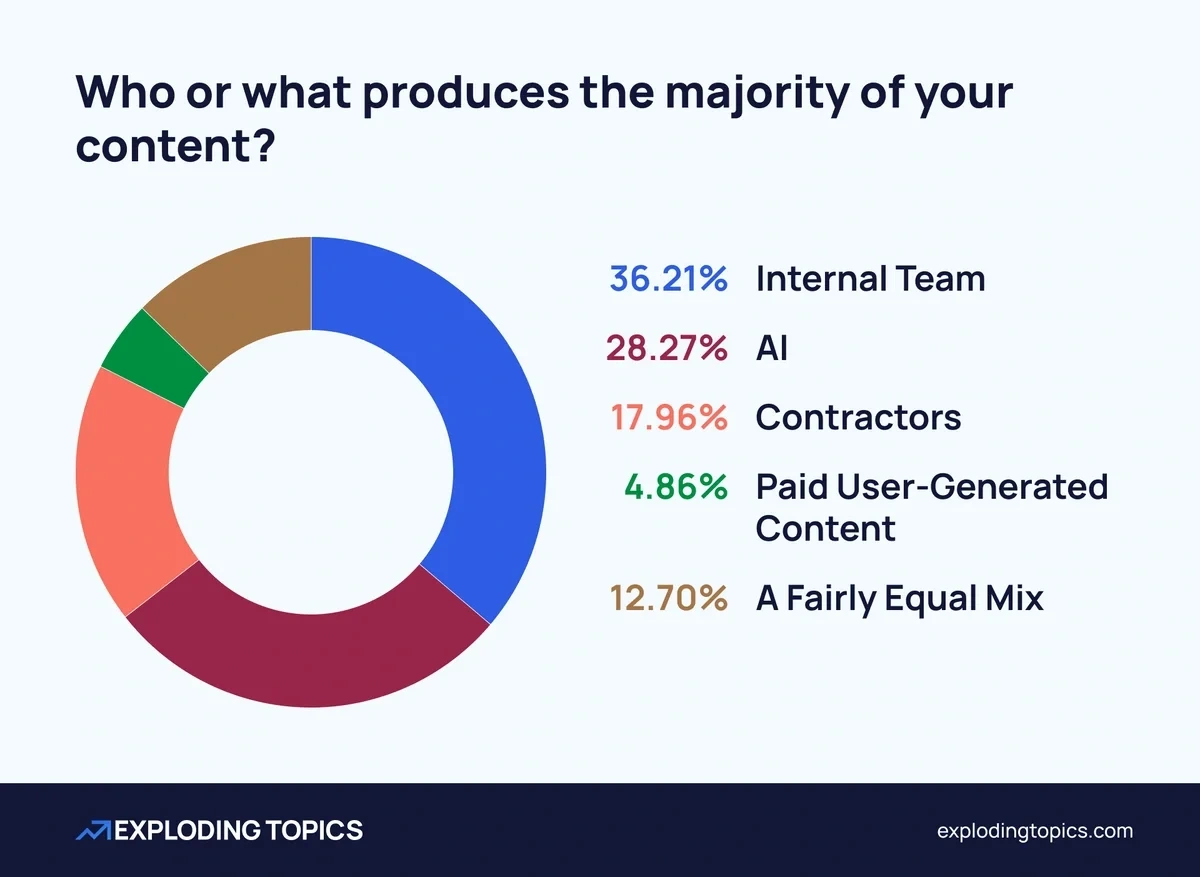
Factoring in marketers who report using a “fairly equal mix” (12.7%), more than 4 in 10 departments are using AI as a major content creator.
And the pace of adoption is increasing. 68.55% of marketing departments are increasing their levels of AI content.
Almost 1 in 3 (32.04%) describe their attitude as “doubling down”: greatly increasing AI content and scaling back human labor hours.
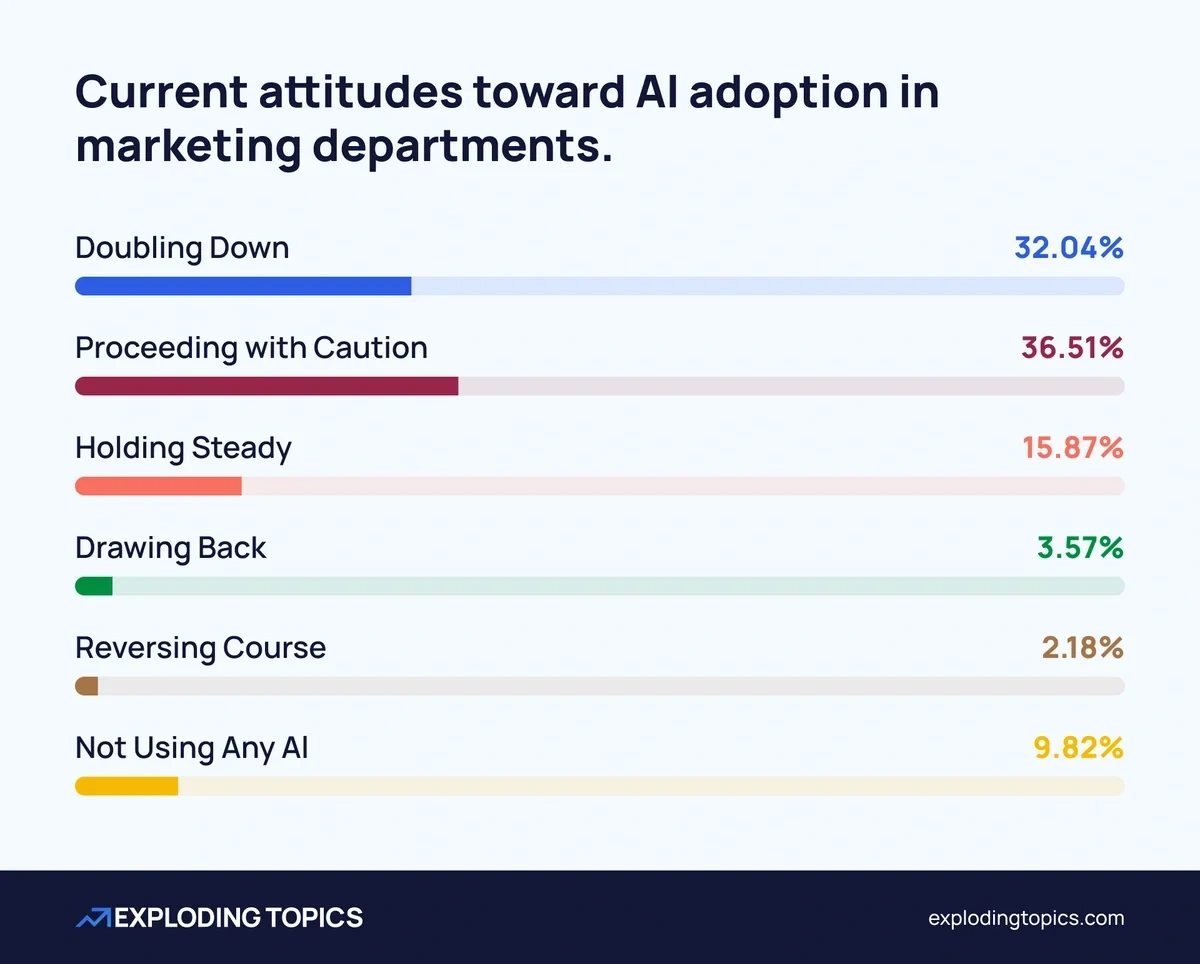
Very few marketers are having second thoughts about AI. Just 2.18% are fully reversing course, with a further 3.57% drawing back a little.
And notably, only 9.82% of marketing departments still haven’t used any AI-generated marketing content.
The Middle Atlantic emerges from the data as an AI marketing hub. 41.28% of respondents from the region are doubling down on AI, with just 1.7% reversing course.
Meanwhile, New England ranks among the most cautious areas. 22.22% have not used AI for any marketing content, and a further 18.52% are either reversing course or drawing back.
AI shakes up the marketing stack
As more marketing departments double down on AI, many existing tools have begun to fall by the wayside.
Almost half (46.33%) of decision-makers have replaced “lots” of marketing tool subscriptions with AI alternatives.
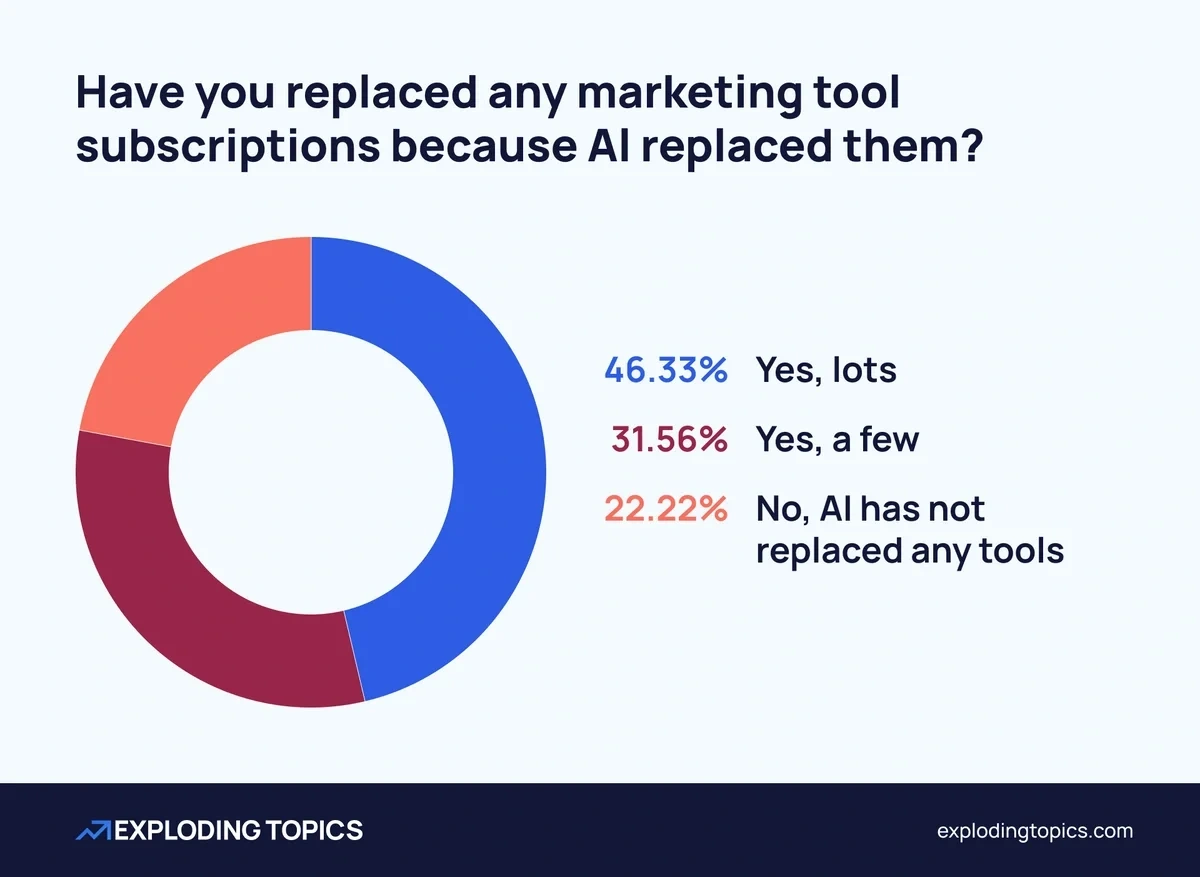
A further 31.45% have replaced “a few” tools, with only 22.22% yet to jettison any of their existing marketing stack.
And the decision-makers with the deepest pockets are being the most ruthless with their existing subscriptions.
Among the departments with the biggest budgets ($10M+), 94.2% have replaced at least some marketing subscriptions with AI tools.
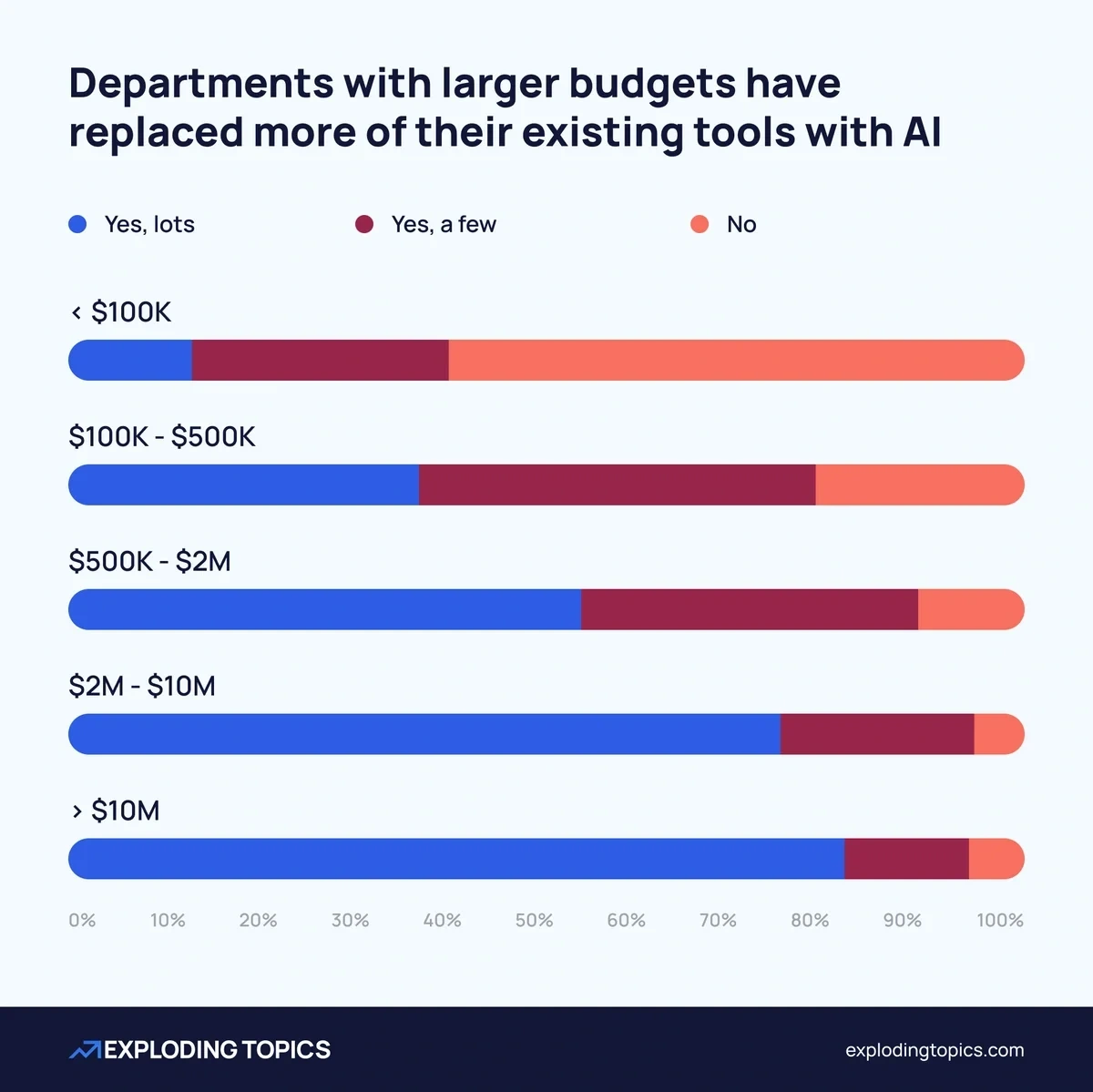
On the other hand, the smallest marketing departments (budgets of less than $100K) are by far the most likely not to have replaced any of their existing tools with AI. 60.2% are yet to make any changes.
But as soon as budgets rise above $100K, most marketing departments are making AI-related changes to their stack. Among departments with budgets between $100K and $500K, only 21.85% have not replaced any of their tools with AI.
New tools, not fewer tools
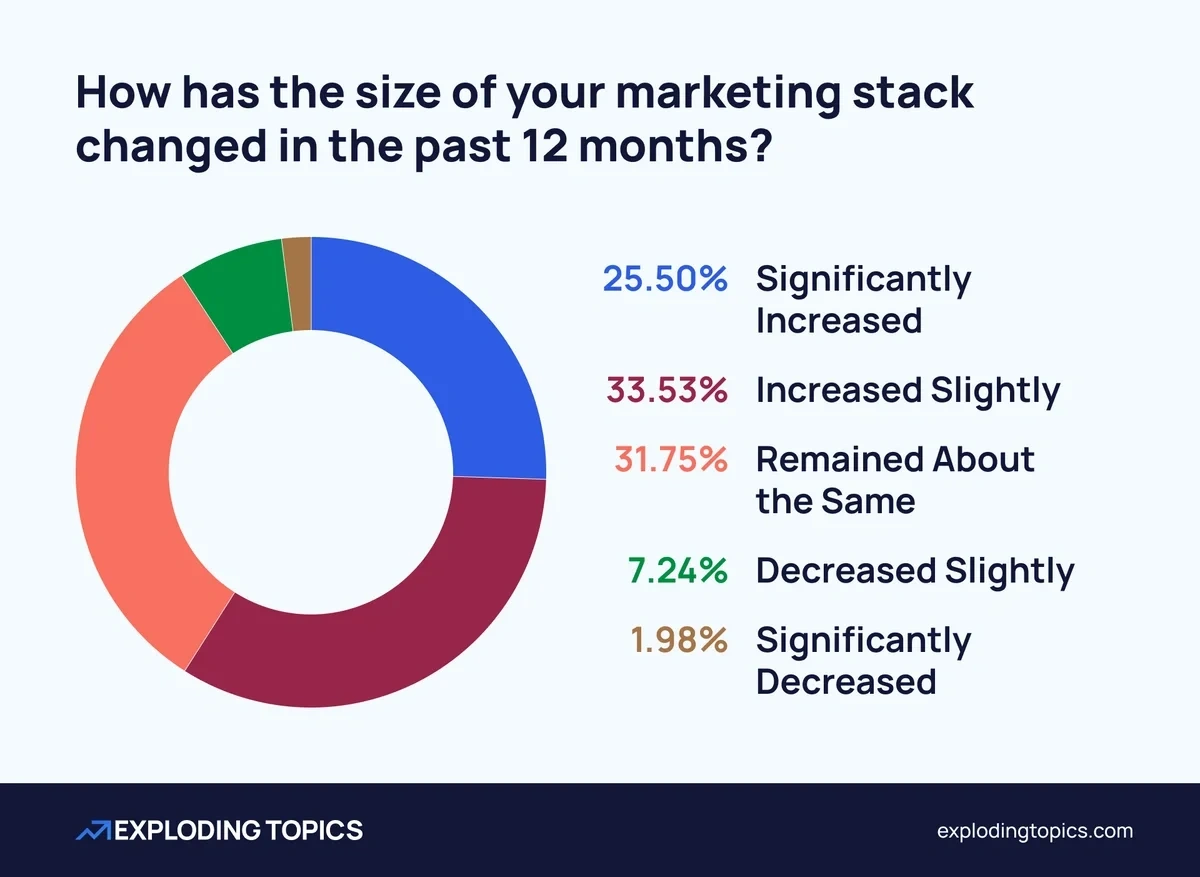
One thing departments of all sizes seem to have in common is that AI is not currently producing a smaller, more efficient marketing stack. Only 9.22% of respondents report that their stack has gotten smaller in the past 12 months.
On the contrary, 59.03% report at least a slight increase in the number of tools, signifying a shift toward more specialized software.
And the most aggressive adopters of AI (those who have replaced “lots” of subscriptions with AI alternatives) are actually by far the most likely to have increased the overall size of their marketing stack. 47.97% of this group have made significant increases in the past 12 months, and a further 35.12% have made slight increases.
By comparison, it’s the marketing departments yet to replace any of their subscriptions with AI tools that are most likely to have reduced the size of their stack.
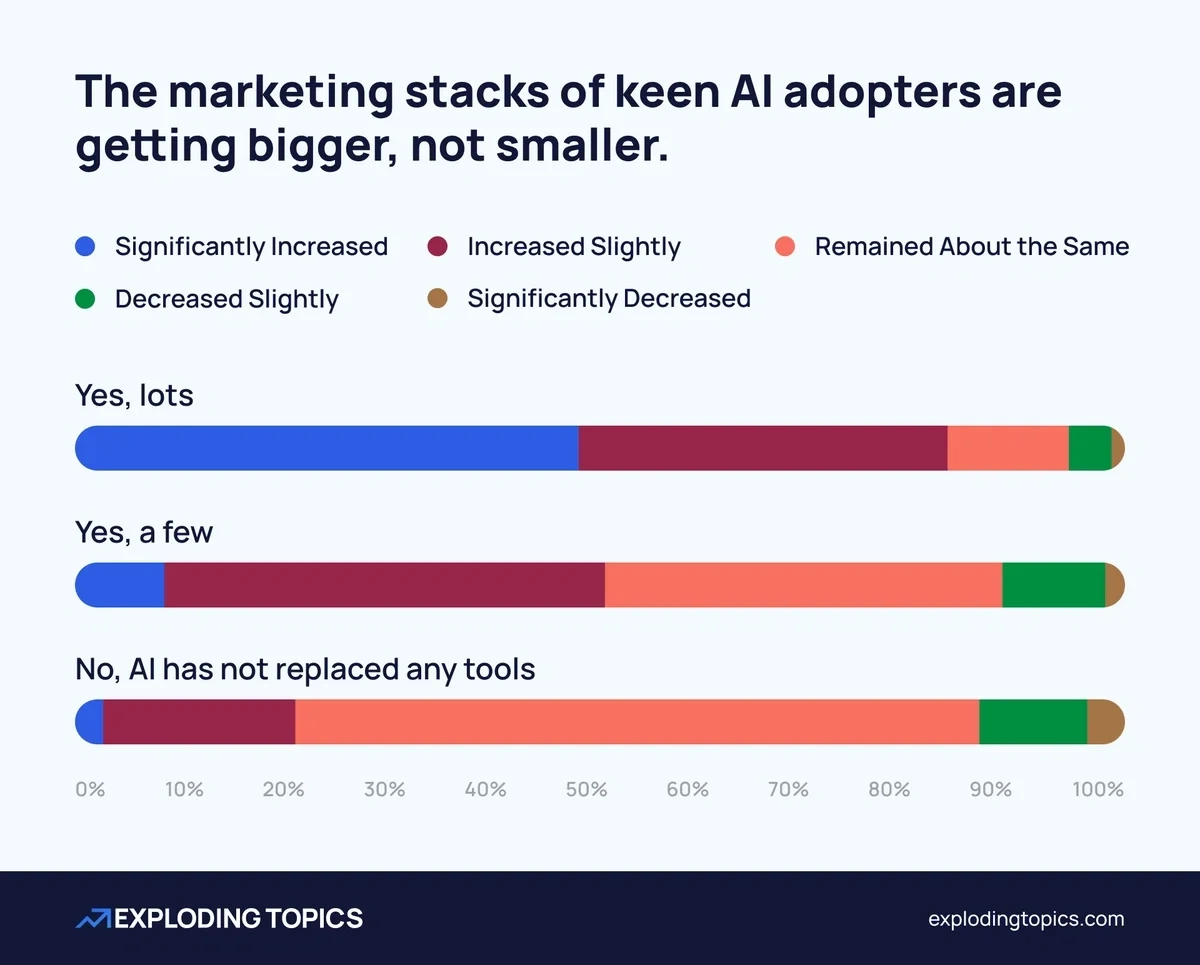
The bottom line at the moment is that more AI tools generally equals more tools overall.
Surge in marketing budgets… and new hires
So AI isn’t reducing the average marketing stack. And as it turns out, nor is it reducing budgets.
Only 16.37% of respondents said that the rise of AI has led to a decrease in their marketing budget. It was far more common (41.96%) to report an increase.
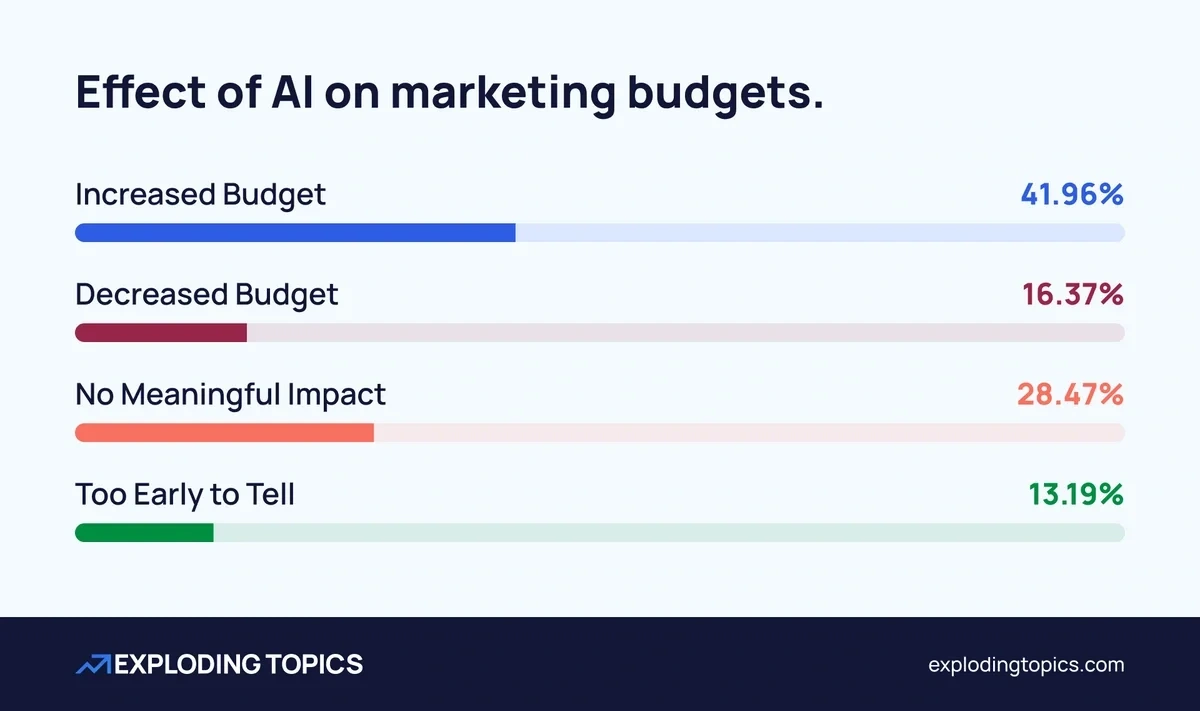
Of course, most marketing departments are still in the early stages of full-scale AI adoption. Understandably, a significant minority of respondents felt that there had been no meaningful impact on budgets yet, or that it was too early to tell.
But for those who have noticed an effect, AI generally isn’t being used as an excuse to cut costs. The West South Central region is something of an exception (34.02% reported decreased budgets), but the overall national picture poses a challenge to a persistent AI myth.
There is a perception that managers are too quick to assume they can automate marketing functions, and that these decision-makers view AI as an easy cost-saving measure. But the data shows that AI is typically an additional investment.
Having said that, there has still been a reallocation of resources away from existing marketing workflows. 40.28% of departments report that AI has caused a major budget reallocation.
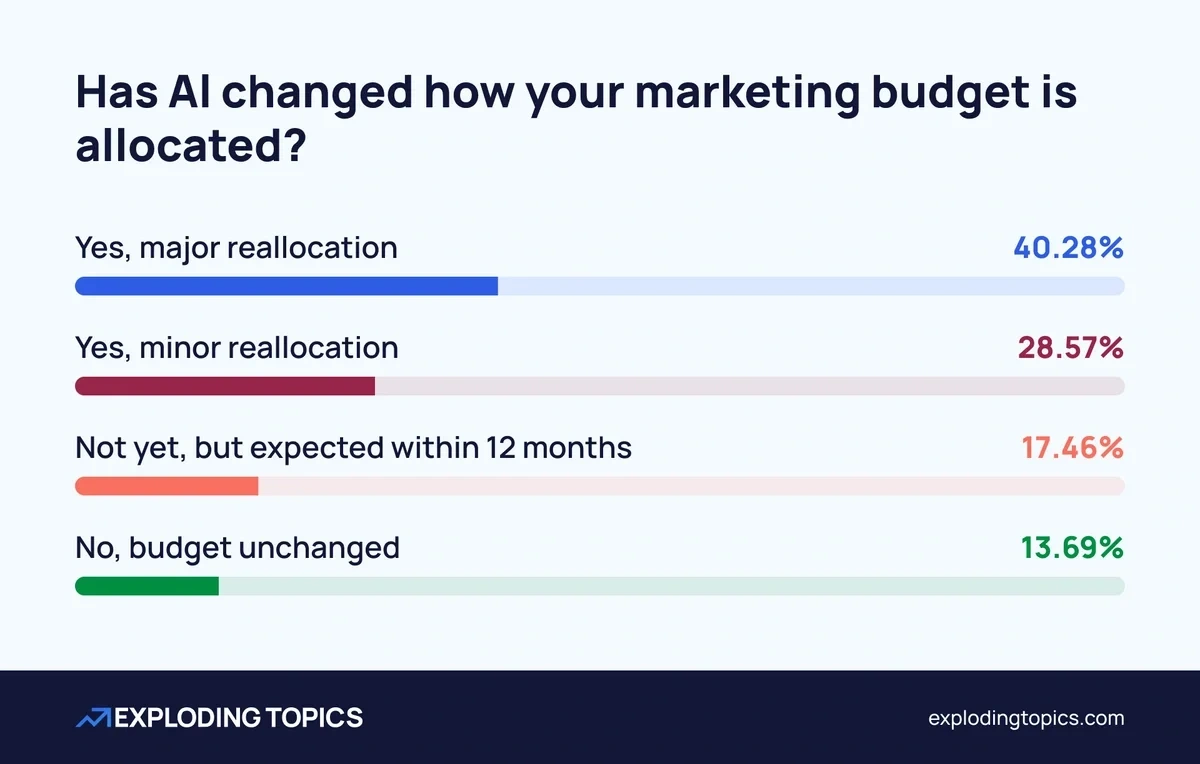
Counting those who anticipate change within the next 12 months, 86.31% of marketing departments are planning or executing AI-driven budget reallocations.
The team size paradox
However, marketing departments don’t seem to be replacing existing human labor with AI. In fact, 60.12% have actually expanded the size of their team within the past 12 months.
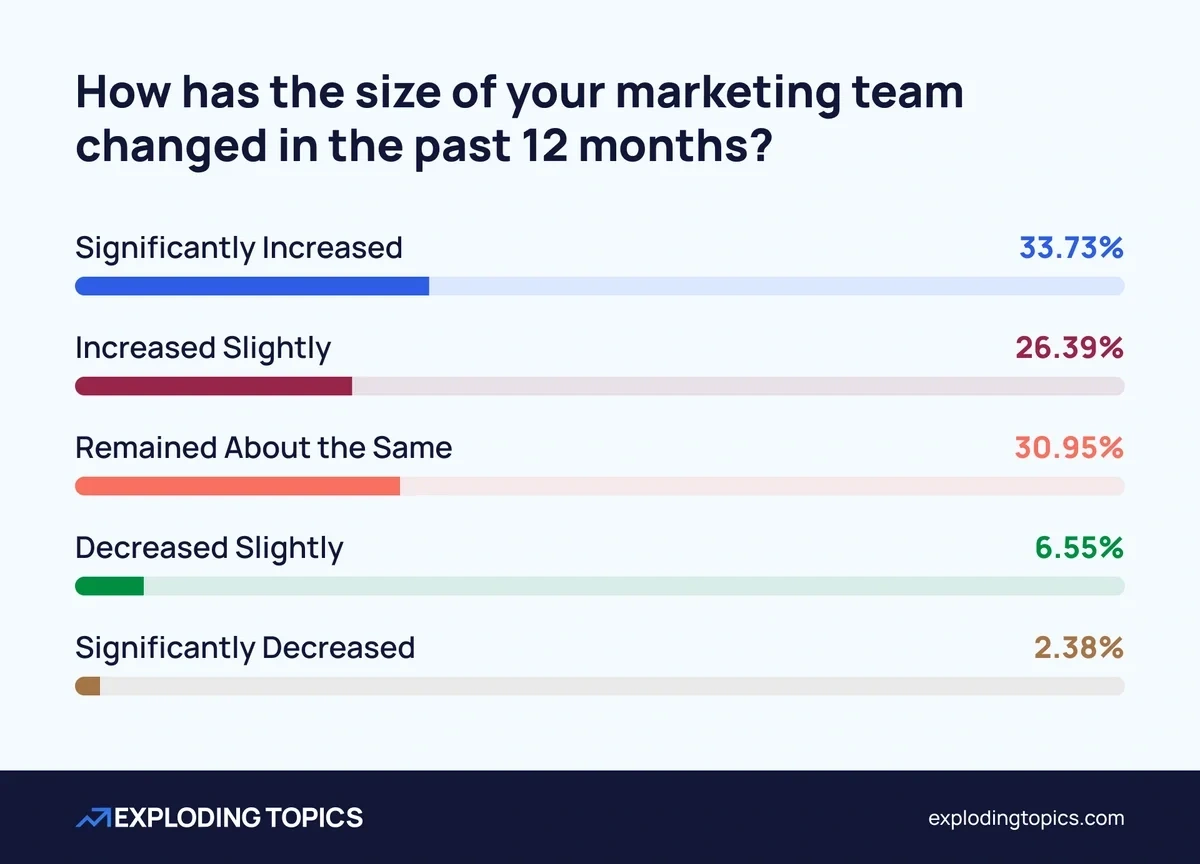
Only 8.9% of marketing departments have seen any sort of reduction in size. That’s quite remarkable against a national backdrop of 1.17 million job cuts in 2025, and within a sector that is clearly embracing AI tools.
And against all expectations, departments who are “doubling down” on AI are also by far the most likely to be significantly expanding their teams.
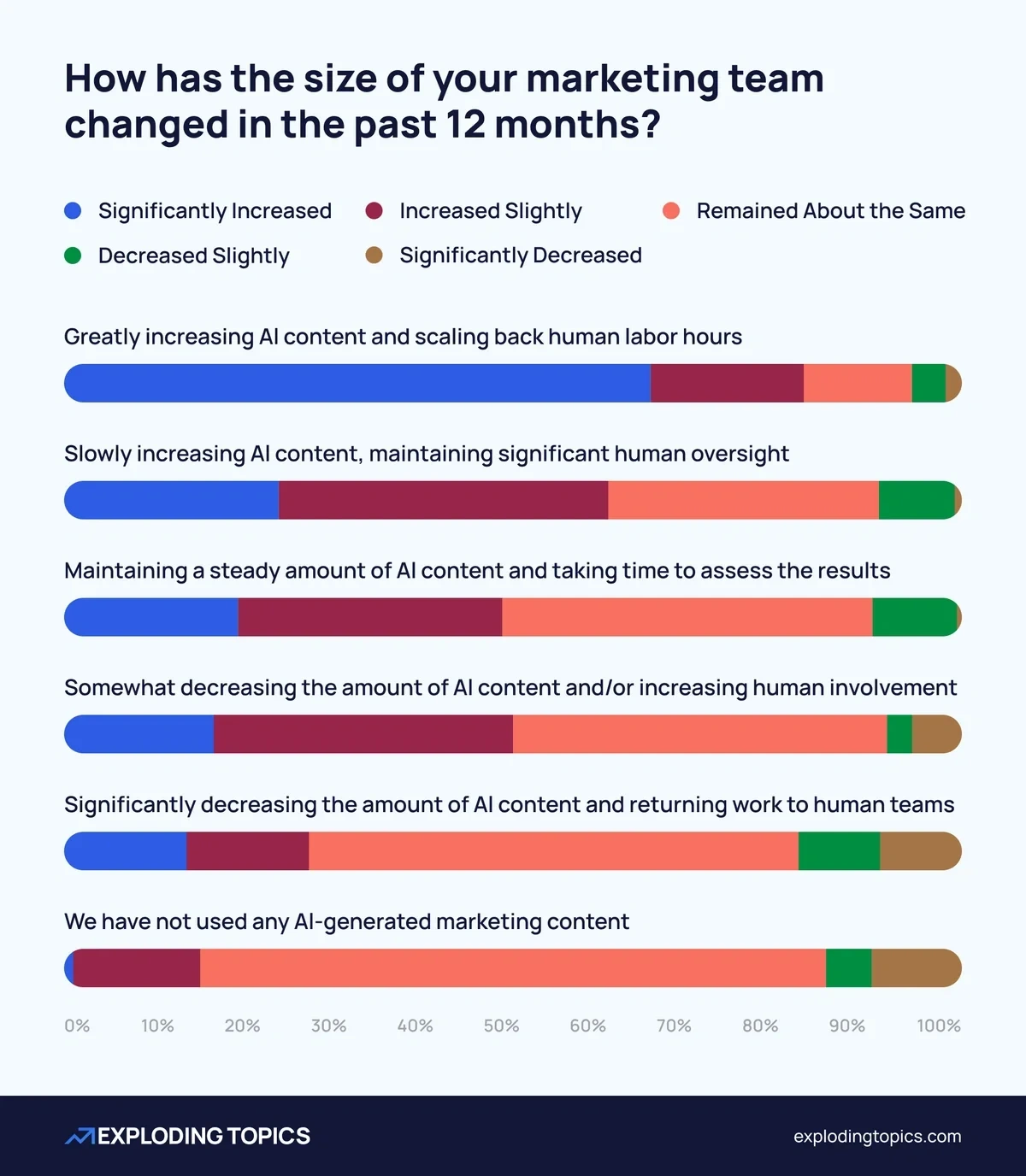
Intuitively, you would expect the AI “reversers” to be the ones increasing hiring, bringing more staff on board in order to undo overambitious automation plans. But only 27.28% of the departments that are fully reversing course on AI have expanded the size of their departments in the past 12 months.
54.55% of these AI backpedallers have retained roughly the same team size, and 18.18% have actually made reductions.
In stark contrast, 65.33% of the marketing departments going full steam ahead on AI have “significantly increased” team size in the last year. A further 17.03% have made slight increases, and only 5.58% have made any sort of reductions.
And as the above chart illustrates so clearly, AI adoption maps directly onto team expansion. At each increment of AI positivity, from reversing course through to doubling down, the percentage of teams who are significantly expanding their team size increases.
In another piece of our original research, we found that 43.31% of workers fear AI making them look replaceable to their employer. But at least in a marketing context, it appears these fears are largely unfounded for the time being.
What might be causing this phenomenon? There are a few possible explanations:
- Handling the vastly increased scales: As AI dramatically increases output volume, more human oversight and strategic direction is needed.
- AI-specific roles: Most marketing teams won’t be building bespoke AI tools in-house, but there may still be a need for some expert AI hires. For instance, marketers skilled in prompt engineering may be in increased demand.
- Two-tier marketing approach: It could be that the biggest AI adopters view the technology as excellent for generic marketing tasks. But if anything, that actually makes high-skill, human-led marketing even more important as a strategic differentiator. Automating one tier of marketing frees up more budget for another.
- Increased ROI expectations: Where AI delivers on its promises, increased revenues will follow. Traditionally, workforce expansion is a natural consequence (although this alone cannot explain specifically what marketing departments are hiring more people to do).
A combination of all these factors is probably at play in most cases. But the upshot is that AI-enabled marketing teams are getting bigger, not smaller.
AI changes marketing strategies
We’ve covered how AI is being used for marketing. But we also need to consider how the rise of AI is changing the very purposes of marketing.
For example, getting to the top of Google SERPs is a long-standing marketing goal. But with the dawn of AI Overviews and the increasing use of chatbots like ChatGPT, does that remain a top priority?
First and foremost, marketing departments are certainly aware of the need to appear in these next-generation searches. 71.52% have begun actively investing in influencing AI-generated answers.
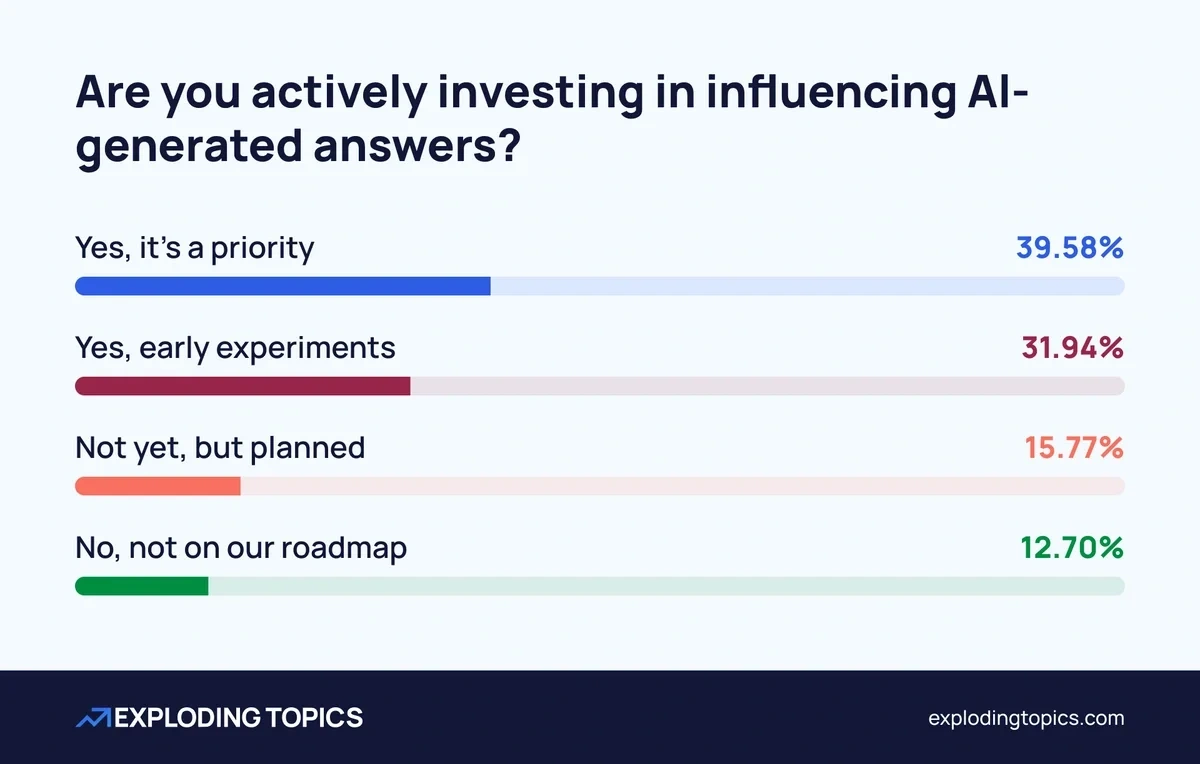
Another 15.77% are planning to start efforts to influence AI responses. That leaves just 12.7% of marketing departments with no plans to do so.
And AI optimization (AIO) is seeing some of the biggest budget increases.
Respondents were asked to select up to three marketing channels seeing the biggest budget uplifts. 36.61% selected AIO, behind only paid search (40.18%).
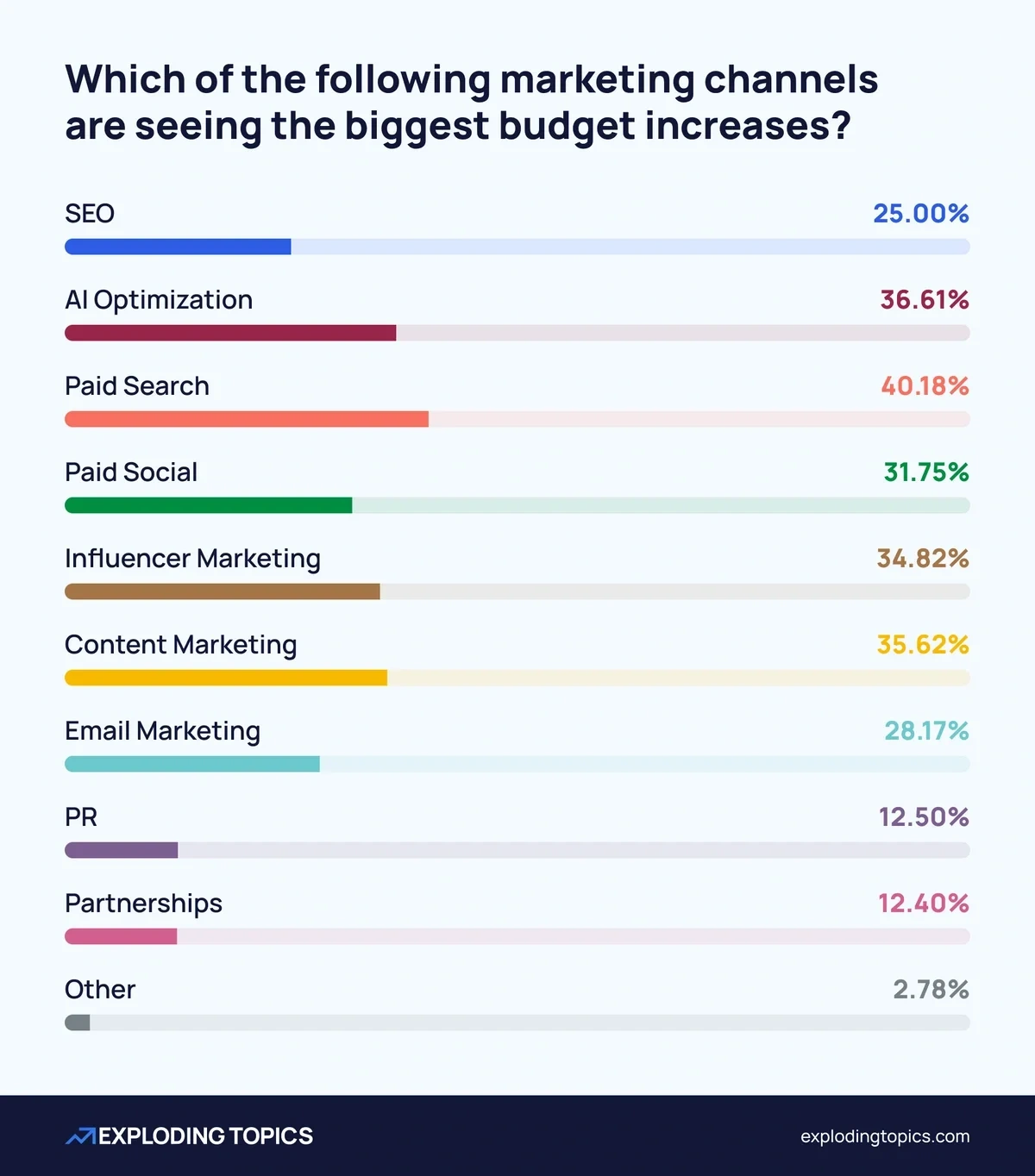
Notably, SEO is only seeing the biggest budget increases in 1 in 4 marketing departments. Only PR and partnerships are receiving a smaller share of budget boosts.
That tells a clear story of shifting priorities. With AI Overviews significantly increasing zero-click searches, marketers have been forced to reassess, and the current focuses are ads and AI.
The great platform shift
Another element of evolving marketing strategy is platform shift. AI is prompting decision-makers to refocus attention on new channels.
More than 95% of respondents said that they redistributed their platform investment in 2025. The number one reason for doing so was “influence in AI search or AI answers” (45.44%).
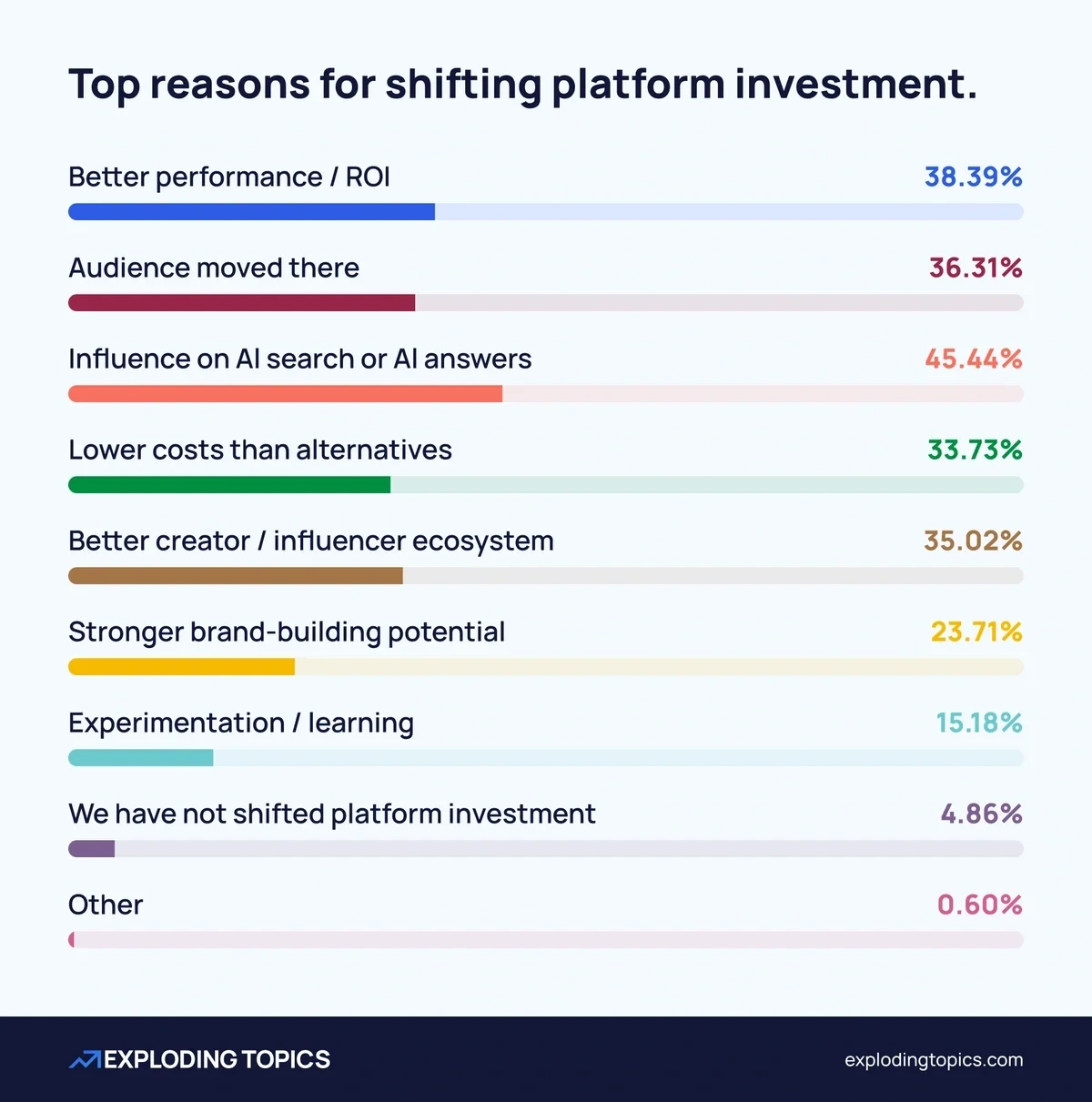
Other common reasons for refocusing included better performance/ROI (38.39%), moving audience (36.31%), and a better creator/influencer ecosystem (35.02%).
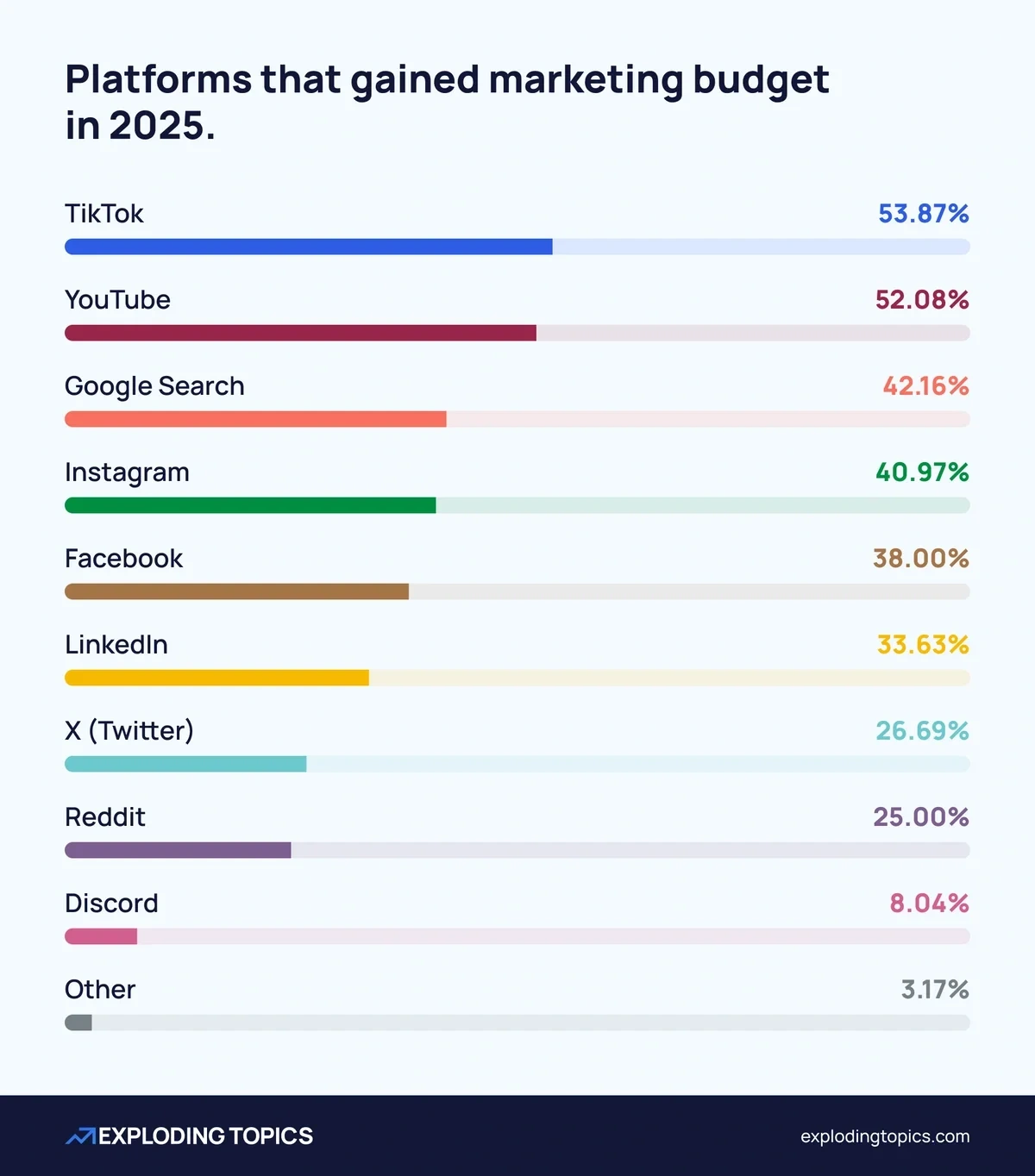
Interestingly, however, attention is not shifting uniformly from one platform to another. For instance, TikTok topped the charts for both gaining budget (53.87%) and losing it (35.52%).
TikTok, YouTube, and Google Search were the top budget gainers:
But TikTok and Google Search featured in the top three again for losing budget:
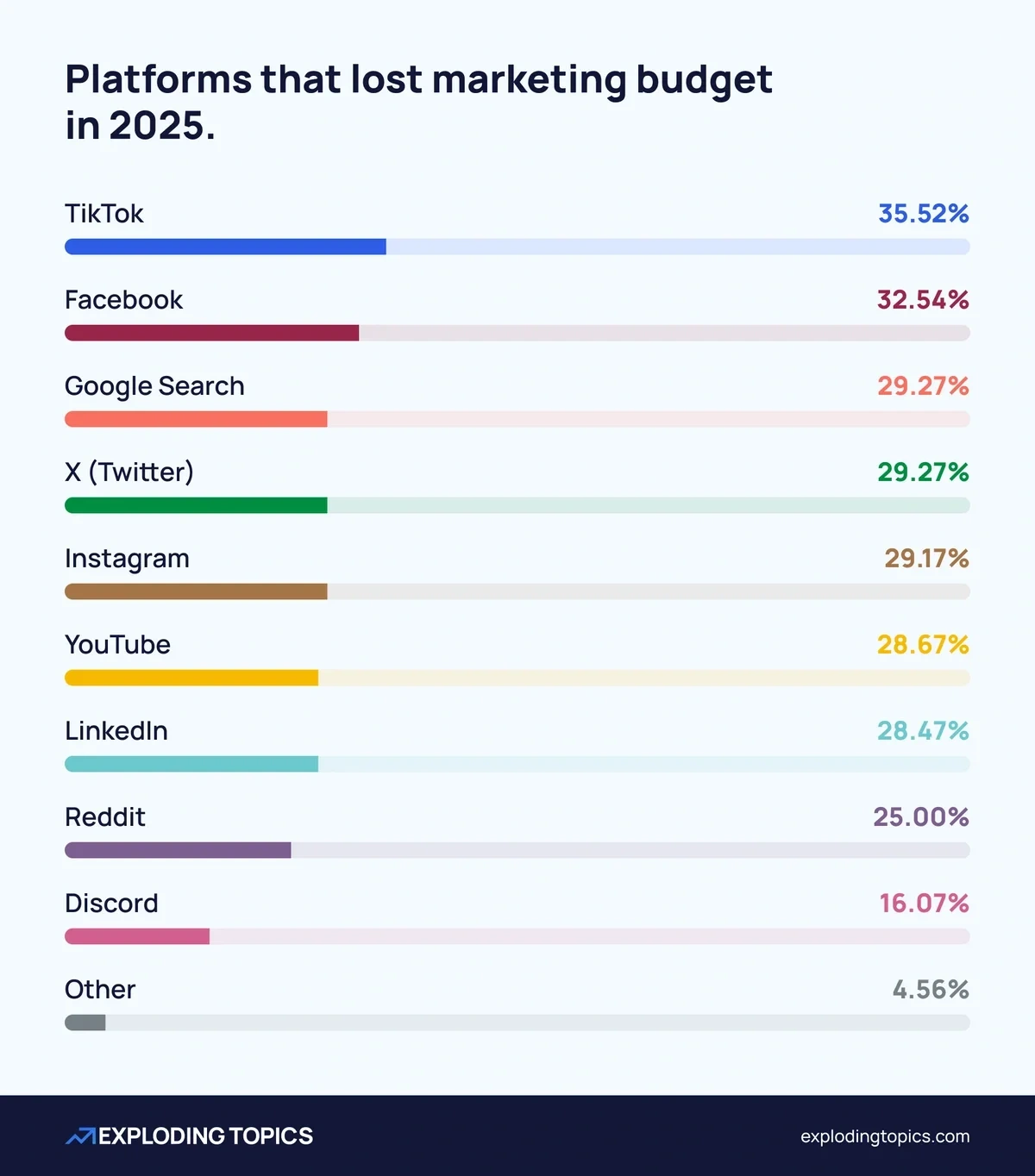
The number of platforms that place similarly in both lists illustrates the absence of a single winning playbook in 2026. Most platforms seem to be working well for some marketing departments but not others, and there is high churn as marketers try to find the winning formula.
One potential exception is X, which did not make the top 5 for gaining budget, but was ranked 4th for losing budget. That suggests a net exodus away from Elon Musk’s platform among marketers.
Meanwhile, YouTube stands out as a more universal winner. Only 28.67% of marketing decision-makers are deprioritizing Alphabet’s video platform, whereas 52.08% are assigning it more budget.
As well as being quite a known quantity amid instability elsewhere, YouTube has the benefit of being a top source for Gemini, so brand efforts on the platform can have a knock-on effect on AI visibility.
When posting to social media, most marketers are focused on building brand social accounts. 41.37% say this is their main emphasis.
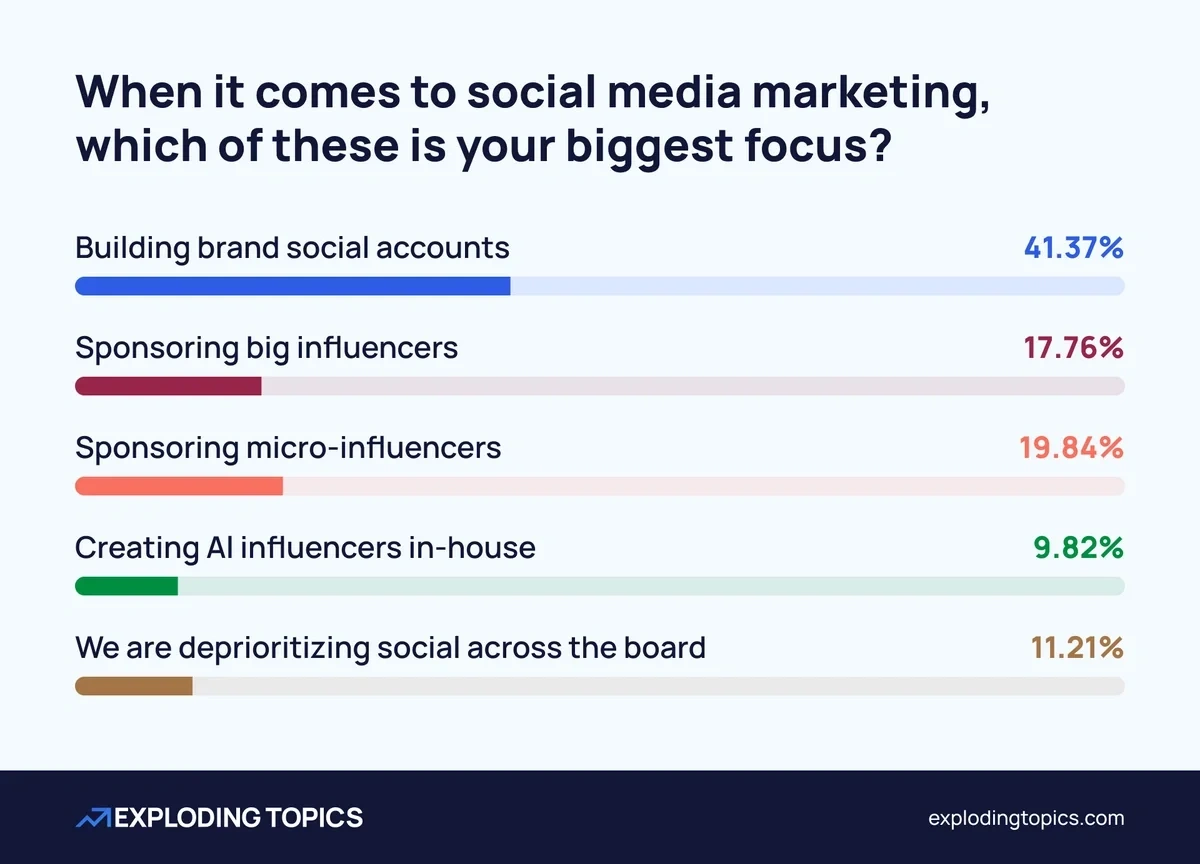
Micro-influencers (19.84%) are slightly more likely to be a main focus than big influencers (17.76%). Meanwhile, a little over 1 in 10 departments are deprioritizing social media altogether.
And while AI is vastly changing the marketing landscape in many ways, AI influencers are yet to become a mainstream strategy. Fewer than 10% of marketing decision-makers are focused on creating them in-house.
Planning for the future
Amid all of this uncertainty, what do marketers plan to do next? Most departments are actively experimenting, committing more funds to pilot projects.
A third of decision-makers (33.23%) are “significantly increasing” the budget assigned to pilot schemes, with another 26.69% “somewhat” increasing budget. Less than 8% are reducing their budget for running experiments.
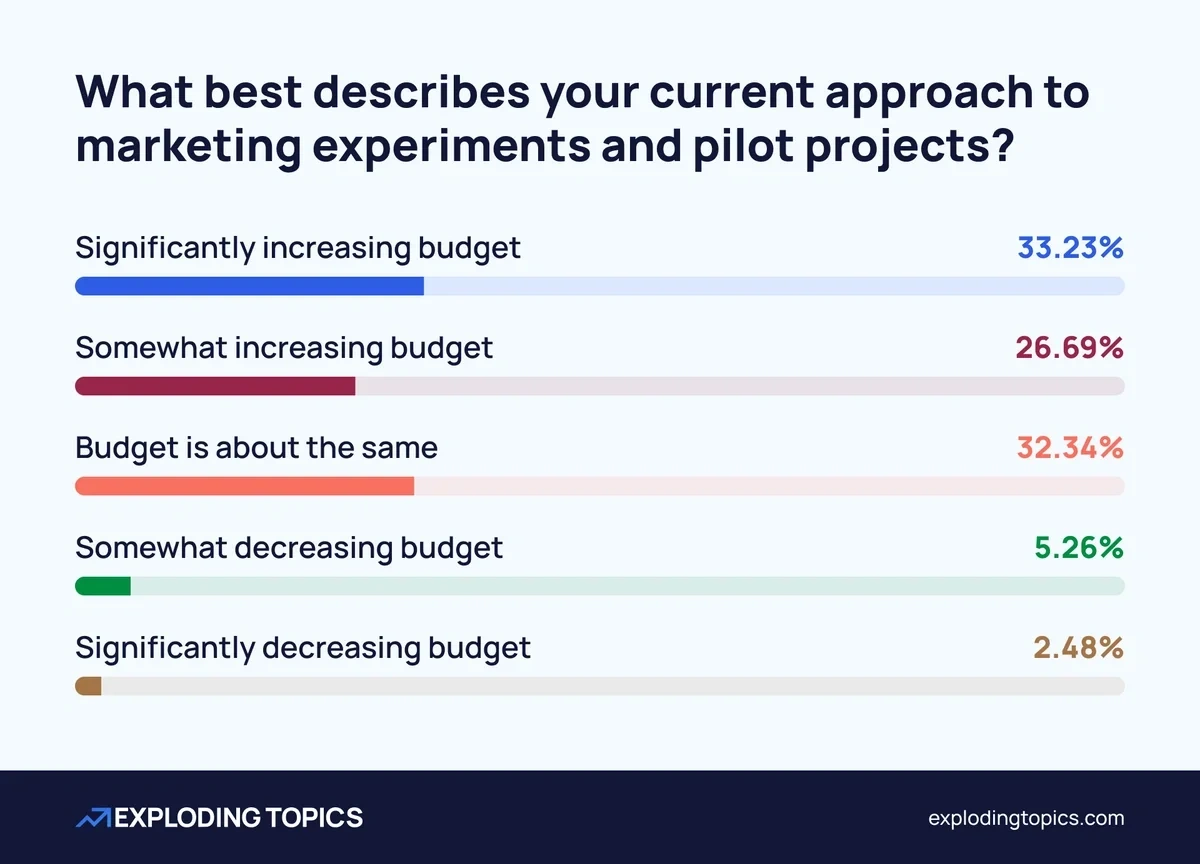
This ties into the significant platform churn we observed. To a certain extent, marketers are just having to throw things at the wall and see what sticks.
However, if there is one thing that stands out as “future-proof”, it is AI.
We asked all of our 1000+ respondents to note down the marketing budget line item that feels most future-proof. AI was the clear recurring theme.
On the other hand, “human” and “people” also appeared in a non-trivial number of responses. “Human employees”, “human touch”, “human oversight”, and “human content” were all submitted as answers.
It’s also notable how prominently “none” featured, further underlining the sheer extent of uncertainty at present.
Attribution: Still trusted, less relied upon
As marketers step up pilot schemes and move to new platforms, how confident are they in their ability to see what is and isn’t working?
It certainly feels as though rising zero-click searches and relative intangibles like AI brand sentiment should have made things harder for marketers, compared to long-standing click-based approaches to attribution.
However, 82.73% of respondents reported that leadership is at least somewhat confident in current attribution models. 43.25% reported being very confident.
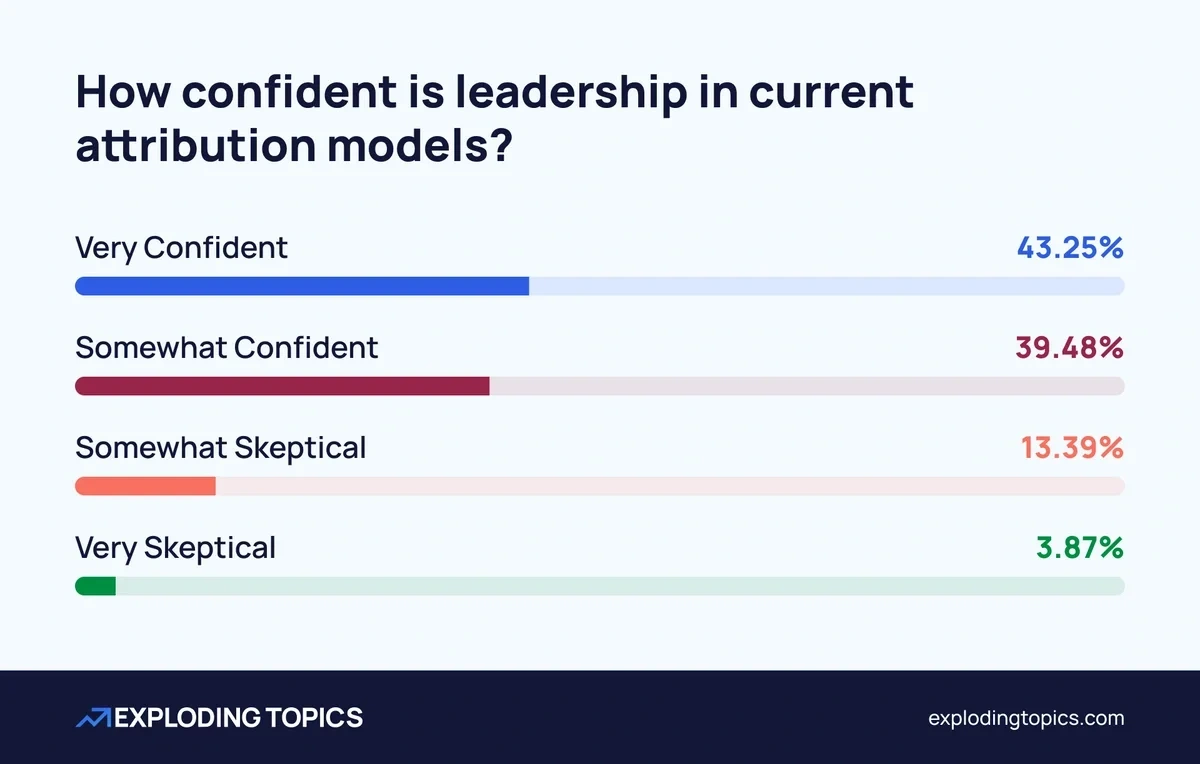
Of course, you could argue that more than half of marketers feeling less than “very confident” does show some level of disruption within attribution. But it was surprising to see less than 1 in 5 respondents report any kind of skepticism.
And confidence in attribution is much higher among marketing departments who are actively trying to influence AI-generated answers.
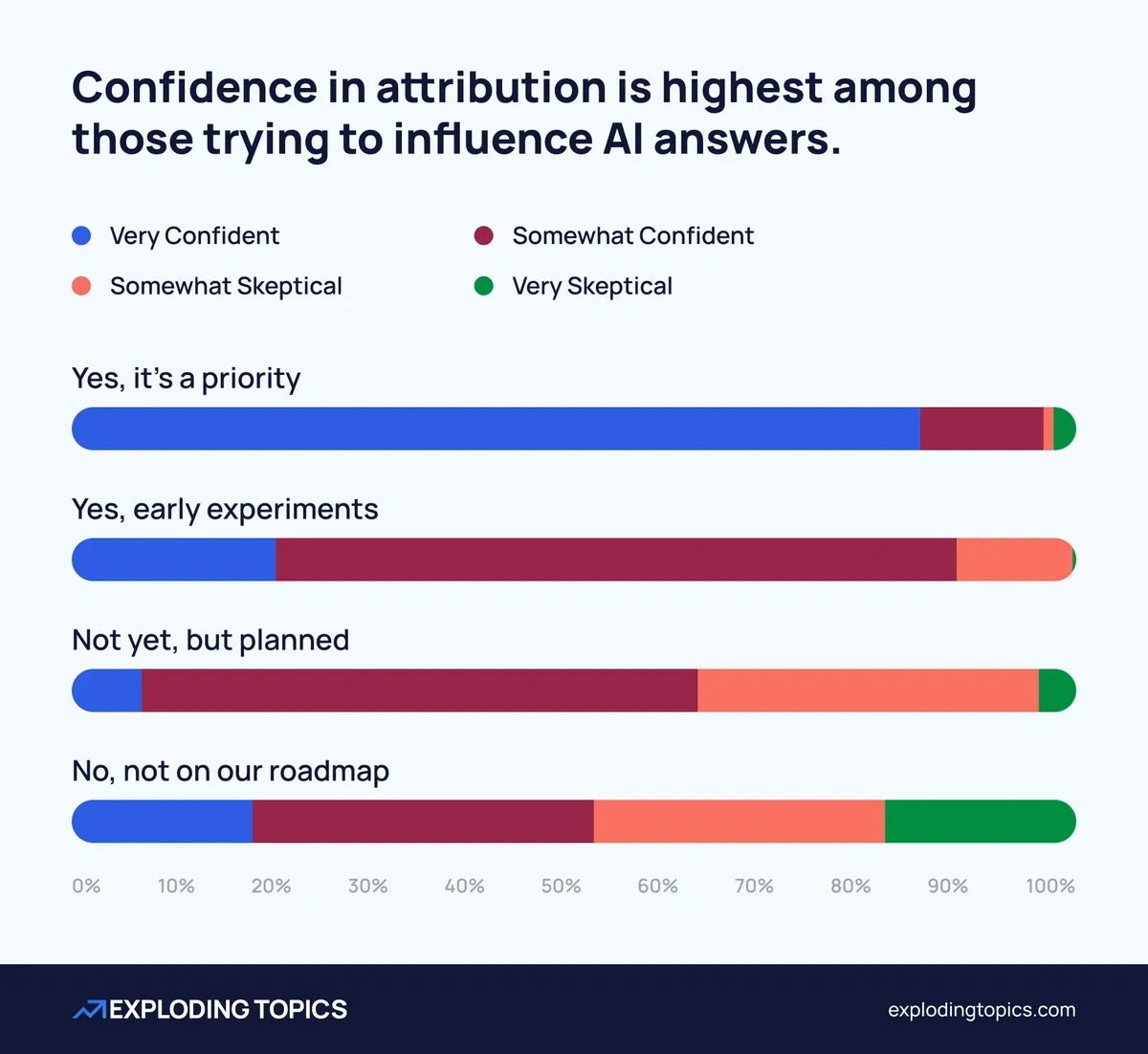
Among the decision-makers placing a priority on influencing AI-generated answers, 84.46% said they were “very confident” in current attribution models. Just 3.26% voiced any sort of skepticism.
By contrast, attribution skepticism among those not even planning to try and influence AI answers reached 47.66%.
This suggests that marketing departments yet to react to “the great decoupling” (an AI-fuelled rise in impressions and drop in clicks) are most likely to feel as though attribution is broken. But marketers who are proactively addressing the new era of AI searches are finding that they are able to quantify their efforts. Tools like Semrush Enterprise AIO are providing increasingly sophisticated solutions.
[cta:custom type="button" heading="Get AI On Your Side" cta_label="Analyze Your AI Visibility Now" url="https://www.semrush.com/semrush-ai-toolkit"]
The shift to less directly attributable channels
Despite continued faith in attribution among most marketers, there is also a shift toward channels with less directly attributable revenue.
More than 1 in 3 (37.3%) marketing departments are significantly increasing investment in channels like brand, PR, community, and AI visibility.
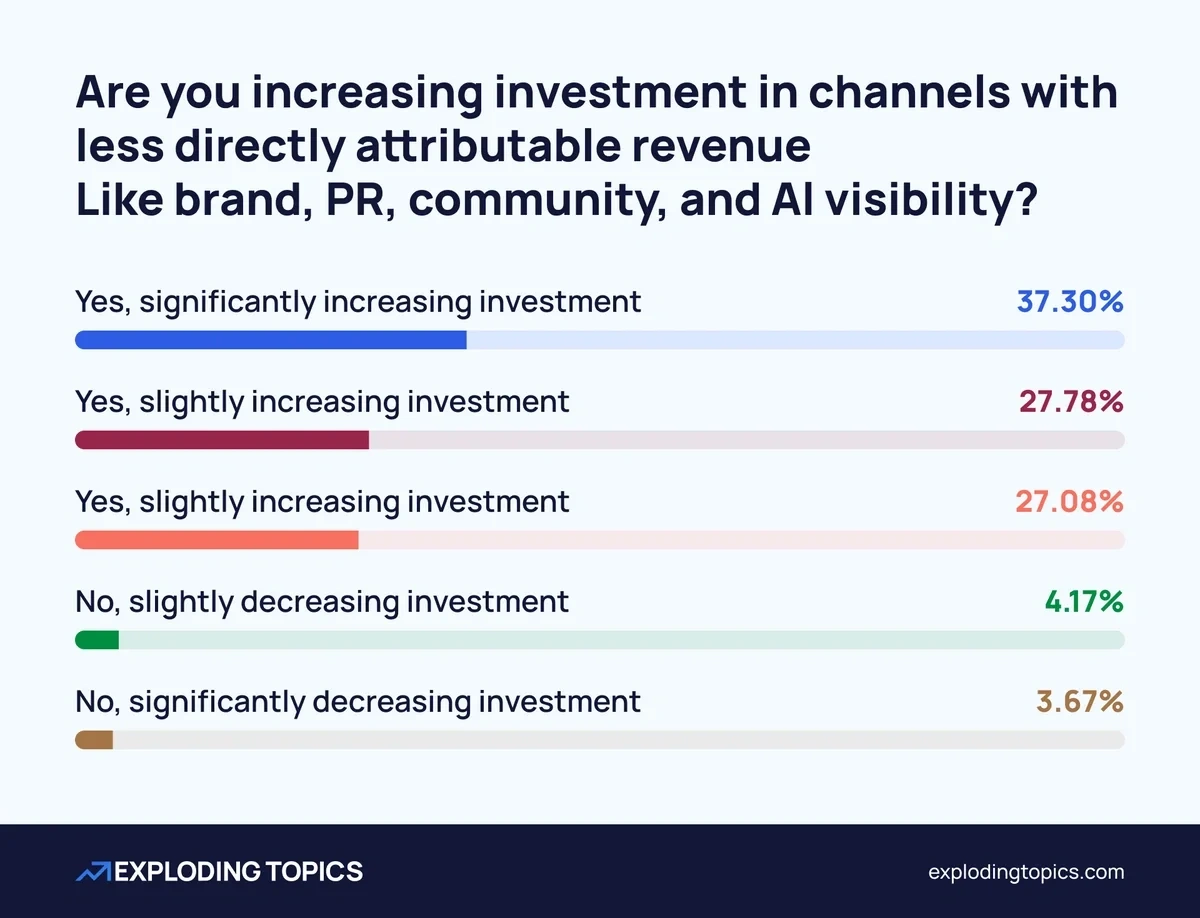
Including those who report a “slight” increase in investment, 65.08% of decision-makers are increasing spend on channels with less directly attributable revenue.
And while a reasonable minority (27.08%) are keeping investment roughly the same, only 7.84% are funnelling investment away from these channels.
Crucially, it appears that willingness to spend on these less attributable channels is closely linked to confidence in attribution models.
Among marketing leaders with high confidence in attribution models, 76.15% are “significantly increasing” spending on channels with less directly attributable revenue.
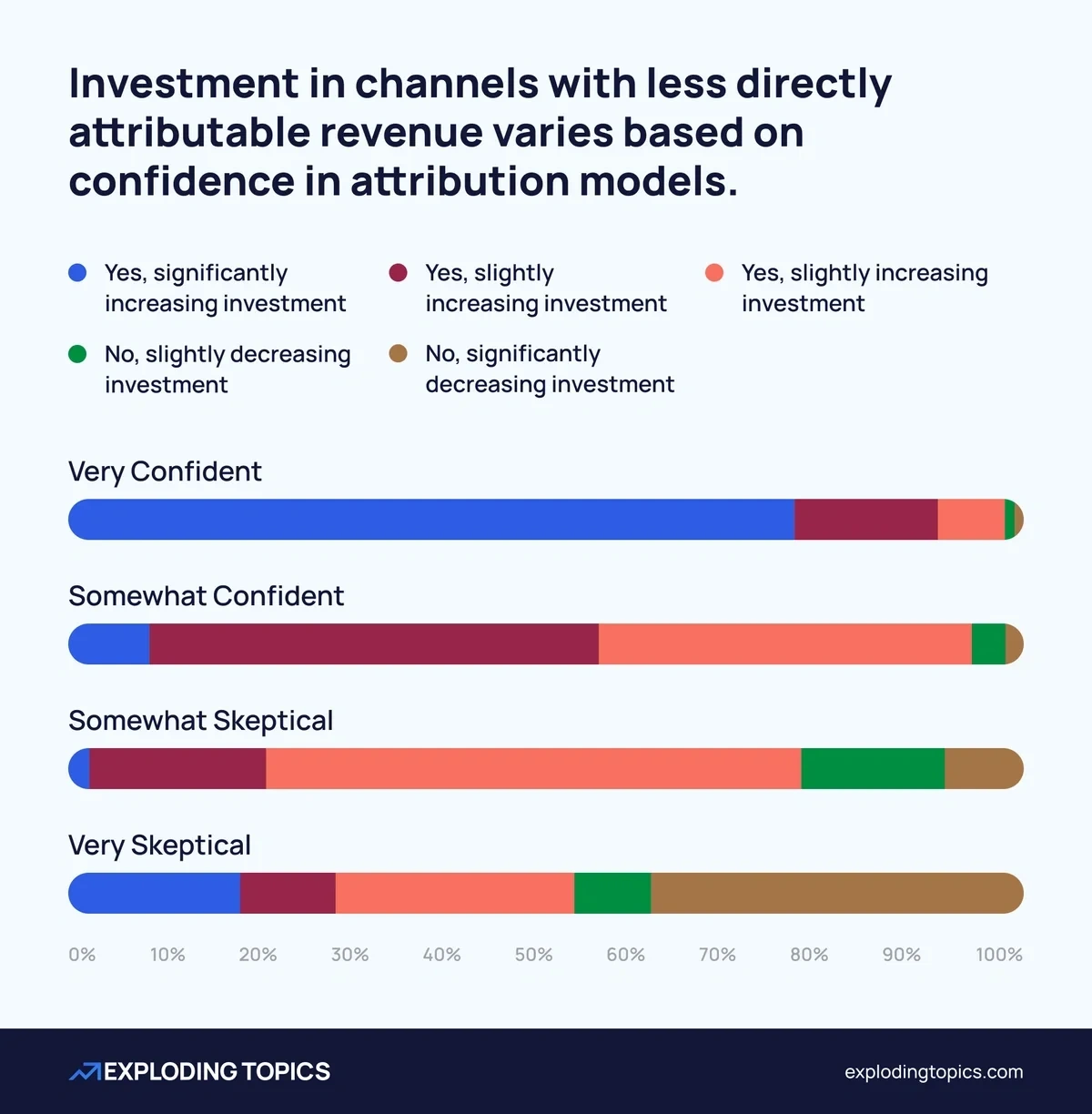
At the other end of the spectrum, 46.15% of respondents who were “very skeptical” about attribution models are also moving investment away from channels where attribution is hardest.
So why would greater faith in attribution trigger more spending on less attributable channels?
In some cases, marketing leaders are presumably satisfied that they have attribution models that can adequately account for channels like AI visibility. This essentially provides the data-backed “permission” to spend.
Alternatively, effective tracking of the channels with more directly-attributable revenue could be providing the headroom to experiment with other channels.
Sure enough, 88.36% of decision-makers who are significantly increasing investment in experiments and pilot projects are also significantly increasing investment in channels with less directly attributable revenue.
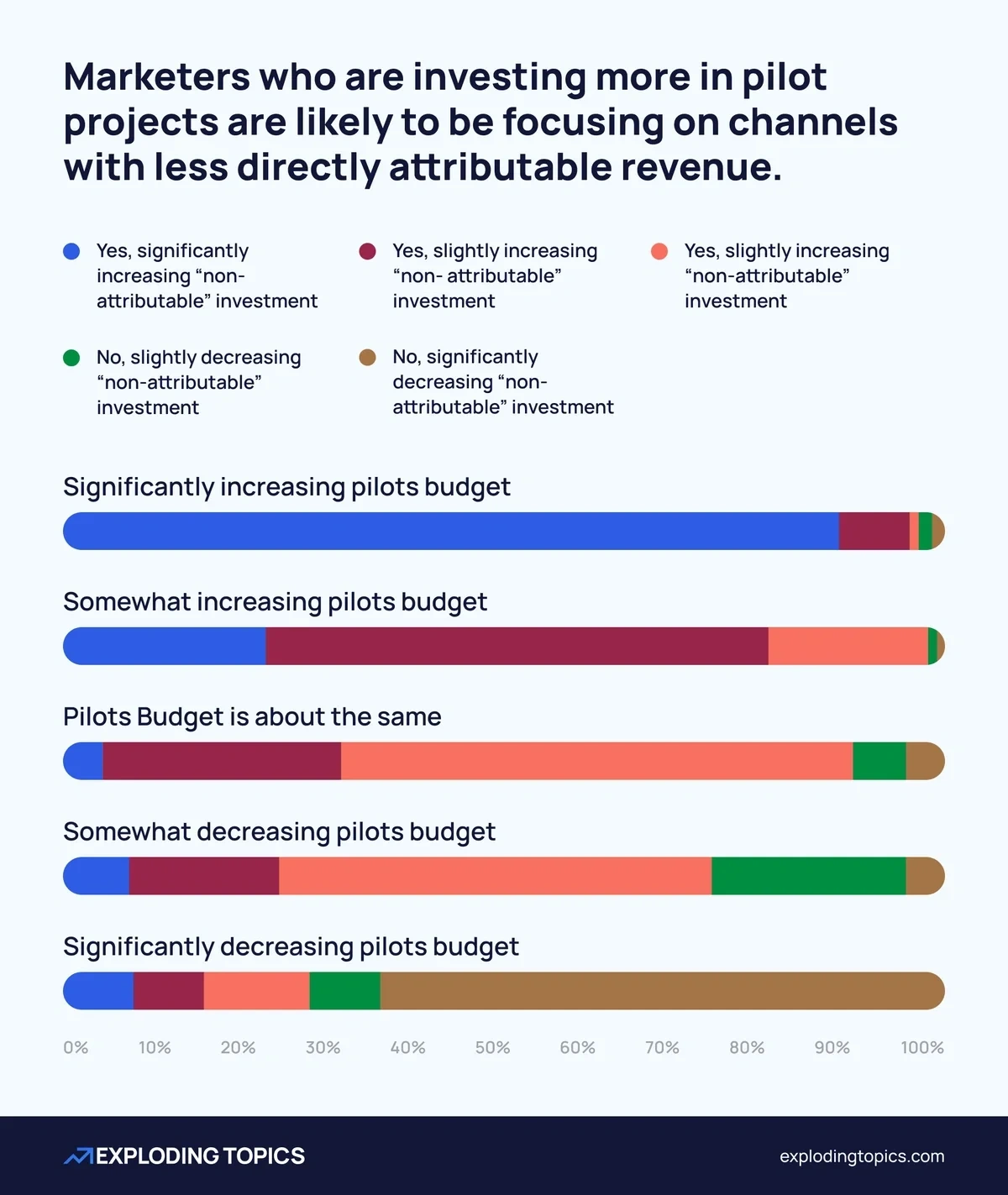
Those who are significantly decreasing investment in pilot projects are also mostly drawing back from less attributable channels.
The reality of AI and marketing
Our hard data from marketing leaders has certainly underlined the significance of AI. But it has also busted some prevalent myths.
And the real, on-the-ground situation is even more fascinating than some of the narratives that have been weaved. It paints a striking picture: AI is not the efficiency play envisaged by many, it’s an expansion play.
To sum up:
- Marketing departments embracing AI are spending more and hiring more
- Three-quarters of marketers have replaced some tools with AI, but stacks are getting bigger, not smaller
- Marketing leaders actively trying to influence AI-generated answers are more likely to trust their attribution models, and spend more in turn on experiments and pilots
It’s the marketing departments yet to embrace AI that are more likely to find their backs against the wall in terms of weak attribution models, declining budgets, and shrinking teams.
Platforms like Semrush Enterprise AIO can help you get to grips with the AI era, handing you back control of attribution and providing the data you need to start embracing expansion. Request a demo today.
Methodology
This survey was put to 1,837 respondents. Of those, 1,010 were marketing budget decision-makers, and 1,008 proceeded to complete the full survey.
35.18% were marketing managers, 26.76% were marketing leaders (CMO/VP/Head of Marketing), 21.11% were founders or CEOs, and 12.49% were consultants or agency workers. “Other” accounted for 4.46% of responses.
49.6% of the marketing decision-makers surveyed were male, and 50.2% were female. Respondents were drawn from all major US regions (there were no responses from US territories).
20.02% of respondents managed budgets of under $100,000. 26.76% managed budgets between $100,000 and $500,000. 31.22% managed budgets of $500,000 to $2,000,000. 15.16% managed budgets of up to $10,000,000, and 6.84% managed budgets in excess of $10,000,000.
Stop Guessing, Start Growing 🚀
Use real-time topic data to create content that resonates and brings results.
Exploding Topics is owned by Semrush. Our mission is to provide accurate data and expert insights on emerging trends. Unless otherwise noted, this page’s content was written by either an employee or a paid contractor of Semrush Inc.
Share
Newsletter Signup
By clicking “Subscribe” you agree to Semrush Privacy Policy and consent to Semrush using your contact data for newsletter purposes
Written By


James is a Journalist at Exploding Topics. After graduating from the University of Oxford with a degree in Law, he completed a... Read more