Exploding Topics
Remineralizing Gum search volume grew from under 100 to 27,100 monthly searches between February 2024 and January 2026.
Remineralizing gum
+5100%
GLP 1 Supplement search volume grew from 5,920 to 74,000 monthly searches between February 2024 and January 2026.
GLP 1 supplement
+1150%
Soursop Bitters search volume grew from 9,900 to 110,000 monthly searches between March 2024 and February 2026.
Soursop bitters
+1011%



Get Advanced Insights on Any Topic
Discover Trends 12+ Months Before Everyone Else
How We Find Trends Before They Take Off
Exploding Topics’ advanced algorithm monitors millions of unstructured data points to spot trends early on.

Keyword Research
Performance Tracking
Competitor Intelligence
Fix Your Site’s SEO Issues in 30 Seconds
Find technical issues blocking search visibility. Get prioritized, actionable fixes in seconds.
Powered by data from
Latest Blog Posts
Featured Case Studies
See what's trending before everyone else
Each week, we'll send you our best Exploding Topics. Plus, expert insight and analysis.
How to do Thought Leadership on LinkedIn

 Add Exploding Topics on GoogleAdd Exploding Topics as your preferred source to see more of our stories on Google.
Whether you’re looking to establish a personal brand or seeking to build corporate credibility, thought leadership is a powerful medium. And LinkedIn is the backdoor marketing channel you may be guilty of totally neglecting.
When you hear thought leadership, you might think of op-eds in leading publications. But with zero barriers to entry, and direct access to your intended business-focused audience, LinkedIn is a great place to start building your credentials as a strategic thinker within your chosen niche.
Without ever plugging your product or flaunting your resume, you can show your target market that you and your brand deserve to be taken seriously. But with AI slop flooding LinkedIn more than just about any other platform, it can be difficult to know how to stand out from the crowd.
Fortunately, there are some simple ways of using technology to help you, without farming out the critical thinking to AI. Everyone has access to ChatGPT, but only you can add truly original value to the conversation.
So if you want to know how to fake thought leadership on LinkedIn, you’re in the wrong place. But if you’re looking to maximize the impact and reach of your insights on the platform, with some pointers on where to start, then this is the guide for you.
What is Thought Leadership?
Thought leadership is the process of establishing yourself as a leading authority within your niche by publishing media that showcases your original insight on prominent topical issues. When done well, your reputation will precede you with potential future clients and/or employers.
“Thought leadership” searches have increased by 379% in the last 5 years.

I’ll admit that the phrase “thought leadership” sets off my corporate jargon alarm. But the idea behind it is deceptively simple and effective.
The potential benefits are both individual and collective:
- Individual: As your reputation within your chosen industry grows, you may find that employers start coming to you with opportunities. Even if you aren’t getting head-hunted, you’re creating an online footprint that will look good when hiring managers come to consider you.
- Collective (for founders/CEOs/senior leaders): Your company image improves by association. Clients feel more inclined to give you their business because they can see that a genuine industry expert is at the helm. And if your thought leadership highlights industry problems, your audience will assume that your products are designed to tackle those pain points.
If you can produce effective thought leadership as a business leader, you’re getting free marketing. And it’s the best kind of marketing: organic, light-touch, and highly targeted at your intended audience.
According to Edelman, 73% of B2B decision-makers believe that an organization’s thought-leadership content is a more trustworthy basis for assessing its capabilities than its formal marketing materials.
LinkedIn, AI, and Thought Leadership
It’s all well and good saying that you should aim to become a leading voice within your industry. While that might be good advice, it runs the risk of being trite.
But while not everyone can become preeminent thought leaders, with entire sectors hanging off their every word, anybody can make a start. That’s where LinkedIn comes in.
You don’t need any kind of established baseline to start producing thought leadership on LinkedIn. You can skip the pitches to industry publications, and you won’t need to wait on a podcast invite: you just start writing.
(And if all goes well, LinkedIn could be your ticket into these other forms of media.)
However, the lack of barriers to entry does mean that you’re losing an important quality filter. LinkedIn has become renowned for its high levels of AI-generated content: some estimates suggest more than half of all posts on the platform are likely created by AI.

Clearly, AI is a very powerful tool. And there’s certainly nothing wrong with using it to help spark inspiration, carry out research, and tighten up your prose.
But if your “thought leadership” carries all the hallmarks of AI writing, how can you expect fellow industry professionals to conclude that you are a stand-out master of your craft? Rather than showcasing your original insight, it runs the risk of implying a lack of it.
But the good news is that with so much generic, pseudo-thoughtful content on LinkedIn, it only takes a little bit of work to genuinely stand out. And there are ways of using technology to your advantage without entrusting your corporate voice to ChatGPT.
Finding Topical Subjects for LinkedIn Thought Leadership
If you’re thinking about how to go about producing thought leadership, the chances are that you already believe you have something valuable to add to the conversation within your industry. You don’t just wake up and decide to be a thought leader if you don’t have anything to say.
That’s a great starting point, and your own industry knowledge and perspective should always be the backbone of the content you produce. It should go without saying that if you’re attempting to showcase your expertise, you need to stick to subject matter you know well and have genuine opinions about.
That being said, if you want to see those lightbulb “insightful” reactions pouring in, you’ll want to generate thought leadership content ideas that are on the pulse.
For instance, let’s say that you’re in the productivity technology sector. A quick look at the “workplace” section of the Exploding Topics database provides some excellent jumping-off points.
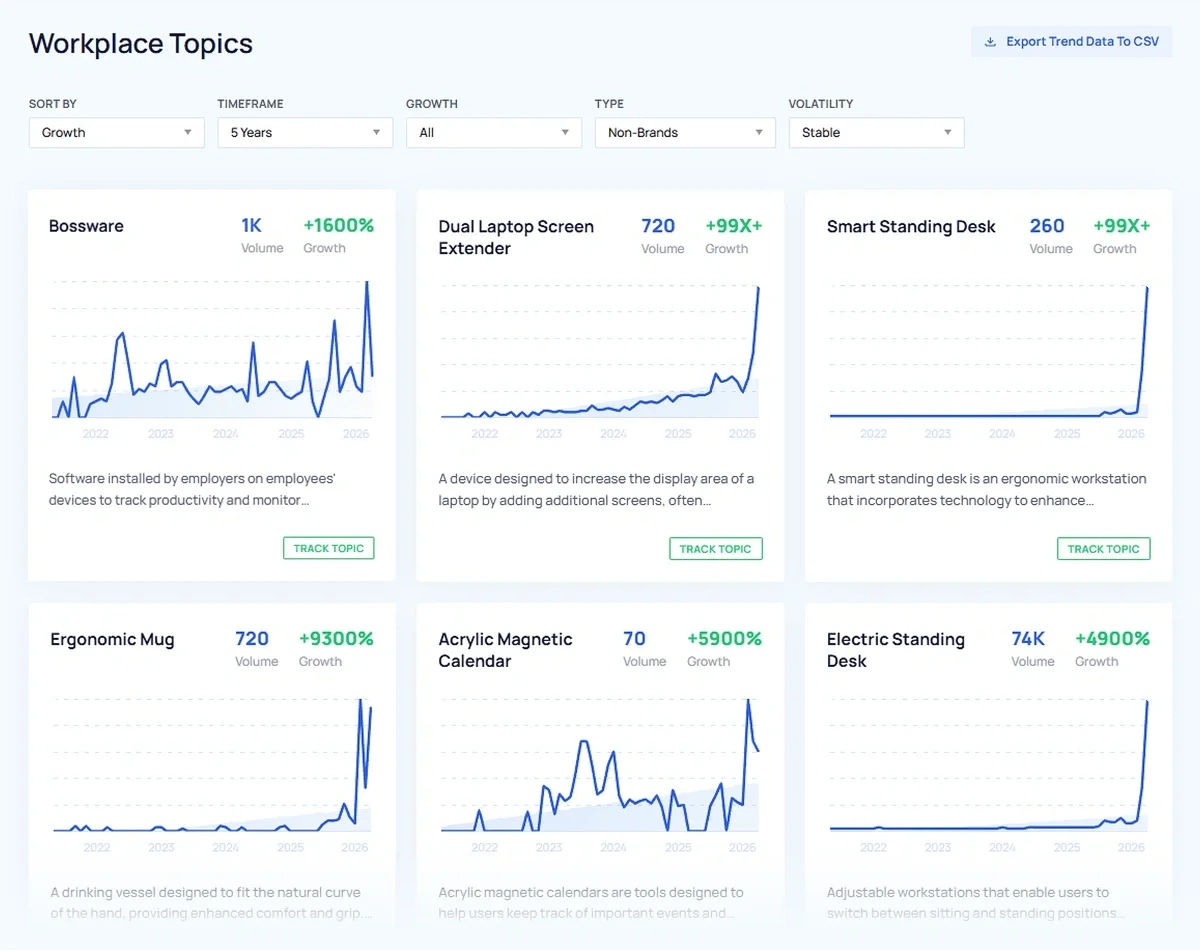
“Bossware” (software installed on work devices to track employee performance) seems particularly promising. It’s timely, topical, and likely to invite diverse perspectives.
That latter point is particularly important. After all, if nobody could reasonably disagree with your post, it probably isn’t thought leadership.
This is where you’ll really stand out from would-be thought leaders who think all they have to do is run a topic through AI and paste the output on LinkedIn. You’ve still made use of technology to make sure you’re writing about something your audience cares about, but you’ll be sharing your genuinely-held opinion, not just an automated aggregation of things that others have already written.
You don’t have to use Exploding Topics to find your subject matter, and there are some other good tools out there. For instance, Google Trends is a leading platform (although it is much harder to genuinely browse, and only really comes into its own when you already have an idea you’re trying to validate).
But one particularly valuable Exploding Topics feature is its channel breakdown. Before you commit to a topic, you can see from the outset whether it’s something people are actually discussing on Linkedin.
In the case of bossware, we can see that LinkedIn is the top channel for the trend. So this looks like a winner as a basis for a thought leadership piece.

Sentiment analysis is another useful feature. You can go beyond a topic’s bare popularity to see how people are talking about it.
Sentiment is divided into positive, neutral or negative. But when it comes to thought leadership, you shouldn’t default to following the crowd.
To be clear, there’s no point being contrarian for the sake of it. But if you find a topic where your perspective runs against the grain, that could be especially valuable.
For instance, we can see that “bossware” has negative overall sentiment attached to it.
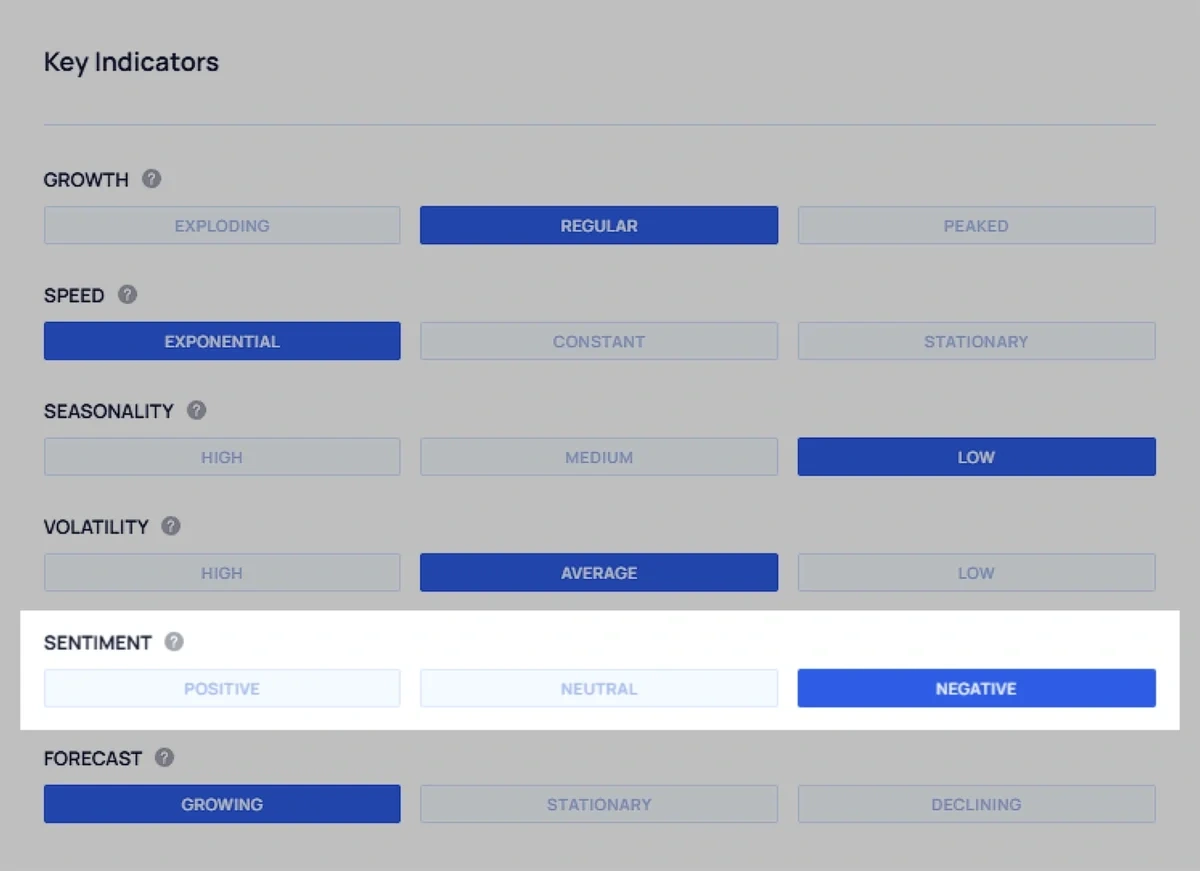
Challenging that negativity would produce some of the most striking thought leadership. You could think about different ways of defying received wisdom:
- Bossware has a PR problem: When you set aside the “Big Brother”-esque name, it’s just using technology to do what managers have always done
- Bossware is part of the data revolution: The productivity sector cannot afford to be left behind because of taboos around gathering and analyzing this one specific kind of data
- Bossware rewards hard-workers: The millions of quiet, head-down grinders who might get missed can be rewarded properly when monitored effectively
But even if you’re in the majority, then you can still produce a highly worthwhile piece of content. In this example, drawing out exactly why bossware is bad, and what solutions companies should be using instead, could add worthwhile insight to the conversation:
- Bossware doesn’t even do what it’s meant to: Keystrokes/time are weak measures of true productivity
- Bossware kills trust: The best way to get productive employees is to empower them to act without standing over their shoulder
- Bossware is a race to the bottom: If the same job is offered elsewhere without intrusive monitoring, you will lose out on high-quality candidates
And in case you were starting to think I’m some kind of totally anti-AI luddite, this part of the thought leadership process is actually a great time to turn to ChatGPT or a similar tool. Using it as an interactive sounding board can help to crystallize and refine your own perspective, clarifying your thoughts before you commit them to writing.
Writing Your LinkedIn Thought Leadership
Once you have your topical subject matter, and you’ve stress-tested your perspective against other possible opinions, it’s time to start writing your thought leadership piece.
If you haven’t done much writing, then this can be daunting (and I completely get the temptation to turn to AI). But that’s another reason why LinkedIn is such a good place to start.
All you need to worry about is writing in your authentic voice. You don’t have any publication house styles to adhere to, and the post can be as long or as short as you like.
And remember, you’ll stand out just by virtue of having made the effort to write it yourself.
With that in mind, there cannot be a single clear formula to good thought leadership. Indeed, avoiding the trap of being formulaic should be one of your top goals.
Even so, if you’re struggling with where to start, there are some very general principles to follow. Forbes breaks down good thought leadership into 3 components:
- Heart: The heart of any good thought leadership is new ideas. Everything should come back to the original perspective that you’re putting forward
- Brain: Bringing in hard data to support what you’re saying will naturally boost your authority. Ideally, you’ll be able to bring original research to the table, but citing figures from other high-quality sources is effective too.
- Mouth: This is all about your tone and style of writing. Try to avoid jargon, and do your best to be authentic. Visuals are also great for making your point more clearly.
These are general enough guidelines that you shouldn’t find yourself churning out boilerplate content. It’s a very loose framework that you can use to create genuinely original thought leadership.
But don’t fret about checking that every sentence follows the “heart, brain, mouth” approach. Ultimately, if your personal perspective is driving what you write, you won’t go too far wrong. And you’ll develop your voice with practice.
LinkedIn Thought Leadership Success Metrics
There are multiple ways to assess whether or not your thought leadership on LinkedIn has succeeded. But the most important measure is whether or not you have started a conversation.
This, after all, is what thought leadership is all about. So if people are in the comments (whether they are agreeing with your perspective or challenging it), you can be pleased with how you’ve done.
At the highest level, success also means generating personal or corporate leads. According to the Financial Times, 69% of CEOs request calls or meetings with companies that produce good quality thought leadership.
You can’t expect every post to bring with it a flood of opportunities. But if people are reaching out to you off the back of what you write, that’s clearly a major win.
Because LinkedIn is a form of social media, you can also use impressions and reactions as secondary KPIs.
What is an impression on LinkedIn?
An “impression” on LinkedIn is effectively a view: every time somebody is shown your post, it will be recorded as an impression.
That can be broken down further into “members reached”, which excludes duplicate views from the impressions data. So if 1 person sees your post 5 times, that’s 5 impressions but only 1 member reached.
Impressions vs engagement
Naturally, a high number of impressions is good. But as with all social media, engagement is king, and that applies particularly strongly when you’re actively trying to create thought-provoking content.
As mentioned, comments are really the gold standard of good thought leadership. But “reactions” are another form of engagement, and they are important; if lots of people react, the LinkedIn algorithm is likely to show your post to more people, creating a virtuous cycle to virality.
On LinkedIn, reactions are broken down into categories: like, celebrate, support, love, insightful, and funny. Thought leadership most naturally targets “insightful”, but any engagements are valuable, and there’s no hard evidence that the algorithm gives preference to a particular reaction type.
Best Time to Post on LinkedIn
It’s not worth getting too weighed down in things like optimal LinkedIn posting times. Your main focus should be on producing genuinely thought-provoking, high-quality content.
But it goes without saying that once you’ve created something you are proud of, you want to get it in front of as many people as possible. Especially when thought leadership can be such effective marketing.
The LinkedIn for Marketing blog assessed data from partners Hubspot, Sprinklr and Buffer. There was no single time slot that emerged as a consensus winner, but as a very general rule of thumb, weekdays between 9-5 appeared to perform best.
This seems to track. The CEOs and decision-makers who you want to be reading your posts are specifically carving out time in their workday to seek out this kind of content: 54% of executives dedicate more than an hour a week to consuming thought leadership.
What is LinkedIn Premium?
Can being a member of the paid LinkedIn Premium service improve the reach of your thought leadership? The short answer is yes (but stick around for the slightly longer answer!).
One of the benefits of LinkedIn Premium is increased visibility. LinkedIn Premium Business subscribers average 13x more profile views, and Premium All-in-One subscribers are 60% more likely to get replies from suggested prospects.
However, LinkedIn Premium is not essential for an effective thought leadership strategy.
While the platform does list visibility benefits for Premium users, it does not say that paid subscribers actually get their individual posts boosted (unlike on X). And although some people have anecdotally observed better reach for posts from Premium users, there is no clear evidence to support it.
The Premium badge may well attract executives to your profile, providing more avenues for your thought leadership to be seen. But if you genuinely manage to start a conversation, there’s nothing to stop your post spreading natively as a Basic user.
LinkedIn Premium Cost
LinkedIn Premium starts from $29.99 per month. There are multiple plans to choose from.
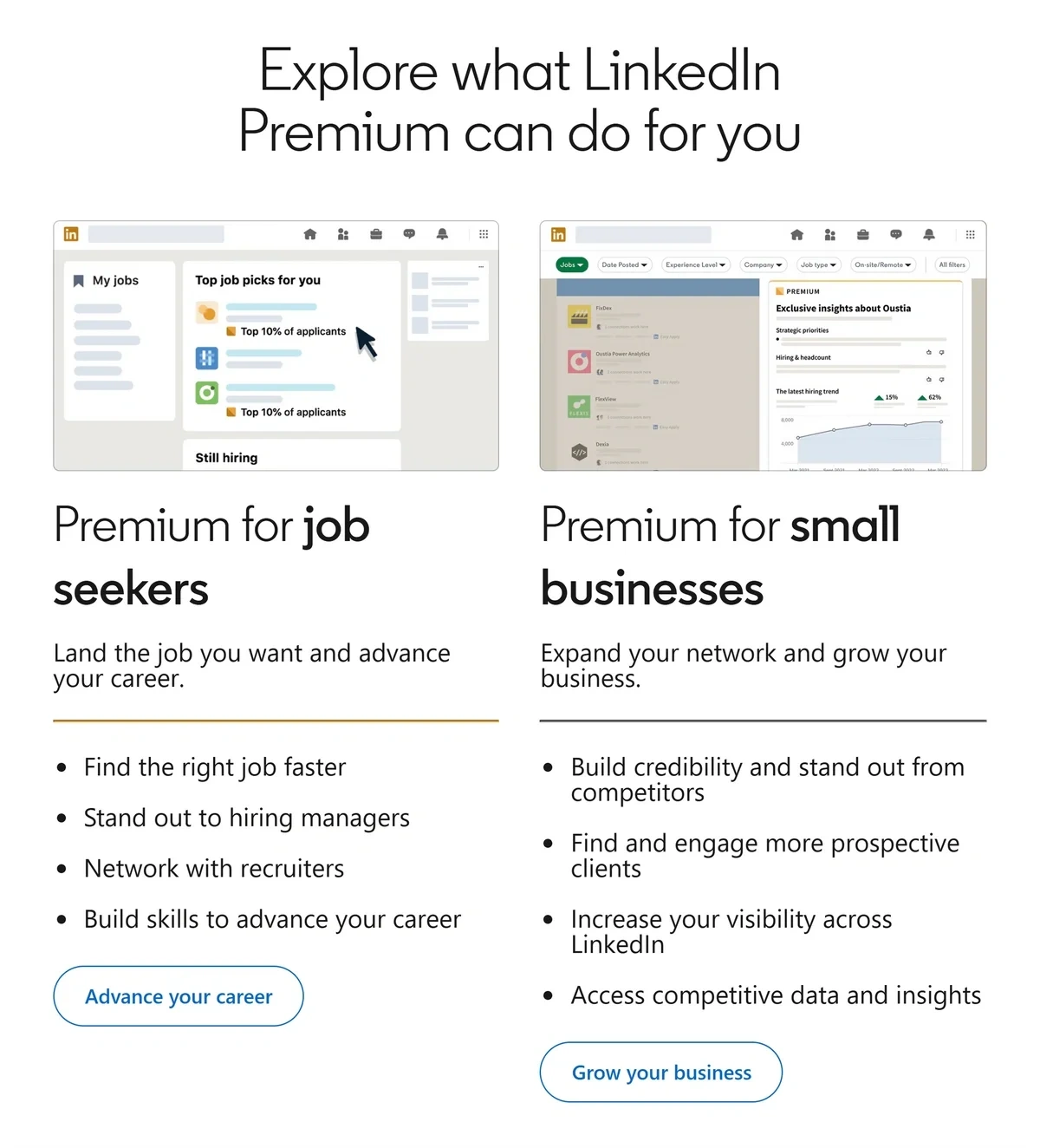
Premium Career ($29.99 per month)
Premium Career is aimed at job-seekers. Subscribers are 39% more likely to hear back after applying for a job.
If you’re looking to become a thought leader in order to improve your personal employability, then Premium Career may be a worthwhile option.
Premium Business ($69.99 per month)
If your goal in becoming a thought leader is to reflect prestige back on your business, Premium Business is probably the right plan. It’s designed to showcase your business and expand your network.
Premium All-in-One ($99.99 per month)
Premium All-in-One is a relatively new tier that offers all of the benefits of Business with some added perks. This plan allows you to actively boost your posts via a $50 monthly advertising credit.
Become a LinkedIn Thought Leader Today
Real thought leadership takes time and effort to produce. But the payoff can be massive.
And with LinkedIn, at least the publishing stage does not pose an additional hurdle. Once you’ve created something you’re pleased with, you have total control over when and how you put it out into the world.
You don’t need any special software to be a thought leader. You don’t need to rely on ChatGPT, and it’s not imperative that you “pay to play” with LinkedIn Premium.
Nevertheless, as long as you use them well, there are tools that can help you. When used responsibly, AI can be great for tightening and refining your arguments.
And Exploding Topics is great for getting Linkedin-specific data. You can find out exactly what people are talking about on the platform, and get inspiration on how you can add to the conversation.
Sign up today for a free trial to help you get started on your journey to becoming a thought leader.
Stop Guessing, Start Growing 🚀
Use real-time topic data to create content that resonates and brings results.
Exploding Topics is owned by Semrush. Our mission is to provide accurate data and expert insights on emerging trends. Unless otherwise noted, this page’s content was written by either an employee or a paid contractor of Semrush Inc.
Share
Newsletter Signup
By clicking “Subscribe” you agree to Semrush Privacy Policy and consent to Semrush using your contact data for newsletter purposes
Written By


James is a Journalist at Exploding Topics. After graduating from the University of Oxford with a degree in Law, he completed a... Read more