Exploding Topics
Remineralizing Gum search volume grew from under 100 to 27,100 monthly searches between February 2024 and January 2026.
Remineralizing gum
+5100%
GLP 1 Supplement search volume grew from 5,920 to 74,000 monthly searches between February 2024 and January 2026.
GLP 1 supplement
+1150%
Soursop Bitters search volume grew from 9,900 to 110,000 monthly searches between March 2024 and February 2026.
Soursop bitters
+1011%



Get Advanced Insights on Any Topic
Discover Trends 12+ Months Before Everyone Else
How We Find Trends Before They Take Off
Exploding Topics’ advanced algorithm monitors millions of unstructured data points to spot trends early on.
Keyword Research
Performance Tracking
Competitor Intelligence
Fix Your Site’s SEO Issues in 30 Seconds
Find technical issues blocking search visibility. Get prioritized, actionable fixes in seconds.
Powered by data from
Latest Blog Posts
Featured Case Studies
See what's trending before everyone else
Each week, we'll send you our best Exploding Topics. Plus, expert insight and analysis.
SpaceX Revenue and Valuation Statistics (October 2026)

 Add Exploding Topics on GoogleAdd Exploding Topics as your preferred source to see more of our stories on Google.
SpaceX made $18.67 billion in revenue in 2025, up 33.2% from 2024, according to its IPO prospectus. It was worth about $1.98 trillion at its closing share price of $146.03 on October 16, 2026.
SpaceX went public on June 12, 2026, at a valuation of $1.77 trillion, the largest IPO on record.
SpaceX now includes xAI and X, which it acquired in February 2026, so its reported revenue covers rockets, Starlink and AI. SpaceX made its first quarterly profit since it went public in Q3 2026, and Starlink still makes most of its operating profit.
In this article, we'll break down SpaceX's revenue, profit, valuation, IPO, ownership and Starlink growth, and what the numbers mean for investors.
Top SpaceX Statistics
- SpaceX made $18.67 billion in revenue in 2025, up 33.2% from 2024 (SpaceX IPO prospectus, June 2026)
- Its Q3 2026 revenue was $14.58 billion, up 161% from Q3 2025 (SpaceX, October 2026)
- SpaceX made a net income of $4.40 billion in Q3 2026, after a net loss of $4.94 billion in 2025 (SpaceX, October 2026)
- It raised $85.7 billion (net) in its June 2026 IPO (SpaceX, August 2026), at a valuation of $1.77 trillion (CNBC, June 2026)
- Elon Musk controls 82.3% of SpaceX's voting power (SpaceX IPO prospectus, June 2026)
- Starlink had 13.6 million consumer subscribers on September 30, 2026, up 89% from a year earlier (SpaceX, October 2026)
- SpaceX launched 170 missions in 2025, up from 138 in 2024 (SpaceX IPO prospectus, June 2026)
How Much Revenue Does SpaceX Make?
SpaceX made $18.67 billion in revenue in 2025, up 33.2% from $14.02 billion in 2024. These figures come from SpaceX's audited accounts in its IPO prospectus.
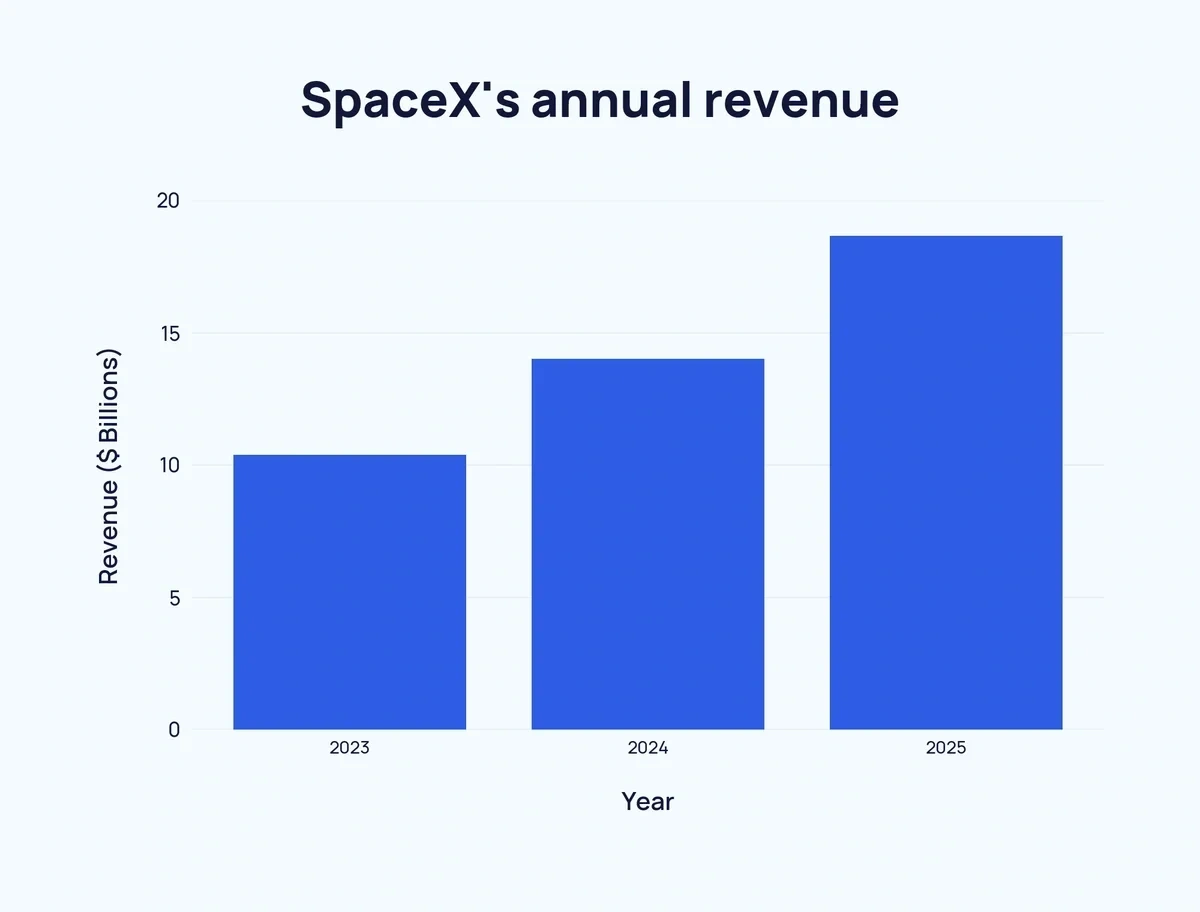
SpaceX's revenue has grown by between $3.6 billion and $4.7 billion a year since 2023, according to the SpaceX IPO prospectus. Revenue rose from $10.39 billion in 2023 to $18.67 billion in 2025.
Here's a breakdown of SpaceX's annual revenue:
| Year | SpaceX Revenue | Change From Previous Year |
| 2023 | $10.39 billion | - |
| 2024 | $14.02 billion | +34.9% |
| 2025 | $18.67 billion | +33.2% |
These figures include xAI and X for every year, because SpaceX restated its accounts after the xAI merger. Earlier press estimates of SpaceX's 2025 revenue, such as $15 billion to $16 billion from Reuters, reported by CNBC, covered only rockets and Starlink. SpaceX's own figures show that rockets and Starlink made $15.47 billion in 2025.
SpaceX made $27.08 billion in the first nine months of 2026, already more than in the whole of 2025, according to its Q3 2026 earnings release.
For investors, the restated figures matter because AI is now the fastest-changing part of SpaceX's revenue. Year-on-year comparisons with older press reports may not be like for like.
What Is SpaceX's Revenue by Segment?
Starlink brings in most of SpaceX's revenue. SpaceX's Connectivity segment, which is mainly Starlink, made $11.39 billion in 2025, or 61% of total revenue, according to the IPO prospectus.
Here's a breakdown of SpaceX's revenue by segment:
| Segment | 2023 | 2024 | 2025 |
| Connectivity (Starlink) | $3.87 billion | $7.60 billion | $11.39 billion |
| Space (launches and development) | $3.56 billion | $3.80 billion | $4.09 billion |
| Super Intelligence, or SI (xAI and X) | $2.96 billion | $2.62 billion | $3.20 billion |
| Total | $10.39 billion | $14.02 billion | $18.67 billion |
SpaceX's Space segment, which sells launches and development work to customers, made $4.09 billion in 2025. SpaceX doesn't count its own Starlink launches as revenue.
SpaceX now calls its AI segment Super Intelligence (SI), starting with its Q3 2026 earnings release. The SI segment now also includes Cursor, the AI coding company SpaceX bought in August 2026.
What Is SpaceX's Quarterly Revenue?
SpaceX's revenue more than doubled in the third quarter of 2026. SpaceX made $14.58 billion in Q3 2026, up 161% from $5.58 billion in Q3 2025, according to its Q3 2026 earnings release.
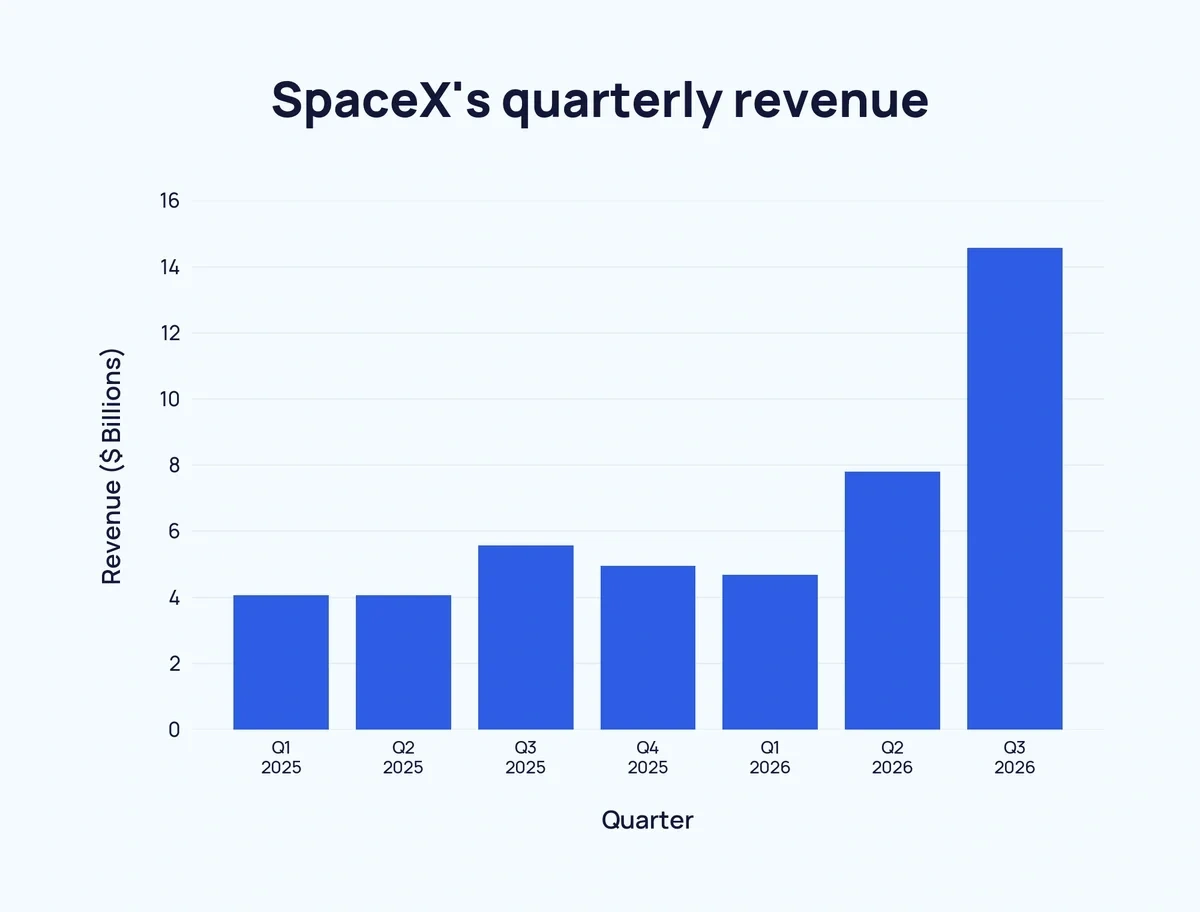
Most of the jump came from AI. SpaceX's SI revenue rose 830% from a year earlier to $7.56 billion in Q3 2026. SpaceX says the growth came mainly from new cloud services deals, the Cursor acquisition and more use of Grok. Cursor added $608 million of revenue between August 14 and September 30, 2026.
Connectivity revenue rose 69% to $5.25 billion, and Space revenue rose 6% to $1.77 billion.
Here's a breakdown of SpaceX's quarterly revenue:
| Quarter | SpaceX Revenue | Change From Same Quarter a Year Earlier |
| Q1 2025 | $4.07 billion | - |
| Q2 2025 | $4.07 billion | - |
| Q3 2025 | $5.58 billion | - |
| Q4 2025 (calculated) | $4.96 billion | - |
| Q1 2026 | $4.69 billion | +15.4% |
| Q2 2026 | $7.81 billion | +92% |
| Q3 2026 | $14.58 billion | +161% |
SpaceX also had a backlog of $47.46 billion on June 30, 2026, according to its quarterly report. SpaceX's Q3 2026 earnings release doesn't give an updated backlog figure.
Is SpaceX Profitable?
Yes, SpaceX made a net profit in Q3 2026, its first quarterly profit since it went public in June 2026. SpaceX had a net income of $4.40 billion in Q3 2026, compared with a net loss of $1.05 billion in Q3 2025, according to its Q3 2026 earnings release.
SpaceX isn't profitable over a longer period yet. SpaceX had a net loss of $413 million in the first nine months of 2026, and a net loss of $4.94 billion in 2025.
About $2.79 billion of SpaceX's Q3 profit came from its operations. The rest came mainly from $1.03 billion of other income and a $390 million tax benefit.
SpaceX is also profitable on an adjusted basis. SpaceX's adjusted EBITDA was $8.81 billion in Q3 2026, up 306% from a year earlier, according to its Q3 2026 earnings release. It was $6.58 billion in 2025, according to the IPO prospectus. Adjusted EBITDA leaves out costs such as depreciation, interest and stock-based pay.
Here's a breakdown of SpaceX's profit and spending:
| Measure | 2024 | 2025 | First Nine Months of 2026 | Q3 2026 |
| Net income (loss) | $791 million | -$4.94 billion | -$413 million | $4.40 billion |
| Operating income (loss) | $466 million | -$2.59 billion | $705 million | $2.79 billion |
| Adjusted EBITDA | $5.35 billion | $6.58 billion | $13.47 billion | $8.81 billion |
| Capital expenditure | $11.16 billion | $20.74 billion | $48.07 billion | $19.59 billion |
| Free cash flow (calculated) | -$5.39 billion | -$13.95 billion | -$34.97 billion | - |
The free cash flow figures are our own calculation: operating cash flow minus capital expenditure. SpaceX doesn't publish a free cash flow figure.
AI spending drove SpaceX's earlier losses. SpaceX's AI segment lost $6.36 billion at the operating level in 2025, according to the IPO prospectus. In Q3 2026, the SI segment made an operating profit of $431 million, compared with a loss of $1.72 billion a year earlier. That profit came after $1.2 billion of stock-based pay linked to the Cursor deal.
SpaceX is still spending heavily. SpaceX spent $19.59 billion on capital expenditure in Q3 2026, and $16.44 billion of that went to the SI segment, according to the Q3 2026 earnings release. SpaceX had $51.29 billion in cash and $38.56 billion in marketable securities on September 30, 2026.
Starlink is still the most profitable part of SpaceX. The Connectivity segment made an operating profit of $2.37 billion in Q3 2026, up 99% from a year earlier, and $4.42 billion in 2025.
For investors, Q3 2026 was the first quarter this year in which SpaceX's AI segment made an operating profit. But SpaceX still spends more on capital expenditure than it makes in revenue.
Build a winning strategy
Get a complete view of your competitors to anticipate trends and lead your market
What Is SpaceX's Valuation?
SpaceX was worth about $1.98 trillion on October 16, 2026, based on its closing share price of $146.03. SpaceX's share price was 8.2% above its $135 IPO price.
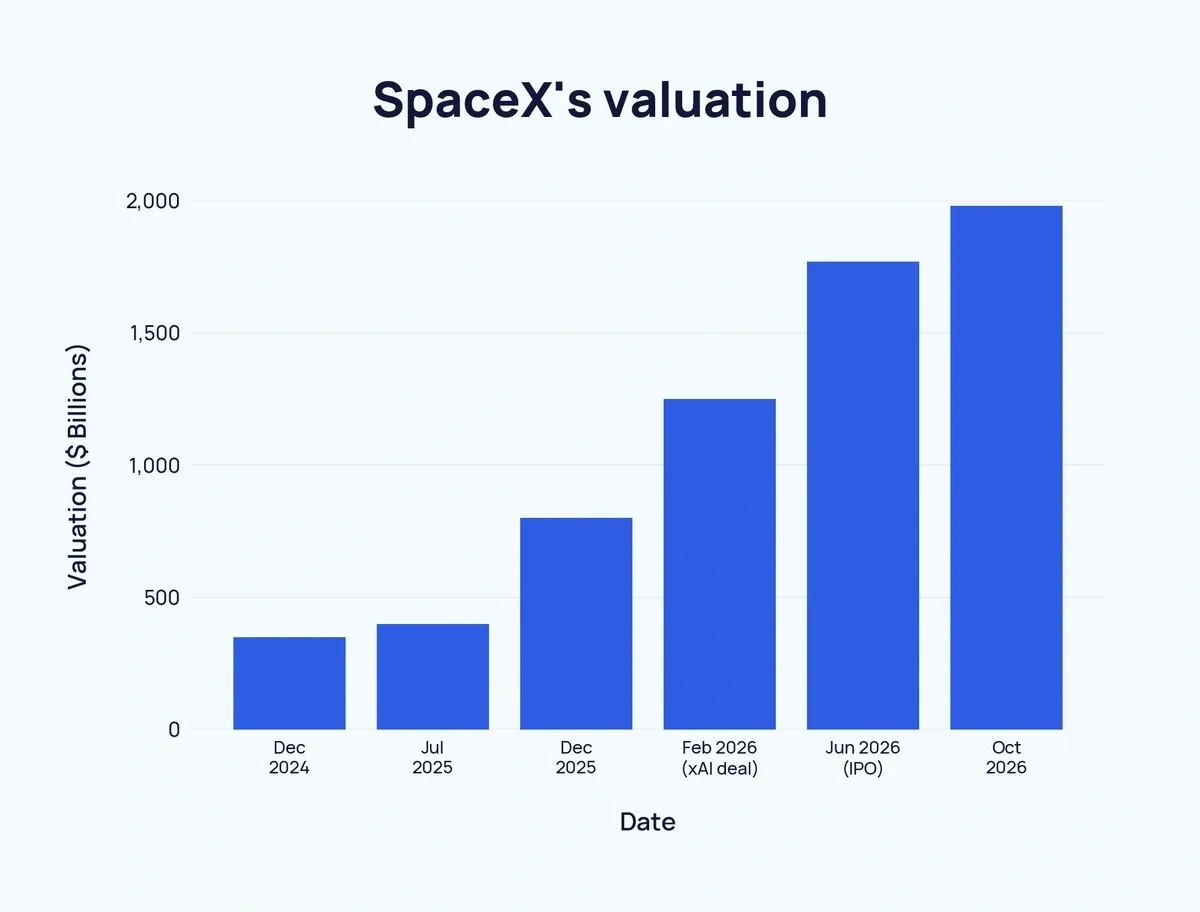
SpaceX's valuation has grown more than fivefold since December 2024, when an insider share sale valued SpaceX at $350 billion, according to CNBC.
Here's a breakdown of SpaceX's valuation over time:
| Date | Event | Valuation |
| December 2024 | Tender offer at $185 a share (before the 2026 stock split) | $350 billion |
| July 2025 | Share sale at $212 a share (before the split), according to Bloomberg | $400 billion |
| December 2025 | Insider share sale at $421 a share (before the split), according to Reuters | $800 billion |
| February 2026 | SpaceX acquires xAI in an all-stock deal | $1.25 trillion (combined) |
| June 2026 | IPO at $135 a share | $1.77 trillion |
| October 16, 2026 | Closing share price of $146.03 | ~$1.98 trillion |
The February 2026 figure covers SpaceX and xAI together. That deal valued SpaceX at about $1 trillion and xAI at about $250 billion, according to Bloomberg.
The October 2026 market value is our own calculation, using about 13.57 billion SpaceX shares. That share count includes the shares SpaceX issued to buy Cursor, the AI coding company, in August 2026, according to SpaceX's filing.
For more company valuations, see our list of decacorn companies, or compare SpaceX with OpenAI's valuation and Anthropic's valuation.
When Did SpaceX Go Public?
SpaceX went public on June 12, 2026, on Nasdaq under the ticker SPCX. SpaceX sold shares at $135 each, which valued the company at $1.77 trillion.
SpaceX's IPO raised $85.7 billion after fees, including shares sold to the underwriters, according to the Q2 2026 earnings release. The IPO was the biggest on record, according to CNBC.
Here's a breakdown of the SpaceX IPO and share price:
| IPO Detail | Figure |
| First trading day | June 12, 2026 |
| Exchange and ticker | Nasdaq, SPCX |
| IPO price | $135 a share |
| Shares sold (including the underwriters' option) | 638.9 million |
| Money raised | $85.7 billion (net) |
| Valuation at the IPO price | $1.77 trillion |
| First-day close | $160.95 (+19.2%) |
| Record close | $201.80 (June 16, 2026) |
| Lowest close | $108.27 (August 5, 2026) |
| Latest close | $146.03 (October 16, 2026) |
SpaceX's shares rose 19.2% on their first day of trading, according to CNBC. The shares fell 13.6% on August 5, 2026, according to Nasdaq data. CNBC reported that the fall came after SpaceX's first earnings report showed capital expenditure more than twice as high as revenue.
More SpaceX shares will become available to trade soon. Up to 1.3 billion shares become free to sell on the second full trading day after SpaceX's Q3 results, which SpaceX reported on October 20, 2026, according to the IPO prospectus. Another 328.4 million shares become free to sell on October 24, 2026. Elon Musk can't sell his shares until June 12, 2027.
For investors, the lock-up schedule may affect the share price in the short term, as early investors gain the right to sell.
Who Owns SpaceX?
Elon Musk controls SpaceX. Musk holds about 82.3% of SpaceX's voting power, through shares that carry 10 votes each, according to the IPO prospectus.
Musk beneficially owns about 6.42 billion SpaceX shares, including unvested performance shares and options, according to his Schedule 13G filing. At the October 16, 2026, closing price, those shares were worth about $937 billion, based on our calculation.
Here's a breakdown of SpaceX's largest shareholders:
| Shareholder | Stake | As Of |
| Elon Musk | 82.3% of voting power | June 2026 (IPO) |
| Elon Musk | 6.42 billion shares (48.4% of Class A, as converted) | June 30, 2026 |
| Alphabet (Google) | 7.2% of Class A shares | June 30, 2026 |
| Valor Equity Partners | 6.5% of Class A shares | June 30, 2026 |
| Founders Fund and Peter Thiel | 5.5% of Class A shares (427.3 million shares, combined) | June 30, 2026 |
Alphabet, Google's parent company, owns 551.2 million SpaceX shares, according to its Schedule 13G filing. Musk's Class B shares give him the right to elect most of the board, so SpaceX is a "controlled company" under Nasdaq rules.
For investors, Musk's voting control means outside shareholders have limited say over strategy, including how much SpaceX spends on AI.
How Many Starlink Subscribers Are There?
Starlink had 13.6 million consumer subscribers on September 30, 2026, up 89% from 7.2 million a year earlier. Starlink added 1.6 million consumer subscribers in the third quarter of 2026 alone.
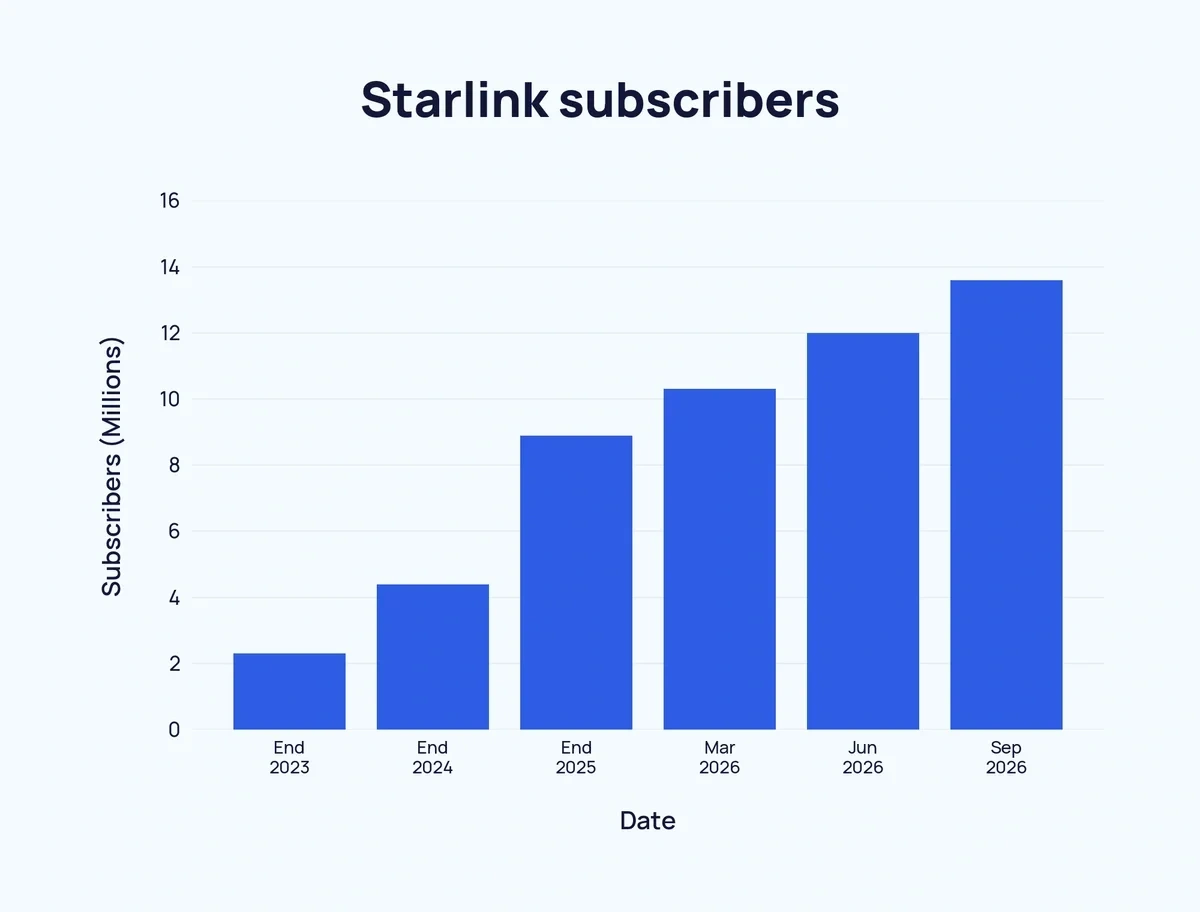
The consumer subscriber count covers home, roaming and business plans. It doesn't include enterprise and government customers, such as airlines and ships, which SpaceX says add hundreds of thousands more. More than 3,800 aircraft had Starlink on September 30, 2026, according to SpaceX's Q3 2026 earnings release.
Starlink's subscriber numbers have roughly doubled every year since 2023, according to the SpaceX IPO prospectus. Starlink served customers in 164 countries, territories and other markets on March 31, 2026.
Here's a breakdown of Starlink subscribers over time:
| Date | Starlink Subscribers |
| End of 2023 | 2.3 million |
| End of 2024 | 4.4 million |
| End of 2025 | 8.9 million |
| March 31, 2026 | 10.3 million |
| June 30, 2026 | 12.0 million |
| September 30, 2026 | 13.6 million |
Starlink's average revenue per consumer user was $69 a month in Q3 2026, up 5% from $66 in Q2 2026 but down from $83 a year earlier, according to the Q3 2026 earnings release. Revenue per user fell every year from 2023, when it was $99 a month, to 2025.
SpaceX had 11,154 Starlink satellites in orbit on October 15, 2026, according to astronomer Jonathan McDowell's satellite tracker.
For investors, Starlink is SpaceX's main source of profit, but money from the IPO and bond sales pays for most of its current AI spending. Revenue per user is still lower than a year earlier, although it rose in Q3 2026, so it may also be worth watching. SpaceX has said the earlier fall came mainly from international expansion and cheaper service plans.
How Much Traffic Does Starlink.com Get?
Starlink.com had 26.51 million visits in June 2026, up 47.5% from June 2025, according to Semrush Traffic Analytics. Starlink.com ranked 1,718th among all websites that month.
SpaceX.com had 3.01 million visits in June 2026, up 73.1% from a year earlier.
Here's a breakdown of Starlink.com's top marketing channels:
| Channel | Proportion of Traffic |
| Direct | 70.24% |
| Organic search | 14.93% |
| Referral | 6.49% |
| Paid search | 4.40% |
| Paid social | 1.53% |
| Organic social | 1.20% |
| Display ads | 0.61% |
| 0.47% | |
| AI assistants | 0.11% |
| AI search | 0.02% |
Here's a breakdown of Starlink.com's traffic by country:
| Country | Proportion of Traffic |
| United States | 36.82% |
| Brazil | 10.34% |
| Canada | 5.29% |
| United Kingdom | 3.93% |
| Germany | 3.70% |
| Mexico | 2.98% |
Figures above are for June 2026.
For the latest monthly figures, see Exploding Topics' starlink.com website traffic analytics.
Want to Spy on Your Competition?
Explore competitors’ website traffic stats, discover growth points, and expand your market share.
How Many Rockets Does SpaceX Launch?
SpaceX launched 170 missions in 2025, up from 138 in 2024. That includes 165 Falcon launches and 5 Starship test flights.
SpaceX carried out about half of all orbital launches worldwide in 2025. SpaceX made 165 of 325 orbital launches, or nearly 51%, according to BryceTech data reported by Via Satellite. SpaceX launched more than 2,200 metric tons of satellites and cargo in 2025, or over 80% of everything sent into orbit worldwide, according to its IPO prospectus.
Here's a breakdown of SpaceX launches by year:
| Year | SpaceX Launches |
| 2023 | 98 |
| 2024 | 138 |
| 2025 | 170 |
| First half of 2026 | 78 |
| First nine months of 2026 | 113 |
SpaceX made its 100th orbital launch of 2026 on August 22, 2026, according to Spaceflight Now. One Falcon 9 booster flew for a record 37th time in August 2026, according to Space.com.
SpaceX made 35 launches in Q3 2026, down from 44 in Q3 2025, and 12 of them were for customers, according to its Q3 2026 earnings release.
Starship, SpaceX's next-generation rocket, reached orbit for the first time on September 28, 2026, according to Space.com. SpaceX calls that flight, Flight 14, its first revenue-generating Starship mission. It carried 26 of SpaceX's own Starlink V3 satellites, according to its Q3 2026 earnings release.
How Many Employees Does SpaceX Have?
SpaceX had more than 22,000 full-time employees on March 31, 2026, according to its IPO prospectus. That figure doesn't include Cursor, which SpaceX acquired in August 2026.
The figure comes from the human capital section of SpaceX's IPO prospectus. For comparison, see how many people work at Anthropic.
What Government Contracts Does SpaceX Have?
SpaceX won more than $6 billion in multi-year US government contracts for Starshield, its military satellite business, in Q2 2026, according to SpaceX's earnings release.
Most of that came from two Space Force contracts, for communications and sensing satellites, according to SpaceX's Q2 2026 earnings release. They include a $4.16 billion contract to track airborne threats from space, awarded in May 2026, according to Military Times.
SpaceX also launched 11 of the 12 National Security Space Launch missions in 2025, and all 5 US crew and cargo missions to the International Space Station, according to its IPO prospectus.
SpaceX added more government work in Q3 2026. It signed 18 more National Security Space Launch missions and 3 more NASA crew missions to the space station, according to its Q3 2026 earnings release.
What Does Search Data Say About SpaceX and Space Startups?
Exploding Topics data shows that searches for "data center in space" grew 800% between October 2024 and September 2026, from 733 to 6,600 a month.
Search interest in other space startups has also grown. Searches for K2 Space, a satellite maker, rose 478% from November 2024 to September 2026, and searches for Stoke Space, a reusable rocket startup, rose 300%.
Here's a breakdown of monthly searches for space startups, according to Exploding Topics:
| Search Term | First Month | Peak | September 2026 | Change |
| Data center in space | 733 (Oct 2024) | 16,316 (Jun 2026) | 6,600 | +800% |
| K2 Space | 2,513 (Nov 2024) | 27,651 (Mar 2026) | 14,524 | +478% |
| Stoke Space | 12,229 (Nov 2024) | 48,918 (Sep 2026) | 48,918 | +300% |
| Relativity Space | 23,142 (Oct 2024) | 88,232 (Jun 2026) | 40,500 | +75% |
| Impulse Space | 12,753 (Oct 2024) | 47,234 (Jun 2026) | 22,200 | +74% |
Searches for most of these startups peaked in mid-2026, around the time of SpaceX's IPO. For investors, these companies may be worth watching as the next wave of space businesses.
For more on the sector, see our list of high-growth space companies and startups, or explore more fast-growing technology startups on Exploding Topics.
Case study: How Aiken House Grew 21 Companies and Raised $234 Million With Exploding Topics
Joey Rahimi runs Aiken House, a Pittsburgh venture studio. Founders rely on him to know what's popular now and what will be next, across technology, marketing and macroeconomics.
Aiken House has built 21 companies and raised $234 million across its ventures, and Rahimi uses Exploding Topics to spot relevant trends early. "I started to use Exploding Topics when it launched and thought, this is genius," he said.
What's Next for SpaceX?
SpaceX expects its revenue to keep climbing quickly. Elon Musk said on SpaceX's Q2 2026 earnings call that SpaceX expects to reach a $100 billion-plus annual revenue run rate in December 2026. This is a company target, not a result.
Chief financial officer Bret Johnsen said on the same call that the target includes Cursor. Musk also said on the call, which is available on SpaceX's investor relations site (a transcript is also available from The Motley Fool), that SpaceX's internal projections for reaching $1 trillion in annual revenue have moved forward from 2031 to 2030. SpaceX expects capital expenditure in the second half of 2026 to stay close to Q2 levels.
Analysts disagree on the stock. Morgan Stanley rated SpaceX a buy with a $300 price target in October 2026, according to CNBC, while CFRA rated it a sell with a $115 target in June 2026, CNBC reported.
SpaceX's Q3 2026 revenue works out to an annual run rate of about $58.3 billion, by our calculation. SI revenue rose 195% from Q2 to Q3 2026, while SI capital expenditure rose 4%, according to SpaceX's Q3 2026 earnings release.
SpaceX also agreed on October 8, 2026, to buy 800 MHz spectrum licenses for Starlink Mobile. The deal is expected to close in the first half of 2027.
How We Compiled These Statistics
We used SpaceX's SEC filings and earnings releases for revenue, profit, IPO, ownership, Starlink and launch figures: the IPO prospectus, the Q2 2026 quarterly report and earnings release, the Q3 2026 earnings release, and shareholders' Schedule 13G filings. Valuations before the IPO come from news reports of tender offers and share sales. Website visits come from Semrush Traffic Analytics, and search volumes come from Exploding Topics. Figures marked as calculations are our own arithmetic on SpaceX's filed numbers. Figures are as of October 21, 2026.
For more company statistics, take a look at:
- OpenAI Revenue and Valuation Statistics
- Anthropic Revenue and Valuation Statistics
- The Complete List of Decacorn Companies
- High-Growth Space Companies and Startups
Want to see how SpaceX's websites, or any company's, are growing? The Semrush Traffic & Market toolkit shows any website's traffic, marketing channels and top countries, so you can track companies before and after they go public. Try Semrush free, and use Exploding Topics Pro to find the fast-growing startups behind the next big IPOs.
Stop Guessing, Start Growing 🚀
Use real-time topic data to create content that resonates and brings results.
Exploding Topics is owned by Semrush. Our mission is to provide accurate data and expert insights on emerging trends. Unless otherwise noted, this page’s content was written by either an employee or a paid contractor of Semrush Inc.
Share
Newsletter Signup
By clicking “Subscribe” you agree to Semrush Privacy Policy and consent to Semrush using your contact data for newsletter purposes
Written By


Claire Broadley is the Lead Editor and AI Content Strategist at Exploding Topics, where she oversees editorial workflows, AI SEO s... Read more