


Get Advanced Insights on Any Topic
Discover Trends 12+ Months Before Everyone Else
How We Find Trends Before They Take Off
Exploding Topics’ advanced algorithm monitors millions of unstructured data points to spot trends early on.
Keyword Research
Performance Tracking
Competitor Intelligence
Fix Your Site’s SEO Issues in 30 Seconds
Find technical issues blocking search visibility. Get prioritized, actionable fixes in seconds.
Powered by data from
Latest Blog Posts
Featured Case Studies
See what's trending before everyone else
Each week, we'll send you our best Exploding Topics. Plus, expert insight and analysis.
AI User Age, Gender and Demographics 2026

 Add Exploding Topics on GoogleAdd Exploding Topics as your preferred source to see more of our stories on Google.
In no time at all, AI has gone from an almost theoretical field to a mainstay of our everyday lives.
“AI” now attracts around 25 million searches per month, up from 1.8 million as recently as February 2022.
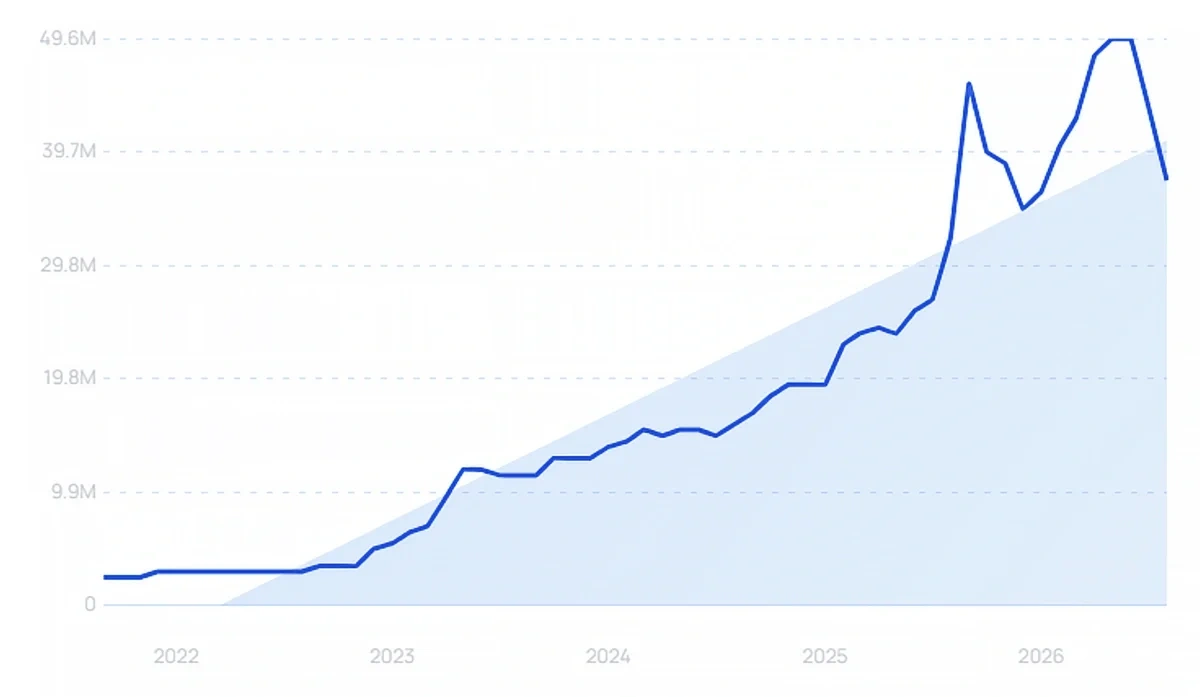
And rapid adoption is only part of the story. AI is also striking for its apparent ubiquity: it has been catapulted so far into the mainstream that it now crosses borders of age, gender, and geography.
But how exactly does the user base break down? Just how widespread has the technology become? And which platforms are the most popular? Read on for a comprehensive analysis of who uses AI in 2026.
AI Demographics Data (Fast Facts)
- 46.79% of people aged 30-44 are daily AI users
- Gen X (38.08%) has more daily AI users than Gen Z (30.07%)
- Almost two-thirds (63.63%) of over-60s use AI at least occasionally
- Nearly 9 in 10 men have used AI, compared with just over 8 in 10 women
- ChatGPT is used equally by men and women
- The UAE has the highest global rate of AI adoption, at 70%
- The Middle Atlantic has the highest proportion of AI users in the US, with 50% reporting daily use
- 66.9% of people in high-income households (>$150,000) use AI daily, versus 23.24% in lower-income households (<$75,000)
- Globally, 1.8 billion people use AI regularly
AI Users by Age
You would typically expect a new technology to be pioneered by the young. But the age profile of AI users is a little more nuanced: Millennials and Gen X are particularly heavy users, with slightly more reticence among Gen Z and Gen Alpha.
Generative AI chatbots (ChatGPT, Claude, Grok, etc.) are most popular among users aged 30-44. Among the 30-44 age group, 46.79% say that they use AI every single day.
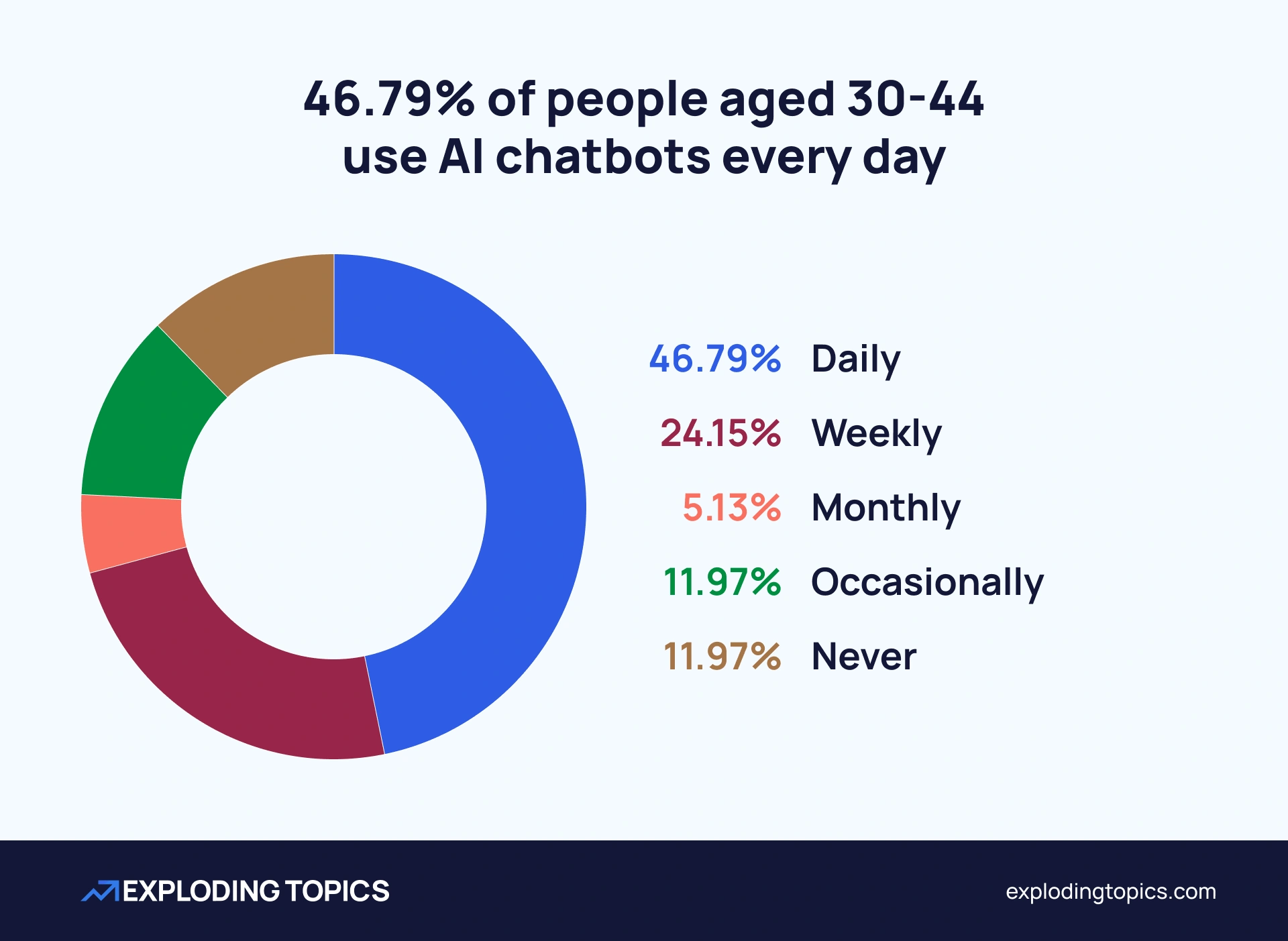
Meanwhile, Gen X (38.08%) is more likely than Gen Z (30.07%) to use AI chatbots on a daily basis. Baby Boomers are the least likely to use AI daily, although more than 1 in 7 over-60s (15.7%) are daily active AI users.
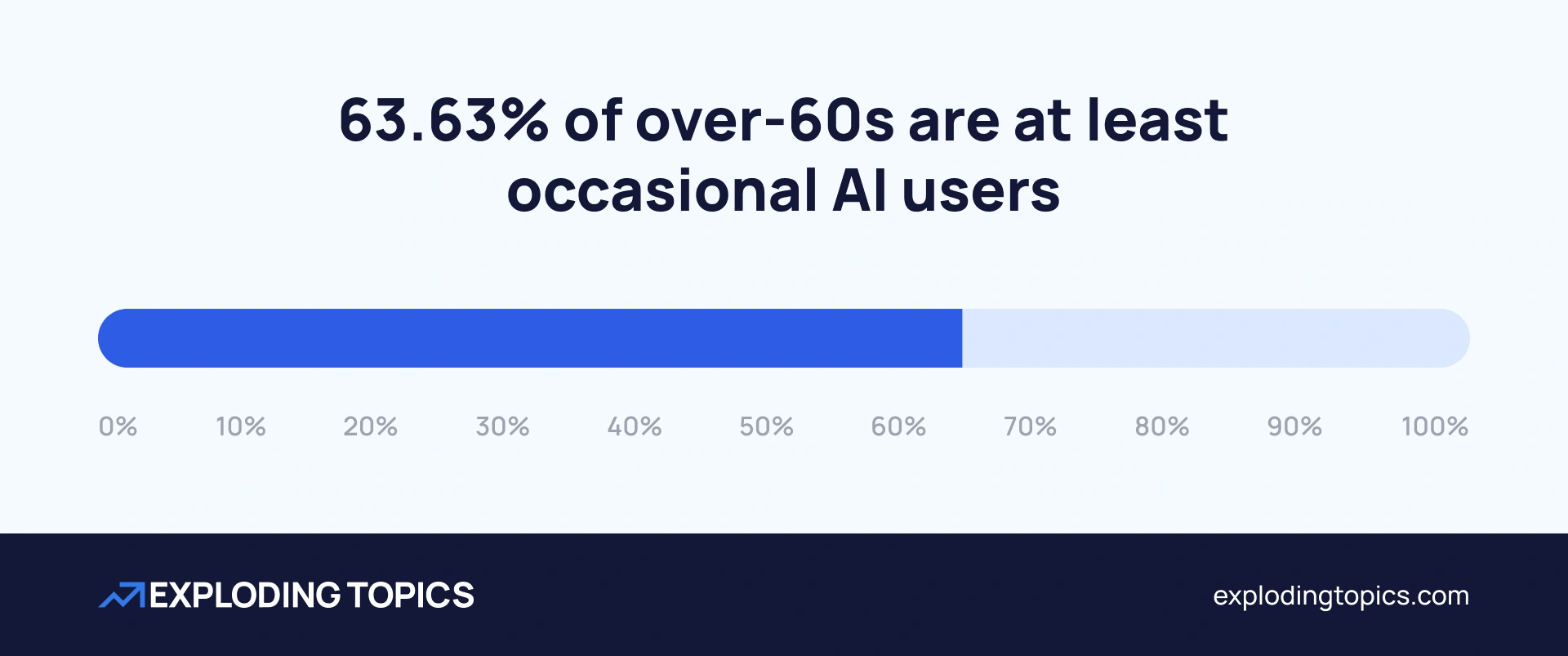
Additionally, 63.63% of over-60s are at least occasional AI users. More than 1 in 3 use AI at least weekly.
When you include all AI usage, from daily to occasional, the biggest users are actually Gen X. Only 11.92% of 45-60s have never used AI, compared with 16.34% of 18-29s and 36.36% of over-60s.
Here is the AI user age data in full, gathered by original Exploding Topics research in 2026:
| Age | Daily AI users (%) | Weekly AI users (%) | Monthly AI users (%) | Occasional AI users (%) | Non-AI users (%) |
| 18-29 (Gen Alpha/Gen Z) | 30.07% | 25.49% | 11.11% | 16.99% | 16.34% |
| 30-44 (Millennials) | 46.79% | 24.15% | 5.13% | 11.97% | 11.97% |
| 45-60 (Gen X) | 38.08% | 18.08% | 10.38% | 21.54% | 11.92% |
| 60+ (Baby Boomers) | 15.70% | 19.83% | 4.13% | 23.97% | 36.36% |
AI User Age Analysis
It’s surprising that less than 1 in 3 people aged 18-29 are using AI on a daily basis, significantly lower than both the 30-44 and 45-60 age groups. But there are a number of possible reasons for the reduced AI uptake among young adults.
Clearly, these non-users are from a highly tech-literate generation. So the decision to restrict or refuse AI usage is likely to be more of a principled choice than a lack of knowledge or ability.
In other AI research carried out by Exploding Topics, Gen Z was the most skeptical about AI privacy. Almost half of 18-29-year-olds suspected that AI companies were saving and reviewing their prompts, while such qualms were lowest among the 45-60 age group.
Moreover, data from Pew Research suggests that teenagers are most likely to moderate their AI usage due to fears about overreliance and loss of critical thinking or creativity. Among the 1 in 4 teens who believe AI will have a net negative societal impact, 34% cited concerns about overreliance.
Other concerns about AI among teenagers included:
- Job loss (25%)
- Misinformation (13%)
- Misuse/threat (11%)
- Loss of human factor (6%)
- Environmental impact (6%)
Most Popular AI Chatbots by Age
ChatGPT is overwhelmingly favored for personal tasks among all age groups. However, age does still make a difference when it comes to AI tool preferences.
AI users aged 30-44 are most likely to use multiple tools. While 86.4% use ChatGPT, 41.77% also use Gemini, while 39.62% use Google AI Mode and 26.73% use Meta AI.
Here are AI users’ top 3 favorite AI chatbots by age:
| Age | #1 Most Popular AI | #2 Most Popular AI | #3 Most Popular AI |
| 18-29 | ChatGPT (84.26%) | Gemini (35.19%)
Google AI Mode (35.19%) | Meta AI (21.30%) |
| 30-44 | ChatGPT (86.40%) | Gemini (41.77%) | Google AI Mode (39.62%) |
| 45-60 | ChatGPT (84.02%) | Google AI Mode (43.56%) | Gemini (39.43%) |
| 60+ | ChatGPT (61.33%) | Google AI Mode (45.33%) | Meta AI (20.00%) |
AI Users by Gender
AI users skew male overall, although a significant majority of both men and women use AI.
In total, 80.73% of women and 88.49% of men use AI chatbots at least occasionally.
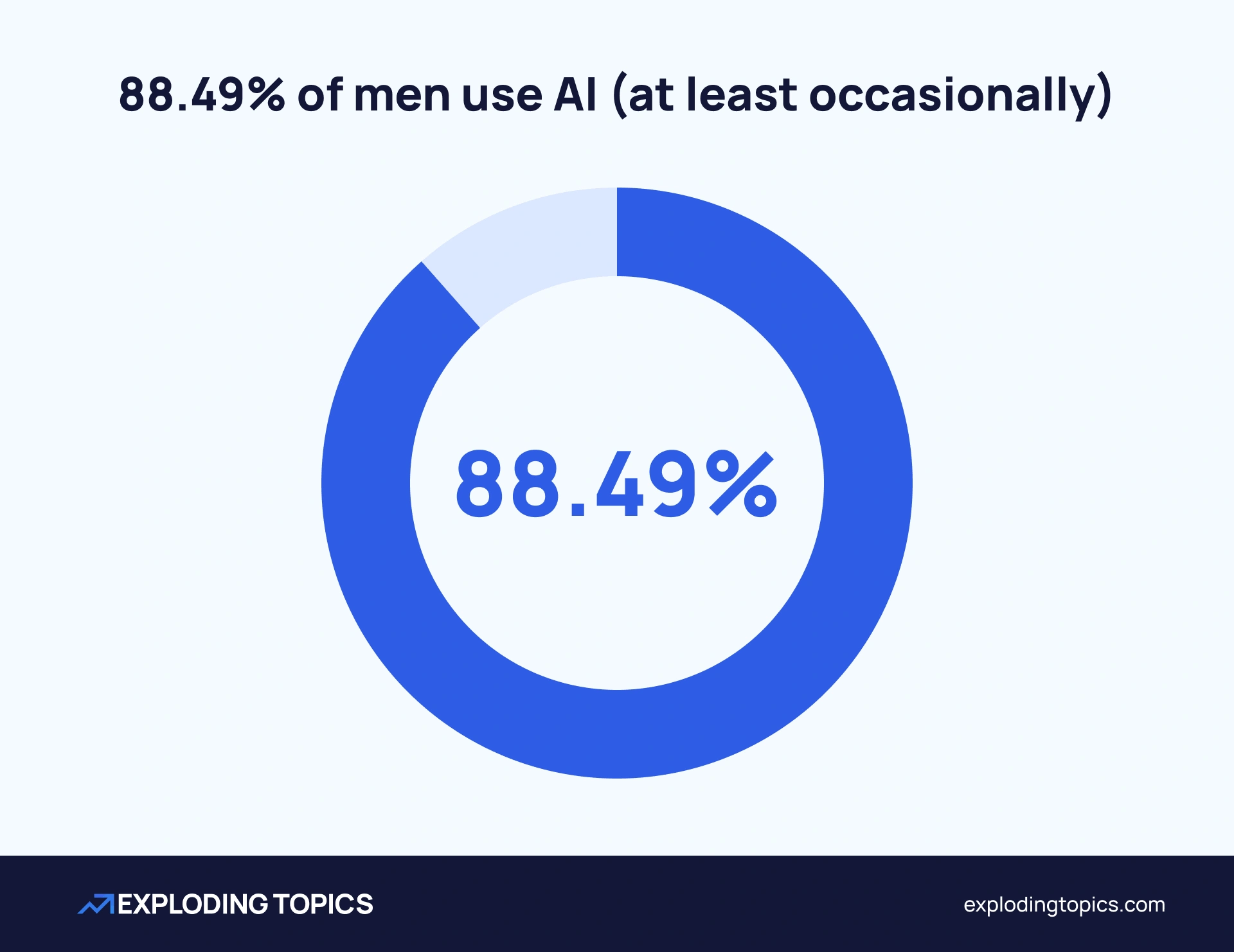
Men are also more likely to be heavy users of AI. 44.56% of men say that they use tools like ChatGPT, Claude or Grok daily, and more than two-thirds of men are at least weekly users.
By contrast, only 32.44% of women use AI tools every day. 54.77% of women are either daily or weekly AI users.
Here’s the full data on AI chatbot use by gender:
| Gender | Daily AI user | Weekly AI user | Monthly AI user | Occasional AI user | AI non-user |
| Male | 44.56% | 22.18% | 8.58% | 13.18% | 11.51% |
| Female | 32.44% | 22.33% | 6.11% | 19.85% | 19.27% |
A separate survey by Lean In showed that women are 22% less likely than men to be regular AI users at work.
However, Pew Research has found that women have been adopting AI at a steeper rate than men since 2024. So the AI gender gap is gradually closing.
Interestingly, that study also showed that ChatGPT is used equally by men and women. The overall gap in usage between men and women comes from other platforms like Gemini, Grok, and Claude.
When it comes to using AI to shop, Grok is the most heavily gendered AI tool. It’s used by 31.98% of men, but only 15.16% of women.
AI Users by Country and Region
AI usage varies significantly by country and region. Let’s start with the global picture.
The UAE has the highest global AI adoption. 70% of its working-age population are regular AI users.
Singapore (63%) and Norway (49%) complete the global top three. The likes of France (48%), Spain (44%), and the UK (42%) also feature in the top 10.
Meanwhile, Canada (37%) and particularly the US (31%) actually have some of the lowest AI adoption rates among developed countries. However, AI adoption in the US is still higher than anywhere in the Global South.
Here’s the full list of the top 10 countries by AI adoption:
| Global rank | Country | AI adoption |
| 1 | UAE | 70% |
| 2 | Singapore | 63% |
| 3 | Norway | 49% |
| 4 | Ireland | 48% |
| 5 | France | 48% |
| 6 | Spain | 44% |
| 7 | New Zealand | 43% |
| 8 | UK | 42% |
| 9 | Netherlands | 42% |
| 10 | Qatar | 42% |
And here’s what AI adoption looks like in some other selected notable countries:
| Australia | 40% |
| South Korea | 37% |
| Canada | 37% |
| US | 31% |
| Brazil | 19% |
| India | 18% |
| China | 16% |
| Russia | 10% |
Source: Visual Capitalist, 2026. Adoption measured by regular AI usage among the working-age population.
AI Adoption by US Region
AI usage varies on a national as well as global scale.
In a recent Exploding Topics survey, the Middle Atlantic stood out as the region with the greatest AI adoption. 50% of respondents from the region reported using AI chatbots on a daily basis, significantly higher than the nationwide rate of 36.34%.
As well as having the most daily users, the Middle Atlantic had the highest proportion of total users. 89% of people in the region described themselves as at least occasional AI users.
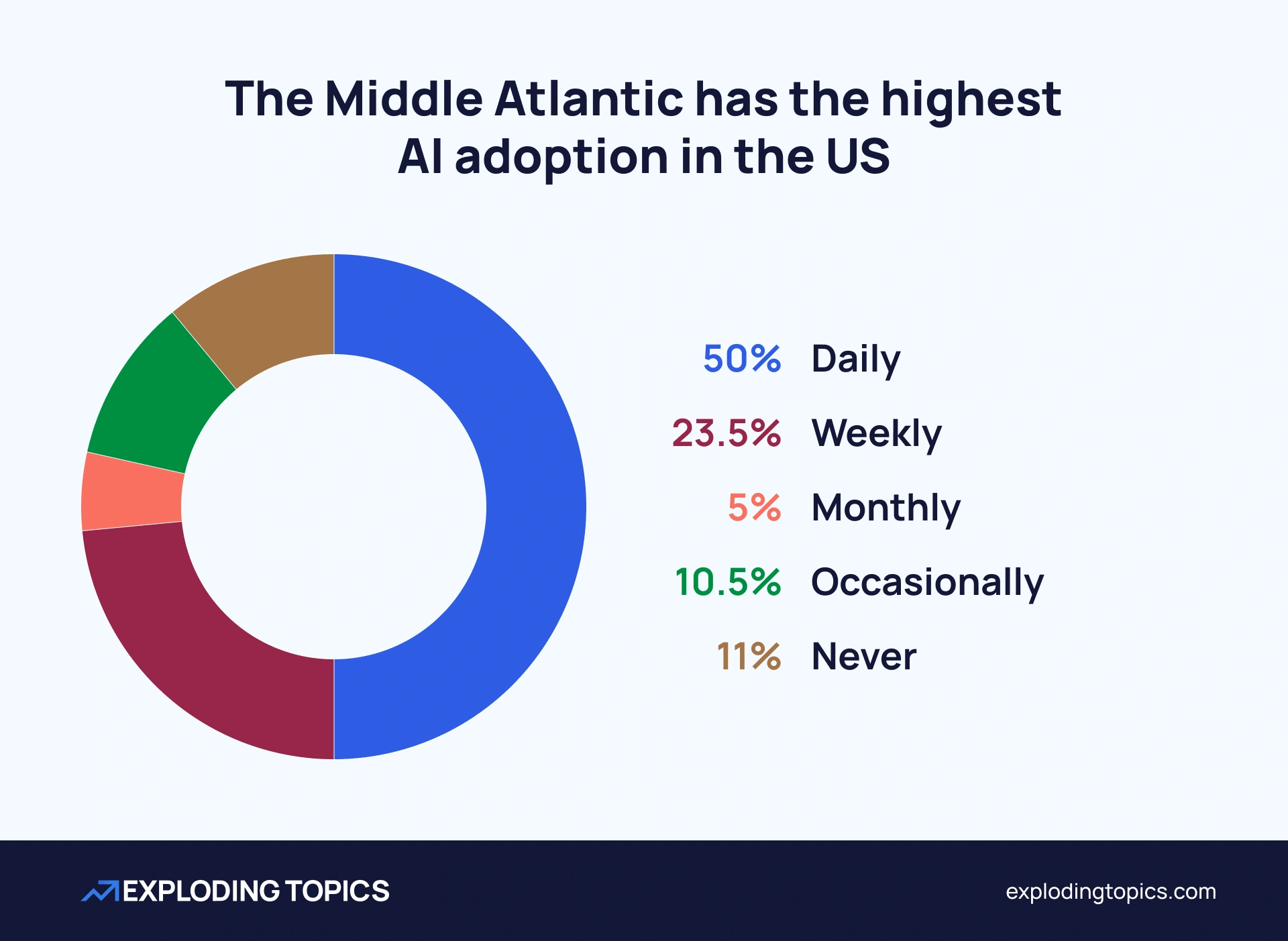
Other notably AI-forward regions included the Pacific and East South Central. Well over a third of users in each region describe themselves as daily AI users.
By contrast, AI adoption is lowest in New England. Barely 1 in 5 (21.62%) New England residents are daily AI users, and 27.03% of residents have never used AI.
Here’s the full regional breakdown of AI users in the US:
| US Region | Daily AI users | Weekly AI users | Monthly AI users | Occasional AI users | AI non-users |
| Middle Atlantic | 50% | 23.5% | 5% | 10.5% | 11% |
| Pacific | 43.95% | 22.87% | 6.73% | 14.8% | 11.66% |
| East South Central | 36.59% | 19.51% | 0% | 26.83% | 17.07% |
| West South Central | 34.48% | 21.84% | 3.45% | 22.99% | 17.24% |
| West North Central | 33.33% | 20.83% | 10.42% | 14.58% | 20.83% |
| East North Central | 28.57% | 19.64% | 10.71% | 20.54% | 20.54% |
| Mountain | 28% | 22% | 8% | 18% | 24% |
| New England | 21.62% | 24.32% | 10.81% | 16.22% | 27.03% |
At state level, Visual Capitalist data shows that AI usage is highest in the District of Columbia, where 40.3% of people are regular AI users. (Specific figures cannot be directly compared to our regional data, with different definitions and reporting methods used.)
Maryland (36.3%) has the next-highest proportion of regular AI users, followed by Utah (35.7%) and Texas (35.3%). That’s compared to a US national average of 31.3%.
Adoption is lowest in West Virginia (20.8%), Maine (21.4%), and Montana (22.7%).
Here are the top 10 states (including the District of Columbia) for AI adoption:
| State | Regular AI users (%) |
| District of Columbia | 40.3% |
| Maryland | 36.3% |
| Utah | 35.7% |
| Texas | 35.3% |
| Virginia | 34.7% |
| New Jersey | 34.5% |
| Nevada | 34.2% |
| California | 34% |
| Connecticut | 34% |
| Georgia | 33.7% |
AI Users by Household Income
AI usage varies by household income more than by any other demographic. There is a stark difference between higher and lower-income households.
People in high-income households are significantly more likely to be heavy AI users. 66.9% of people with household incomes of at least $150,000 use AI daily, versus just 23.24% of people with household incomes below $75,000.
Those in high-income households almost universally use AI at least occasionally. Only 3.18% of people with household incomes above $150,000 say they have never used AI.
The chart below shows a clear trend: as household income increases, so too does AI usage.
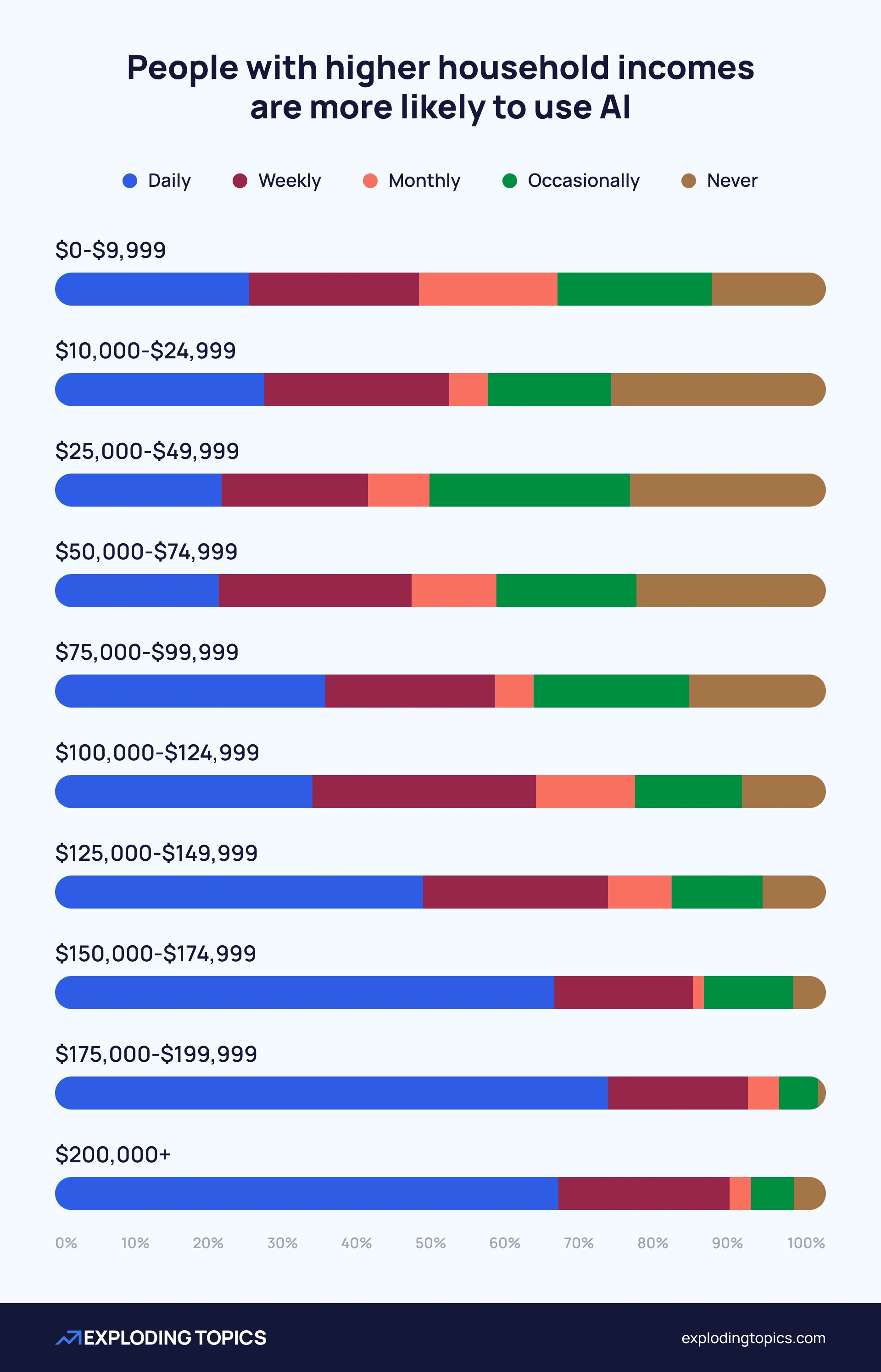
Research by Ipsos and Epoch AI shows that income also affects typical AI user preferences. Almost 80% of Claude users in the US have household incomes of at least $100,000, compared to just 37% of Meta AI users.
Here’s a full breakdown of AI chatbot preferences based on household income:
| Under $25,000 | $25,000- $50,000 | $50,000- $75,000 | $75,000- $100,000 | $100,000+ | |
| ChatGPT | 7.4% | 9.8% | 11.1% | 11.4% | 60.3% |
| Google Gemini | 8.5% | 11.1% | 12.7% | 11.7% | 55.9% |
| Meta AI | 17.1% | 15.0% | 17.3% | 14.1% | 36.5% |
| Claude | 2.5% | 3.9% | 6.4% | 7.8% | 79.8% |
| Microsoft Copilot | 5.7% | 8.9% | 11.9% | 9.8% | 63.7% |
| Grok | 9.5% | 12.1% | 12.3% | 9.9% | 56.2% |
Overall AI adoption
We’ve now seen the demographic breakdown of AI users. But how many people use AI overall?
In total, 1.8 billion people worldwide have used AI tools. 500-600 million people are daily AI users.
ChatGPT alone has over 1 billion monthly active users.
Young and old, male and female, it’s clear that AI has become a massive part of our everyday lives. Although the slight reticence of Gen Z and Gen Alpha is a fascinating and notable caveat, businesses that don’t adapt to AI still undoubtedly risk being left behind.
The percentage of zero-click searches is only going to keep rising. AI visibility is the new holy grail for brands: even without major click-through, positive mentions in some of Google’s most valuable real estate can have a powerful effect.
The Semrush AI Visibility Toolkit is a great tool to guide you through this new era of user behavior. It gives you granular data on your AI performance, and tailored suggestions on how to optimize your content and brand presence specifically for AI.
Sign up to Semrush now for a free trial.
Stop Guessing, Start Growing 🚀
Use real-time topic data to create content that resonates and brings results.
Exploding Topics is owned by Semrush. Our mission is to provide accurate data and expert insights on emerging trends. Unless otherwise noted, this page’s content was written by either an employee or a paid contractor of Semrush Inc.
Share
Newsletter Signup
By clicking “Subscribe” you agree to Semrush Privacy Policy and consent to Semrush using your contact data for newsletter purposes
Written By


James is a Journalist at Exploding Topics. After graduating from the University of Oxford with a degree in Law, he completed a... Read more