


Get Advanced Insights on Any Topic
Discover Trends 12+ Months Before Everyone Else
How We Find Trends Before They Take Off
Exploding Topics’ advanced algorithm monitors millions of unstructured data points to spot trends early on.
Keyword Research
Performance Tracking
Competitor Intelligence
Fix Your Site’s SEO Issues in 30 Seconds
Find technical issues blocking search visibility. Get prioritized, actionable fixes in seconds.
Powered by data from
Latest Blog Posts
Featured Case Studies
See what's trending before everyone else
Each week, we'll send you our best Exploding Topics. Plus, expert insight and analysis.
28+ AI Water Usage and Environmental Impact Stats (2026)

 Add Exploding Topics on GoogleAdd Exploding Topics as your preferred source to see more of our stories on Google.
The age of AI has arrived. A billion people are using ChatGPT every month, and 88% of companies are using AI in their daily operations.
AI is ushering in numerous benefits: increased efficiency, round-the-clock availability, and hyper-personalization, to name a few. But as AI technology is adopted at scale, questions remain about environmental impact.
The amount of water that AI data centers use has proved particularly controversial. But there are also concerns about electricity usage (and knock-on carbon emissions) and AI-driven overextraction of various minerals.
On the other hand, there are ways in which AI can aid environmental efforts. Turning the full power of AI toward climate issues has the potential to surface new insights, optimize renewable energy grids, and more.
With strong feelings on both sides of the debate, it can be hard to get the full picture. Which is why we’ve put together a neutral’s guide to the real statistics on AI water usage and environmental impact.
Headline Stats
- AI data centers will use more than 1 trillion liters of water annually by 2028
- Over 90% of AI water usage is indirect, coming from electricity generation rather than data center cooling
- Sam Altman claims each ChatGPT query uses just 1/15th of a teaspoon of water
- More than half of data centers are in areas facing at least medium-level vulnerability to drought, flooding, and/or declining water quality
- A GPT-5 query uses up to 20x more energy than a GPT-4 query
- By 2028, AI data centers will use enough electricity to power 22% of US homes for a year
- Almost three-quarters of US consumers are at least a little worried about AI’s environmental impact
- AI could unlock 175 gigawatts of additional transmission capacity by improving grid efficiency
How Much Water Does AI Use?
Water usage is one of the hottest topics in debates about the environmental impact of AI. The perceived strain on water supplies comes from the need for vast amounts of water in order to cool servers in AI data centers.
However, Sam Altman and others have argued that the individual impact of each AI prompt is vanishingly small. Additionally, some data center cooling systems reuse the same water multiple times (although there are complications), so overall figures can be misleading. Other industries may also place a similar or greater strain on water supplies.
Let’s see what the data says:
AI data centers are projected to use 1.068 trillion liters of water per year by 2028 (Morgan Stanley)
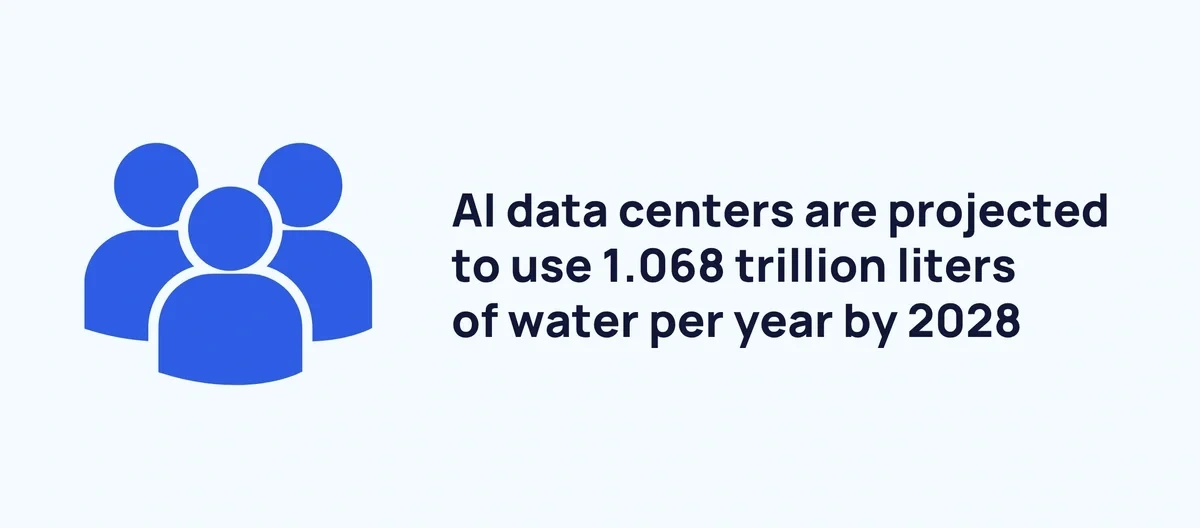
Looking at the water required both for cooling and for electricity generation, Morgan Stanley estimates that AI data centers will require over a trillion liters of water by 2028. That’s an 11x increase versus estimated 2024 water usage. On top of that, semiconductor manufacturing also requires up to 5 million gallons of ultrapure water every day.
92.54% of AI water usage is “indirect” (CBS News)
Data center cooling is most often cited in discussions about AI water usage. But the biggest water impact by far is actually indirect usage, via the water used to generate electricity that data centers subsequently consume.
A single ChatGPT query uses the equivalent of about one-fifteenth of a teaspoon of water (Sam Altman’s blog)
OpenAI has made limited public statements about its water and electricity consumption, but CEO Sam Altman provided some figures on his personal blog in 2025. He revealed that each individual query uses 0.000085 gallons of water, as well as 0.34 watt-hours of electricity (roughly what a high-efficiency lightbulb would use in a couple of minutes).
Google's parent company, Alphabet Inc., used 10,869 million gallons of water in 2025 (Google)
Google's 2026 Environmental Report shows about a 34% increase in water consumption between 2024 and 2025. It attributes the increase to increased demand for its products and services driving higher data center activity.
Making 10-50 queries using GPT-3 is enough to consume about 500ml of water (Association for Computing Machinery)
Research published last year cast doubt on Altman’s water usage claims, suggesting that it only takes 10-50 medium-length queries using GPT-3 to use up half a liter of water. Additionally, merely training the model used an estimated 5.4 million liters. Given the time it takes to complete scientific studies, data is often based on older models, but it’s reasonable to assume that water usage has only grown more intense with subsequent models that are larger than GPT-3.
Golf courses, leaking water pipes, and residential toilets all consume more water in a year than AI data centers (CBS News)
Combining water for cooling (17 billion gallons per year) with the far larger figure for electricity generation (211 billion gallons), AI data centers use in the region of 228 billion gallons of water. That’s still dwarfed by the direct water usage of golf courses (531 billion gallons), leaking pipes (900 billion gallons), and residential toilets (1.3 trillion gallons).
In a survey of industry professionals, 73% said water availability is at least somewhat slowing the development of data centers (AlphaStruxure)
Given the arguments on both sides, it’s helpful to hear a perspective from industry insiders who are actually invested in building and expanding data centers. By and large, they do recognize that water supply is struggling to keep up with data center demand. However, only 21% described water availability as an “extremely significant” constraint, with utility capacity, permitting issues, fiber availability, and access to computer chips all ranked higher.
More than half of the world’s top data center hubs are already in medium-level water basin risk areas (Morgan Stanley)
Despite the large overall numbers, the biggest strain AI places on water is at a local rather than global level. Data center hubs place huge localized strain on supplies, with more than half of these areas now facing at least medium risk of issues like drought, flooding, and declining water quality.
Almost 68% of data centers are near protected areas or Key Biodiversity Areas (UK Government)
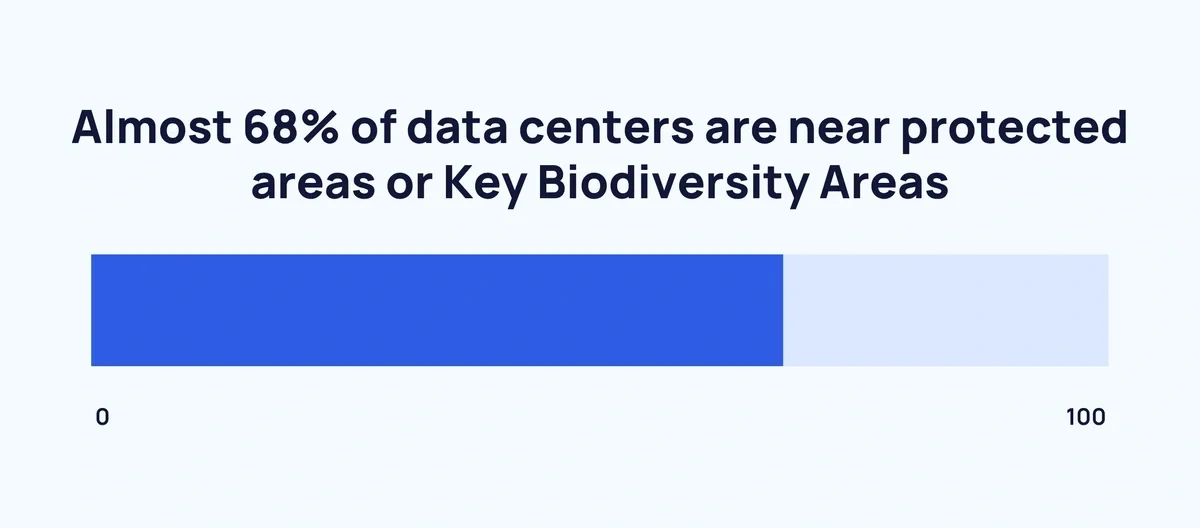
An outsized number of data centers are in areas of ecological significance. Reductions in clean water supply within those areas may lead to habitat loss and species decline. There are also risks to local people: 55% of data centers worldwide are in river basins with a high risk of water pollution, and the demands of AI could put further stresses on supply.
Microsoft is committed to a 40% improvement in data center water use intensity by 2030 (Microsoft)
Microsoft has included water usage among its five “Community-First AI Infrastructure” pledges. It plans to reduce the intensity of water usage at its data centers by optimizing water usage in cooling systems, improving the balance between water-based and air-based cooling, and launching a new closed-loop design that constantly recirculates the same cooling liquid. Microsoft has also pledged to replenish more water than it uses, with Google making the same pledge.
Closed-loop cooling systems could reduce data center water usage by 50-70% (World Economic Forum)
Reusing the same water to cool data centers is not without its challenges; dirty water can lead to bacterial growth, clogs, and corrosion. However, systems that do operate a closed loop can make water savings of 50-70%.
AI Electricity Usage
As well as possible strain on water supplies, AI also consumes electricity. The continued reliance of the grid on non-renewable power sources means that electricity usage has a significant environmental impact in practice.
Data centers now make up 4.7% of US electricity consumption, up from 1.9% in 2018 (Environmental Law Institute)
As AI increases the load on data centers, electricity use has been steadily increasing. Forecasts suggest that data centers could account for 11.8% of all US electricity consumption by 2030.
By 2028, the annual electricity going to AI data centers will be enough to power 22% of US households (MIT)
Forecasts suggest that data centers will consume more electricity for AI-specific purposes in 2028 than they currently use for all purposes (AI and non-AI). The amount of electricity used for AI purposes (165-326 terawatt-hours per year) will be enough to power 22% of US homes.
By 2030, AI could account for 3% of global electricity usage (United Nations)
The United Nations predicts that AI will follow the “Jevons paradox,” whereby increased efficiency of AI will lead to a rise rather than fall in total consumption. As such, AI electricity demand by the end of the decade could account for 3% of all usage worldwide.
A single GPT-5 query uses up to 20x more energy than a GPT-4 query (Guardian)
The average medium-length response using the GPT-5 model is a little over 18 watt-hours, almost 53x the per-response figure that Sam Altman cited in his 2025 blog. A simple recipe request using GPT-5 could use up to 20x more energy than previous models.
44% of data center companies are waiting at least 4 years for more grid power (AlphaStruxure)
More than 9 in 10 data center industry professionals cite utility capacity as a top barrier to building more infrastructure. Almost half are facing a wait of 4+ years for more power from the grid.
57% of global electricity generation still comes from fossil fuels (Ember)
The significant amount of electricity which AI uses comes from a global grid that is still majority-reliant on fossil fuels. As such, high usage still correlates with increased greenhouse gas emissions.
AI Mineral Usage
Although water and electricity take most of the headlines, AI and the accompanying infrastructure could also place a strain on various mineral supplies, especially copper. Mining comes with further environmental effects, expanding the indirect environmental impact of AI. On the other hand, the US and global economy could benefit from increased demand.
AI could raise demand for copper by 72% in coming decades (Business Insider)
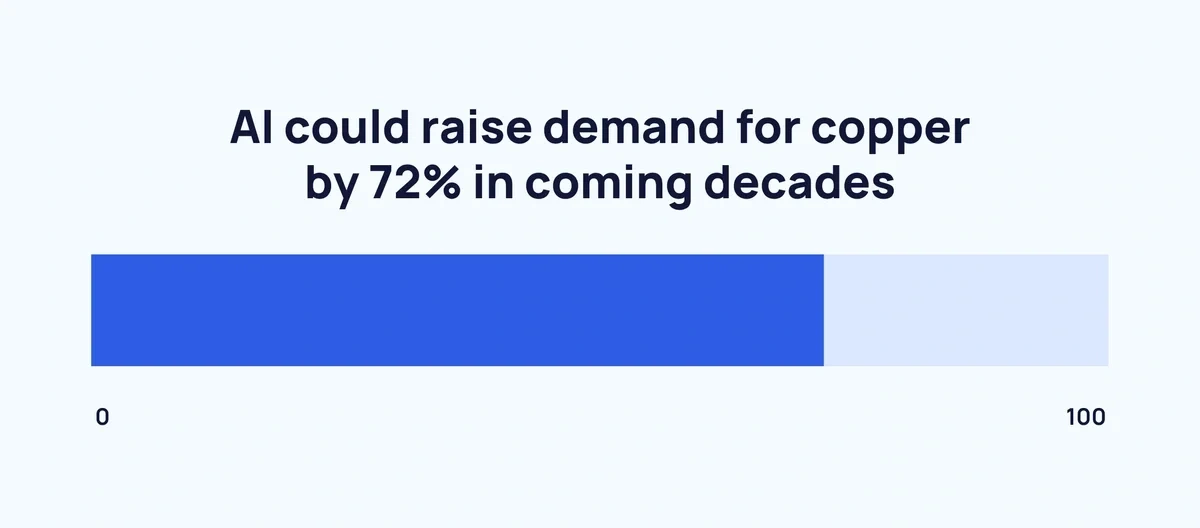
AI data centers could account for 6% to 7% of copper demand by 2050, up from less than 1% in 2024. Meanwhile, demand for copper is already outstripping usable supply. Copper is classified as a critical material by the US Department of Energy.
The US is responsible for 6% of the world’s copper supply (Vermont Journal of Environmental Law)
The US stands to be one of the biggest beneficiaries of an AI “copper rush.” It is the world’s fifth-largest producer of copper, behind only Chile, Peru, China, and the Democratic Republic of Congo.
92% of water treatment systems around US copper mines have failed (Vermont Journal of Environmental Law)
Byproducts of copper mining can enter waterways, leading to potentially dangerous contamination. One study found that the vast majority of water treatment systems fail to prevent contaminated mine seepage.
AI could increase demand for up to 20 critical materials by 2030 (Resources Policy)
Although copper (83%) makes up the vast majority of total modeled mineral mass by 2030, AI and the accompanying infrastructure also uses various other critical materials. Grain-oriented electrical steel stands out as an especially constrained enabling material, with demand projected to reach 198 kilotons by 2030.
Consumer Attitudes to AI and the Environment
On the whole, consumers are at least somewhat worried about AI’s impact on the environment. However, it does not necessarily rank among their top concerns, and many feel as though there is inadequate available information to make informed choices.
74.46% of people in the US are at least a little worried about the environmental impact of AI (Exploding Topics)
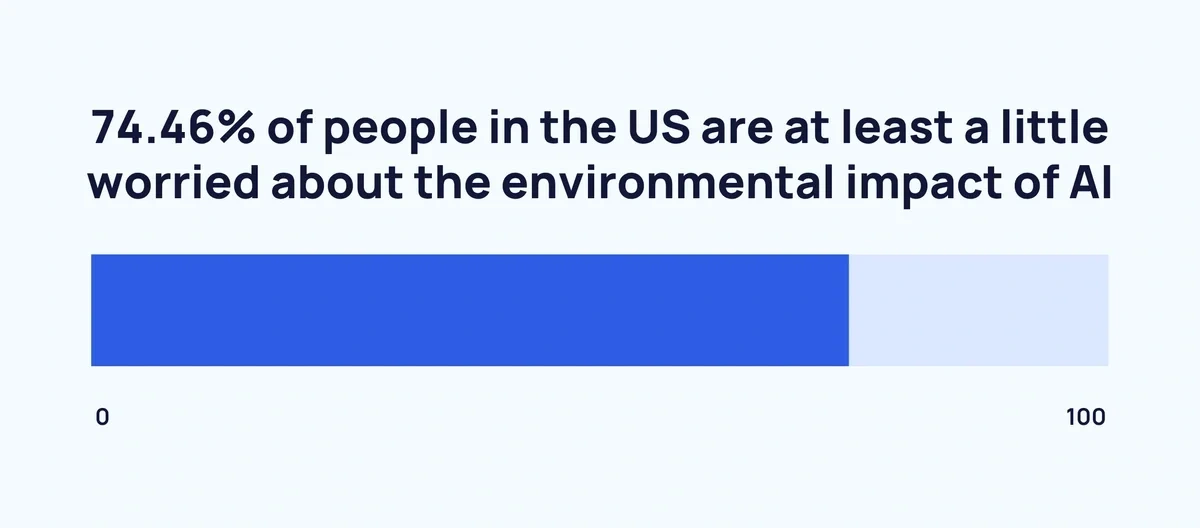
Almost three-quarters of people are at least a little concerned about the potential environmental impact of AI. Men (77.51%) are more likely than women (72.88%) to be concerned about AI and the environment, although that gap is entirely accounted for by women being more likely to say that they are “not sure.”
Roughly half of the people in the US are “extremely” or “very” worried about AI’s impact on the environment (University of Chicago)
Americans are more worried on average about the environmental impact of AI than cryptocurrency, air travel, and meat production. Whereas 41% were worried in 2025, new data for 2026 shows that that number has climbed to 53%.
Over-60s are most likely to have no concerns about the environmental impact of AI (Exploding Topics)
Environmental concerns about AI don’t cut cleanly along age lines. For instance, people aged 60+ are actually most likely to worry “a lot” about AI and the environment (37.41%). But they also account for the highest proportion of people who do not have any environmental AI concerns at all (20.14%). People aged 30-44 are most likely to be at least “a little” concerned about the environmental impact of AI, followed closely by the 18-29 age group.
27% of people don’t feel they have enough information to make sustainable choices about AI tools (Kantar)
Although 63% of current AI users would be open to adopting sustainability-positive AI tools, more than 1 in 4 consumers feel they don’t have the means to make informed choices.
Among teenagers who believe AI will have a net negative impact on society in the next 20 years, only 6% cite the environment as the main reason (Pew Research)
Teens who are worried about AI are more likely to cite overreliance, loss of critical thinking and creativity (34%), job loss (25%), misinformation, (13%) and misuse (13%) than environmental impacts (6%) as the main reason for their AI-negative attitude.
Positive Impact of AI on the Environment
Finally, it would not be fair to consider the potential negative environmental impacts of AI without looking at the positives. Advocates argue that artificial intelligence could help find the answers to some of the most pressing climate problems of our time.
AI could unlock 175 gigawatts of additional transmission capacity through efficiency gains (International Energy Agency)
Electricity systems have to manage complex supply, transmission, and demand profiles. Use of AI to model and analyze data could produce significant additional capacity within existing lines, while also enabling greater integration of renewable energy.
AI-based weather forecasting is up to 50% more accurate than standard forecasts (Atmo)
Using AI to predict weather patterns can help with disaster preparedness, mitigating some of the worst effects of climate change. It can also better forecast the amount of electricity that renewables like solar and wind will generate, making them more feasible to integrate into energy grids at scale.
Researchers studying animals in the Amazon can work 10x faster with the help of specialized AI models (Microsoft)
The headline benefit of AI is the efficiency gains it unlocks, and that is no different in the environmental sector. One example is Microsoft’s AI for Good Lab, which has partnered with groups working to protect the Amazon rainforest in Colombia. An Amazon-specific AI species identification model has allowed staff to work 10x faster.
AI is changing the world
For better or worse, AI is surely here to stay. As such, the focus should turn to how it can be used as a force for good, and how its own environmental impact can be minimized.
On an individual level, it’s about responsible usage, although consumers need to be provided with enough information to make genuinely informed choices.
Sign up to the Exploding Topics newsletter for a (human-curated) weekly briefing on the trends and startups shaping our world.
Stop Guessing, Start Growing 🚀
Use real-time topic data to create content that resonates and brings results.
Exploding Topics is owned by Semrush. Our mission is to provide accurate data and expert insights on emerging trends. Unless otherwise noted, this page’s content was written by either an employee or a paid contractor of Semrush Inc.
Share
Newsletter Signup
By clicking “Subscribe” you agree to Semrush Privacy Policy and consent to Semrush using your contact data for newsletter purposes
Written By


James is a Journalist at Exploding Topics. After graduating from the University of Oxford with a degree in Law, he completed a... Read more