Exploding Topics
Remineralizing Gum search volume grew from under 100 to 27,100 monthly searches between February 2024 and January 2026.
Remineralizing gum
+5100%
GLP 1 Supplement search volume grew from 5,920 to 74,000 monthly searches between February 2024 and January 2026.
GLP 1 supplement
+1150%
Soursop Bitters search volume grew from 9,900 to 110,000 monthly searches between March 2024 and February 2026.
Soursop bitters
+1011%



Get Advanced Insights on Any Topic
Discover Trends 12+ Months Before Everyone Else
How We Find Trends Before They Take Off
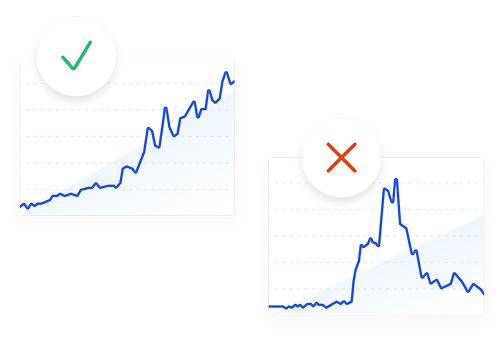
Exploding Topics’ advanced algorithm monitors millions of unstructured data points to spot trends early on.
Keyword Research
Performance Tracking
Competitor Intelligence
Fix Your Site’s SEO Issues in 30 Seconds
Find technical issues blocking search visibility. Get prioritized, actionable fixes in seconds.
Powered by data from
Latest Blog Posts
Featured Case Studies
See what's trending before everyone else
Each week, we'll send you our best Exploding Topics. Plus, expert insight and analysis.
E-commerce SEO in 2026: Grow Your Traffic Without Ads

 Add Exploding Topics on GoogleAdd Exploding Topics as your preferred source to see more of our stories on Google.
Organic search can be a huge traffic driver to your store. And it can work for you day and night, whether or not you’re currently spending money on ads, creating content on social media, or sending emails.
On average, organic search drives about one in three visits to E-commerce stores, according to Promodo. That’s 33% of overall traffic!
And although it takes some SEO work behind the scenes, that traffic doesn't stop the moment you stop spending on ads or posting on social media.
Organic traffic, on the other hand, can compound. Pages that rank today can drive sales for a while without additional spend.
But organic traffic doesn’t just come on its own. You’ll need a solid E-commerce SEO strategy—one that’s built for the way search works now, with AI Overviews and large language models (LLMs) answering searchers’ questions before you can.
In this guide, I’ll cover creating a full E-commerce SEO strategy, including how to build and optimize the right page types and how to show up in both traditional and AI-powered search results.
Plus, I’ll include a bonus section on how to find products with growing search demand to kick off your whole SEO strategy a step ahead of the competition.
What is E-commerce SEO? How is it Different From Standard SEO?
E-commerce SEO is not just a scaled-up version of standard SEO.
E-commerce SEO is the process of optimizing an online store to rank higher in search results and attract buyers without paying for clicks or impressions.
The end goal is to get product pages, category pages, and supporting content in front of consumers who are actively looking for what you sell.
An online store can have thousands of product pages, category variations, seasonal collections, and filtered navigation pages to optimize, so it usually needs a more expansive SEO plan than a typical website running standard SEO.
E-commerce sites also need to rank across multiple intent types simultaneously. Product pages target transactional queries from buyers who are ready to purchase. Category pages target broader browsing queries. Blog content targets informational queries from shoppers still in research mode. Each page type has different optimization requirements and a different role in moving someone from search to sale.
E-commerce SEO has three main foundations:
- Technical SEO (making sure Google can crawl and index your store)
- On-page SEO (optimizing each page type for the right queries)
- Content strategy (building topical authority that lifts rankings across the entire site over time)
This guide covers all three.
But before we take a look at those, here’s how you can set yourself up for success before you even put your whole SEO strategy in place.
Start by Stocking Products With Growing Search Demand
Other E-commerce SEO guides start with optimizing your existing product pages. That's cool if your catalog is already set in stone.
But if you want to give your SEO a head start, stock up-and-coming products that are just about to have their moment.
Already do that? Great! Then you can use search trend data to decide which products to prioritize before investing in SEO.
If you hop on a trend before it goes mainstream, you can build your topical authority and really dial in your technical and on-page SEO for that product or product category before your competitors even stock the product.
But how do you find trending products to stock and optimize before they hit it big?
With Exploding Topics, you can find products or product categories whose search interest is gaining momentum across search engines and social platforms.
Momentum equals opportunity.
How to Find Trending Products & Categories
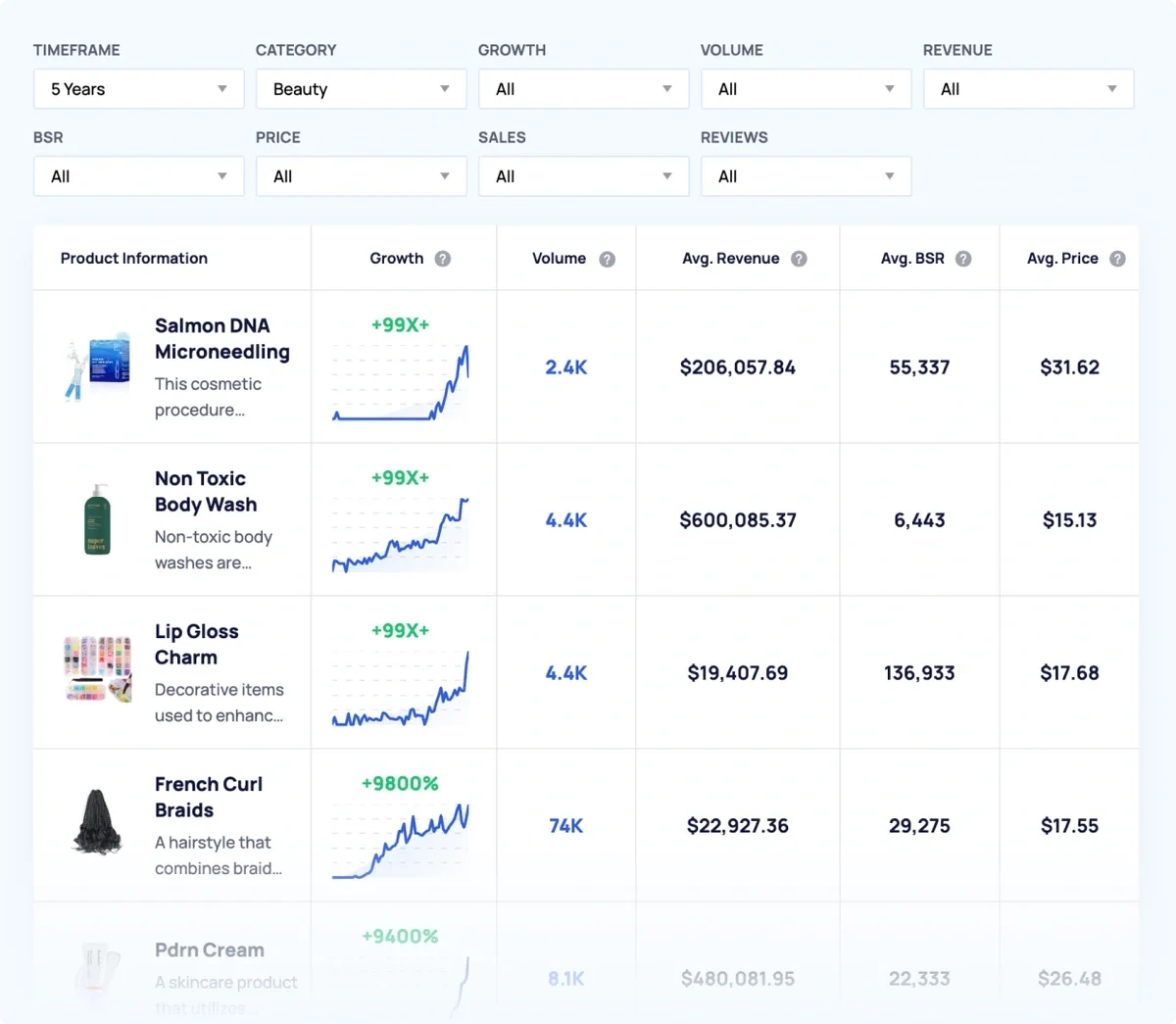
Exploding Topics has a dedicated Trending Products report that filters trend data specifically to emerging products.
To find the best, most relevant trending products for your store:
- Navigate to “Trending Products” and filter by your niche or category:
- Use the other filters to scale down further. For example, the Growth filter can help you find products that are “Exploding” (signals fast, recent growth—best for getting in early), “Regular” (steady, sustained demand—best for products worth long-term investment, or “Peaked” (declining interest, a harder SEO climb against competitors already ranking).
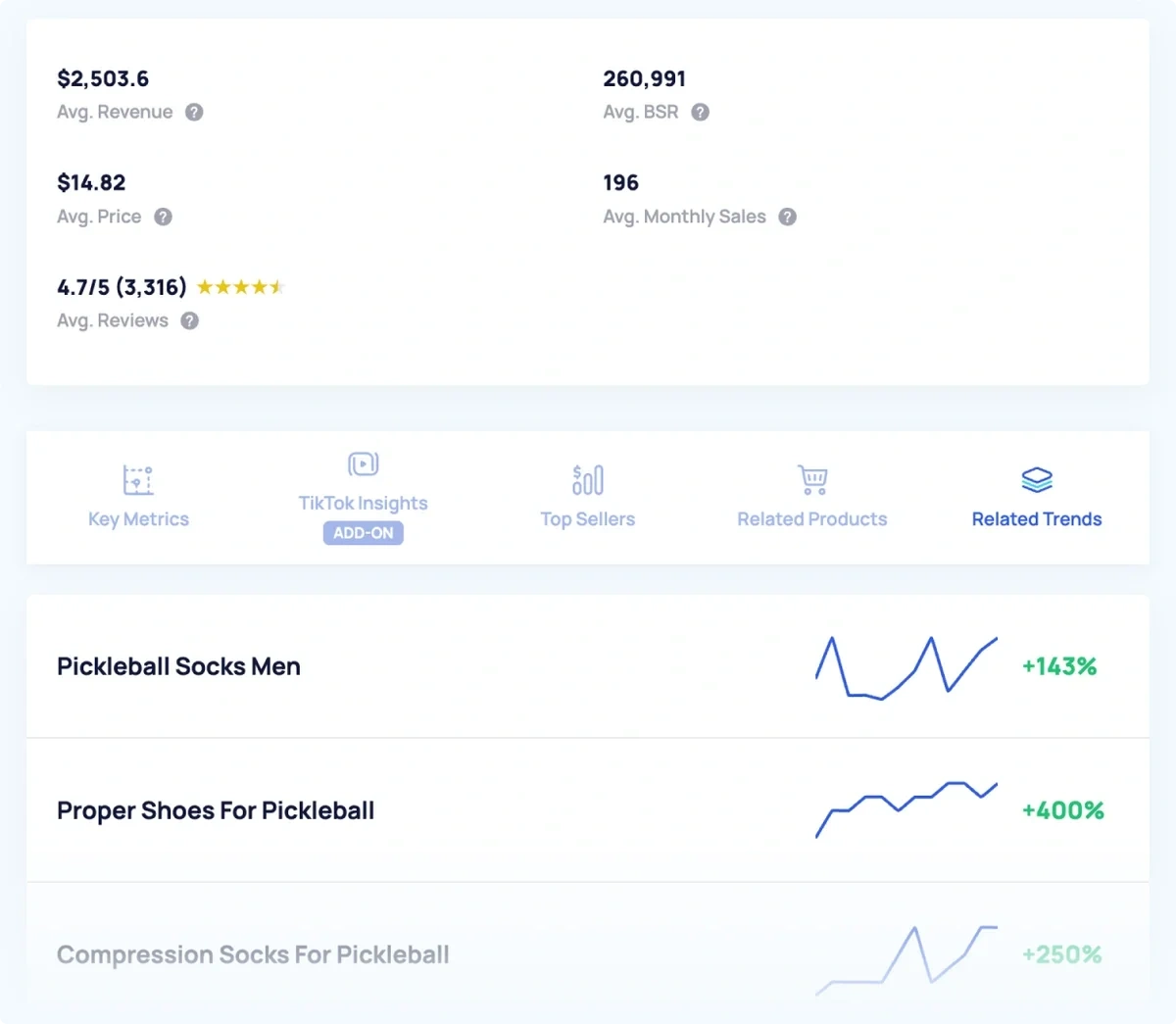
- Once you identify a promising product, click through to the detail page. Here you’ll find a forecast, related products, top-selling product brands, a channel breakdown, and more.
Start your free trial of Exploding Topics Pro now.
Once you know which products are worth prioritizing, the next step is making sure you're building the right pages to capture how people actually search for them.
Matching Search Intent to Your Page Types
Knowing which products to stock and work on optimizing first is only half the E-commerce SEO equation. The other half is building the right pages and the right content to capture each type of search query and topic your products generate.
Start by mapping intent.
Take one of your trending products, type it into a keyword research tool and get a feel for how people are searching for it. Queries like "buy [product]" or "[product] price" are transactional. Queries like "how does [product] work" or "best [product] for [use case]" are informational.
Each query type belongs on a different page, and assigning them correctly before you build out your content is incredibly important.
E-commerce stores need three distinct page types to cover the full range of how buyers search, and each one has to be optimized differently. Getting this wrong is one of the most common E-commerce SEO mistakes. If you don’t map out your plan beforehand, you may end up optimizing multiple pages for the same keyword or topic, causing them to cannibalize each other.
That just means you’ve confused search engines and LLMs, so they don’t know which page or content is right to serve to searchers and end up avoiding your content altogether.
So, keep your SEO work focused, not disjointed.
| Page Type | Query Type | Example Query | Funnel Stage | SEO Focus | Primary Goal |
| Category page | Broad, high-volume | "men's trail running shoes" | Mid-funnel (browsing) | Primary keyword in H1, title tag, and URL | Capture browsers comparing options |
| Product page | Specific, transactional | "Brooks Cascadia 18" | Bottom-funnel (buying) | Product name, model, and variant keywords | Convert shoppers who have decided |
| Blog / buying guide | Informational | "best trail running shoes for wide feet" | Top-funnel (researching) | Topic coverage, internal links to category and product pages | Introduce shoppers early and build topical authority |
The three page types you need to optimize separately are:
- Category pages target broad, high-volume queries. Someone searching "men's trail running shoes" is browsing and comparing options—they haven't decided yet. Your category page should use the primary keyword/topic in the H1, title tag, and URL, and the page content should help a shopper understand what differentiates your selection.
- Product pages target specific, transactional queries. The same shopper eventually searches "Brooks Cascadia 18"—they've decided and they want to buy. Product pages convert better than category pages because intent is further down the funnel, but they won't typically capture the earlier-stage traffic a category page does.
- Blog content and buying guides target informational queries that happen before someone has decided what to buy. "Best trail running shoes for wide feet" and "trail running shoes vs road shoes" are informational queries. A well-built buying guide ranks for these, introduces shoppers to your store at the research stage, and links through to the relevant category and product pages when they're ready to browse.
The three page types work as a funnel. Blog content builds topical authority and captures early-stage visitors. Category pages are for mid-funnel browsers. Product pages bring in buyers. Internal links should connect all three tiers, flowing authority from content down to category pages and from category pages down to products.
At least, that’s how funnels are designed to work. These days, traditional funnels have broken a bit with the fragmented way searchers now research and discover products online. So although it’s still incredibly important to optimize your pages in the way I described, know that you need a well-rounded strategy that includes SEO, content marketing, and PR to drive traffic.
Also, make sure that you’re researching and targeting complete topics, not just one-off keywords.
For a deeper look at how to build a research process around topics and intent rather than individual keywords, see Why Keyword Research Doesn't Work in 2026 (And What to Do Instead).
Important Note: Avoid Keyword Cannibalization
One of the biggest mistakes people make with E-commerce SEO is not paying enough attention to keyword cannibalization.
Cannibalization happens when two pages on the same site target the same keywords or topic and split the ranking signals that should be concentrated on one. One of the most common versions in E-commerce: a category page and a blog post both targeting the same broad topic.
The fix for this is intent alignment before you build. Make category pages own transactional keywords, whereas blog content owns informational keywords. Map each topic to exactly one page type, and you’ll eliminate the overlap before it becomes a problem.
Site Structure and URL Strategy
With your page types mapped out, the next thing to think about is how those pages connect—and how Google navigates between them.
A thoughtfully organized site structure tells Google which pages matter the most and makes it easy for shoppers to move through your website from discovery to purchase.
The standard E-commerce page hierarchy is typically homepage → category pages → subcategory pages → product pages, with each level reachable within a few clicks. Pages buried too deep can get a bit lost both to search engines and to customers, so keep your products from sinking too deep down the line.
For the best possible E-commerce SEO, URLs should reflect your hierarchy and stay human-readable. A URL like yourstore.com/womens-boots/ankle-boots/chelsea-boot-brown tells both Google and the visitor exactly where they are. Parameter-heavy URLs like yourstore.com/product?id=4872&color=brown are harder to index and don't communicate anything useful.
Some websites use faceted navigation—filtering by size, color, or price, for example. This can generate large numbers of near-duplicate URLs that dilute your crawl budget and fragment ranking signals.
To fix that issue, use canonical tags to point filtered variants back to the main category or product page, or apply a noindex tag to low-value filter combinations. The goal is to concentrate Google's crawl budget on pages that actually have ranking potential.
Site Structure Note: Internal Linking for E-commerce SEO
Internal linking is one of the most underleveraged tools in E-commerce SEO, and one of the easiest to improve without creating new content.
Every internal link passes authority from one page to another. In an E-commerce context, that means blog content and high-authority category pages can actively strengthen the rankings of product pages simply by linking to them. Category pages should link to relevant subcategories and top products. Blog content should link to the category pages it's most closely related to. The flow of authority should always point toward the pages that drive transactions, but don’t discount interlinking blog posts and category pages, too.
Anchor text matters as well. Use descriptive, relevant anchor text that tells Google what the destination page is about. "Women's waterproof hiking boots" is more useful than "click here" or "these boots." Vary the phrasing across different links pointing to the same page rather than repeating identical anchor text each time.
For large E-commerce catalogs, it's worth periodically auditing for orphan pages—pages with no internal links pointing to them. Google relies on links to find and rank content, so orphaned pages rarely get found regardless of how well optimized they are on the page level. A tool like the Semrush Site Audit can find these quickly.
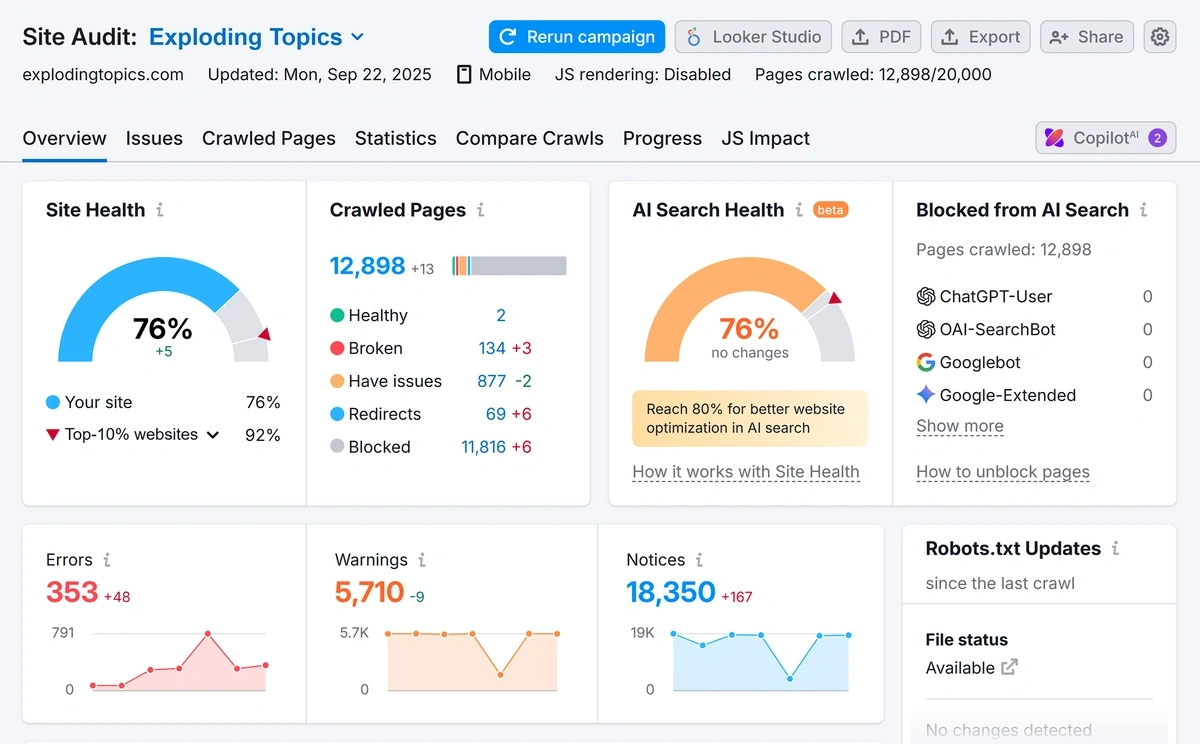
For a full walkthrough of internal linking best practices, see our Internal Linking Guide.
On-Page SEO for Product and Category Pages
Once your site’s structure is solid, the next E-commerce SEO layer is optimizing the individual pages within it.
Each product and category page needs a unique title tag that leads with the primary keyword/topic and stays under 60 characters. Meta descriptions likely won't directly affect rankings, but they may influence click-through rate from the SERP, so write them for the shopper, not the algorithm.
Product descriptions are also important, and they’re where many E-commerce stores lose ground. Copying manufacturer descriptions creates duplicate content across dozens of retailers, giving Google no reason to rank your version over anyone else's.
If possible, write original descriptions that address how the product solves a specific problem, naturally incorporate target keywords, and answer the questions a shopper would ask before buying.
Structured data (specifically Product schema) is one of the highest-impact on-page investments an E-commerce store can make. Product schema enables rich results in Google SERPs showing price, availability, and review ratings directly in the search listing.
These rich results increase click-through rates and, critically, make your product data readable by AI systems evaluating purchase-related queries. Review schema and Breadcrumb schema compound this effect across your catalog.
Image optimization matters more in E-commerce than in almost any other site type. Every product image should have descriptive alt text that includes the product name and relevant topical information. Compress images to minimize page load time without sacrificing quality, as slow-loading product pages lose both rankings and conversions.
Content Marketing That Builds Topical Authority
Strong on-page optimization improves how individual pages rank. Content marketing, though, improves how the entire site ranks.
Product pages and category pages alone won't build the kind of authority your store needs to show up in search results. Informational content (like buying guides, comparison posts, and how-to articles) does that work by establishing your store as a trusted source on topics related to what you sell.
This is topical authority at work.
When you cover a subject area widely and with expertise, Google and LLMs start to recognize it as a reliable source and will hopefully start to surface your content consistently across that topic.
For more on building a content strategy, check out our Free Content Strategy Template With Tools & Examples.
One of the absolute best things you can do for your content strategy in the age of AI Overviews and increasing LLM usage is jumping on search trends and building authority before your competitors can catch up.
Use Trend Data to Get Ahead of Content Competition
You've already identified trending products in your niche using the Trending Products report in Exploding Topics. Now, use the Trend Analysis tool to surface the informational topics forming around those products.
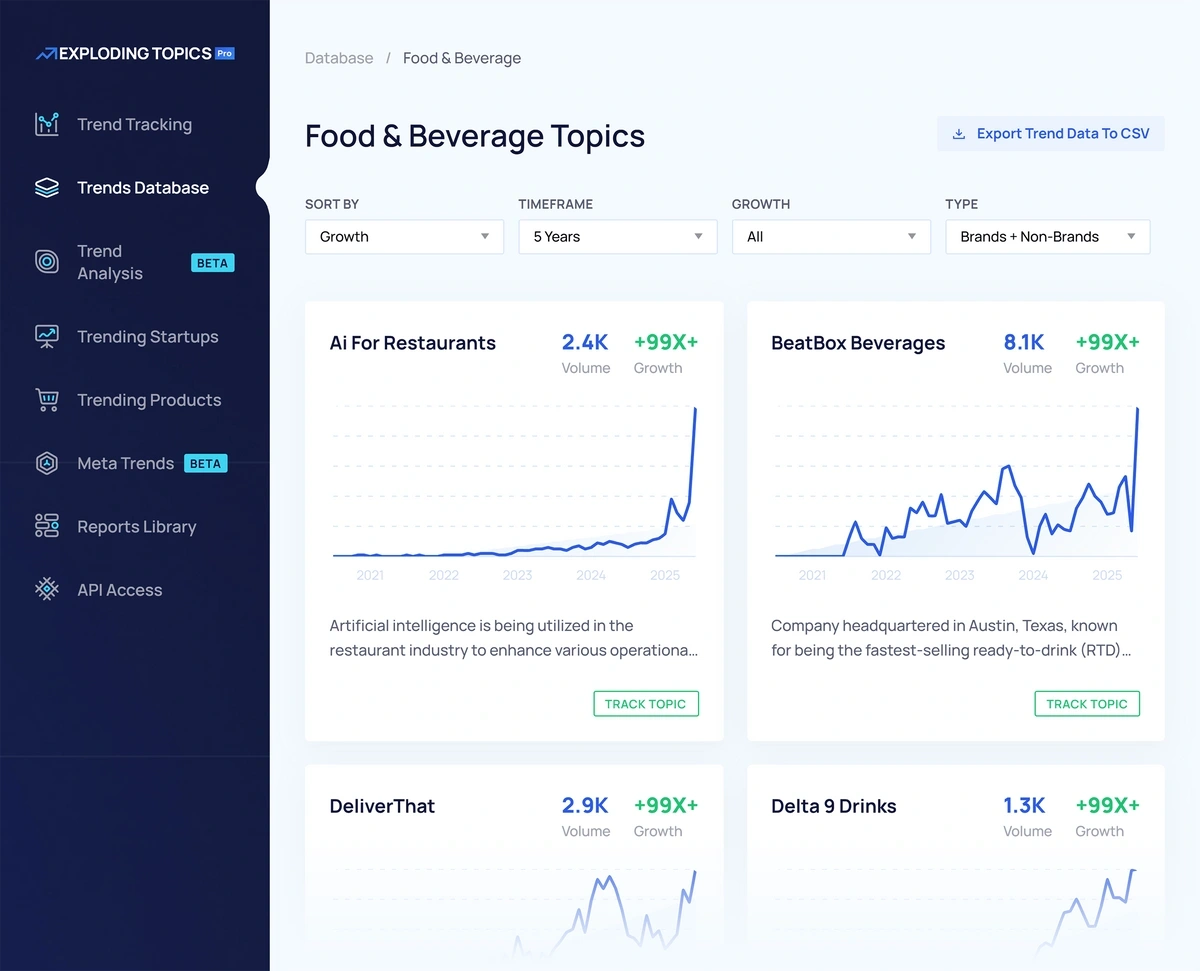
Think questions people are starting to ask, related concepts gaining popularity, and trending use cases that haven't been covered extensively yet.
Creating content around these rising topics now means you're building authority in a less competitive environment. So by the time the topic reaches its highest traffic point, your content has more age, backlinks, and engagement signals than all the newer content that’s popping up.
Remember to build your internal links from your new trendjacking content. Every informational piece should link to the most relevant category page, routing the topical authority it builds toward the pages that drive transactions.
Learn how to use Exploding Topics to build early authority in What is Trendjacking? How to Use it in Your Marketing.
That content foundation also sets you up for the fastest-changing part of E-commerce SEO right now: showing up in AI-powered search results.
E-commerce SEO in the Age of AI Overviews
The most rapidly changing part of E-commerce SEO right now is what happens outside of the organic results.
Google’s AI Overviews, AI Mode, ChatGPT, and Perplexity now all surface product recommendations directly in chat responses, complete with pricing, ratings, and links to purchase. For E-commerce stores, this is a crazy cool opportunity for a meaningful new discovery channel, but it operates by different rules than traditional search.
Here are three things you can do right now to make sure your store and your products are visible in these new search environments.
1. Make Sure AI Can Find and Read Your Store
The E-commerce AI search visibility starting point is crawlability. AI search engines use their own bots, and these need to be permitted in your robots.txt file. If you're inadvertently blocking them, no amount of content optimization will help.
Beyond crawlability, structured data is the highest-impact technical investment you can make for AI visibility. I mentioned Product schema earlier, but you’ll also want to think about adding others like Offer schema, AggregateRating, and Review schema. These make your product data machine-readable in a way that plain text descriptions don't.
Price, availability, return policy, and shipping details should all be marked up clearly and kept consistent across your product feeds, on-site schema, and page content. Inconsistencies between these can cause AI systems to display inaccurate information, which may cost you the sale.
2. Keep Product Feeds Updated
AI shopping recommendations don't rely on web content alone. Semrush research found that ChatGPT's product recommendations align with top Google Shopping results around 75% of the time, which means keeping your Google Merchant Center feed accurate, complete, and up to date is as important as any on-page optimization.
3. Create Content That Earns AI Citations
I already touched on how AI search platforms actively cite product review articles, buying guides, and comparison content when answering shopping-related queries. So keep going on that!
Also, product descriptions and buying guides should be written in direct, specific language that addresses particular use cases, audience needs, and product attributes. AI systems match products to queries by reading feature labels and intent signals from your content, so clearly answer what a product does, who it's for, and why it's the right choice for a specific need.
Reviews and user-generated content are important, too. Ratings appear prominently in AI product carousels. Products with poor ratings or thin review coverage are unlikely to be featured, regardless of how well optimized the product page is.
For a full breakdown of how to optimize your E-commerce store for AI shopping features, see How to Optimize Your E-commerce Store for AI Search.
If you'd like to dive deeper into the data on how AI is impacting online shopping habits, we at Exploding Topics conducted a study and compiled the data for you.
Read more: New data: 77% use AI to shop. Nearly 1 in 3 won't let it spend. (Exploding Topics original research, 2026)
Once you've got all of this in place, the last piece is knowing how to tell whether it's actually working.
How to Measure E-commerce SEO Performance
Building a full-featured E-commerce SEO framework takes real investment, so you’ll want to track the right signals to figure out if it’s actually working or not.
Tracking E-commerce SEO performance starts with Google Search Console, which shows which queries are driving impressions and clicks to which pages. Monitor category pages, product pages, and blog content separately, since they serve different stages of the buyer journey and have different success metrics.
Organic revenue and assisted conversions in your analytics platform help you figure out whether your visibility is translating to sales, not just traffic. Keep in mind, though, that this attribution can be tricky to measure. Today’s customers often have multiple different interactions with your brand through multiple different channels before converting.
Core Web Vitals scores, crawl coverage, and index status are also important metrics to keep an eye on. Google Search Console surfaces these directly, and addressing issues as they appear is more effective than treating technical SEO as a one-time audit.
For visibility tracking and competitive benchmarking beyond what Search Console provides, Semrush One gives you the full picture of traditional rankings together with AI visibility.
The real key to E-commerce SEO is consistency. Treat it as an ongoing priority to build up and keep both organic and AI visibility as high as possible.
Stop Guessing, Start Growing 🚀
Use real-time topic data to create content that resonates and brings results.
Exploding Topics is owned by Semrush. Our mission is to provide accurate data and expert insights on emerging trends. Unless otherwise noted, this page’s content was written by either an employee or a paid contractor of Semrush Inc.
Share
Newsletter Signup
By clicking “Subscribe” you agree to Semrush Privacy Policy and consent to Semrush using your contact data for newsletter purposes
Written By


Jolissa Skow is a senior content writer and content strategist with a background in SEO, Google Analytics, and WordPress. She's be... Read more