Exploding Topics
Remineralizing Gum search volume grew from under 100 to 27,100 monthly searches between February 2024 and January 2026.
Remineralizing gum
+5100%
GLP 1 Supplement search volume grew from 5,920 to 74,000 monthly searches between February 2024 and January 2026.
GLP 1 supplement
+1150%
Soursop Bitters search volume grew from 9,900 to 110,000 monthly searches between March 2024 and February 2026.
Soursop bitters
+1011%



Get Advanced Insights on Any Topic
Discover Trends 12+ Months Before Everyone Else
How We Find Trends Before They Take Off
Exploding Topics’ advanced algorithm monitors millions of unstructured data points to spot trends early on.
Keyword Research
Performance Tracking
Competitor Intelligence
Fix Your Site’s SEO Issues in 30 Seconds
Find technical issues blocking search visibility. Get prioritized, actionable fixes in seconds.
Powered by data from
Latest Blog Posts
Featured Case Studies
See what's trending before everyone else
Each week, we'll send you our best Exploding Topics. Plus, expert insight and analysis.
How to Find Recently Funded Startups (Before Your Competitors Do)

 Add Exploding Topics on GoogleAdd Exploding Topics as your preferred source to see more of our stories on Google.
How do you usually discover a startup's funding round? Is it when a headline shows up in your feed, or a Crunchbase alert lands in your inbox?
Those are fine ways to find recently funded startups, but by that point, the round has already closed, valuations are set, and competitors have already made contact.
If you want to be one of the first to reach out, you’ll need to discover them earlier.
Keeping an eye on signals like search momentum, category growth trends, and social media activity is a great place to start with finding startups before your competition does. To do that, you’ll need a trending startups discovery tool like Exploding Topics.
In this guide, I'll walk you through how to use Exploding Topics to identify recently funded and pre-announcement startups, keep track of them over time, and validate what you find. I’ll also take a look at some tips for searching effectively.
Why Search for Recently Funded Startups?
You should search for recently funded startups because they’re at a critical point and their trajectory where validation, momentum, and opportunity combine. These are companies that already attracted capital based on early success and are now under pressure to grow fast.
Startups that have just secured funding are:
- Already vetted for high potential, with professional investors having already done preliminary due diligence on the market and the team
- Growing quickly and under pressure to sustain that pace, which keeps decision-making fast and strategic priorities clear
- Actively hiring and expanding, which gives you early signals about where the company is headed
- More likely to raise again, giving investors who engage early a relationship advantage before the next round gets competitive
- Still defining their strategic partnerships and board relationships, which means there's real influence to be had at this stage
If you can find the companies gaining pre-funding popularity, you’ll secure an edge in deal sourcing before a round is even announced.
To get there first, start watching trend data.
How to Find Recently Funded Startups Early
Exploding Topics tracks startups gaining popularity across the web. Those popularity signals often come before or accompany funding activity, since early traction and market interest are key inputs into many investment decisions.
And as startups grow, PR coverage and marketing investment tend to push search interest even higher. In many cases, Exploding Topics finds and surfaces those companies that are on the rise before any announcement is public.
Here's how to use the platform to build your flow of high-potential targets.
Step 1: Start with the Trending Startups Database
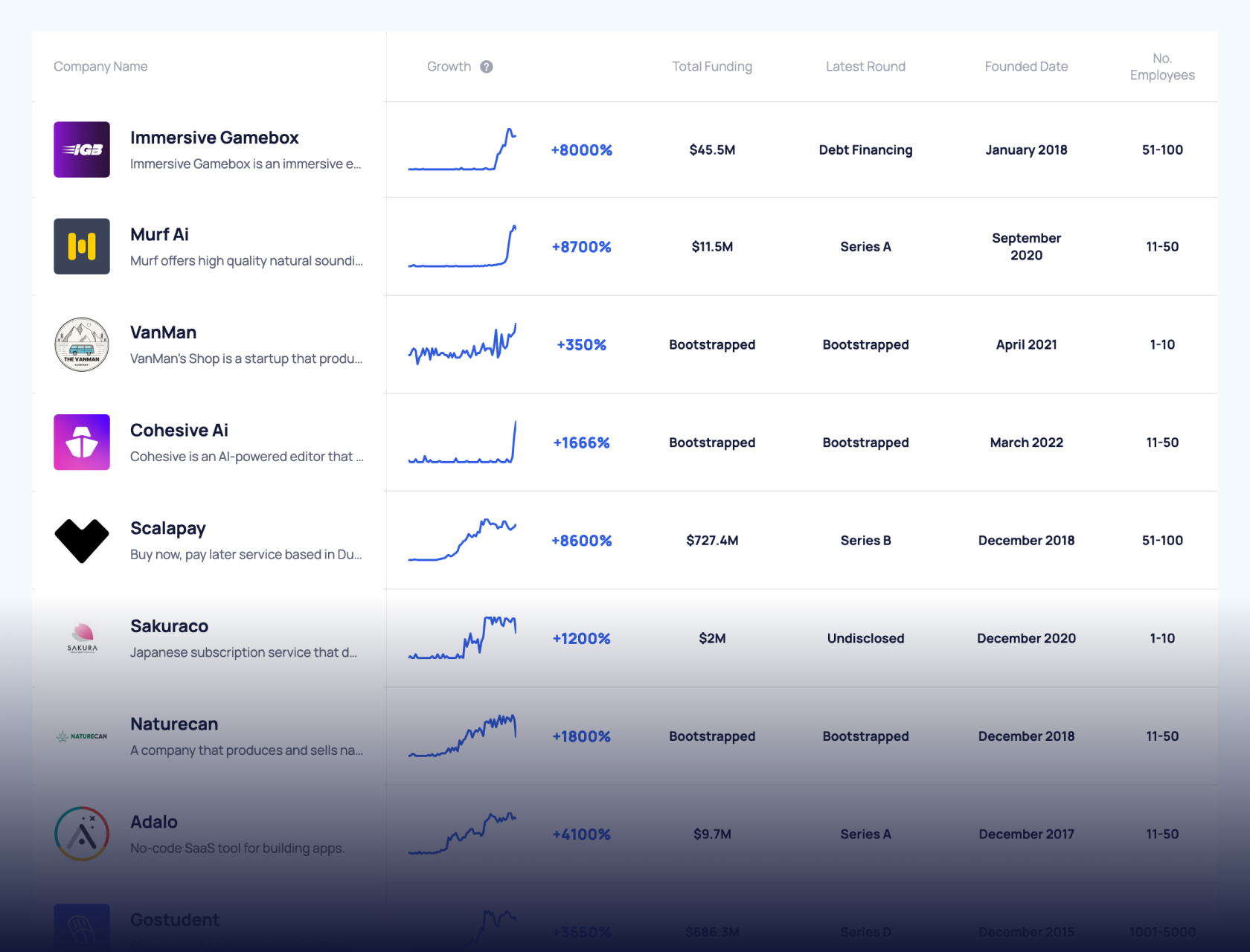
The “Trending Startups” report is the most direct route to finding up-and-coming startups. It surfaces companies with significant growth in search interest, filterable by category — like Finance, Health, Technology, Gaming, Education, and more.
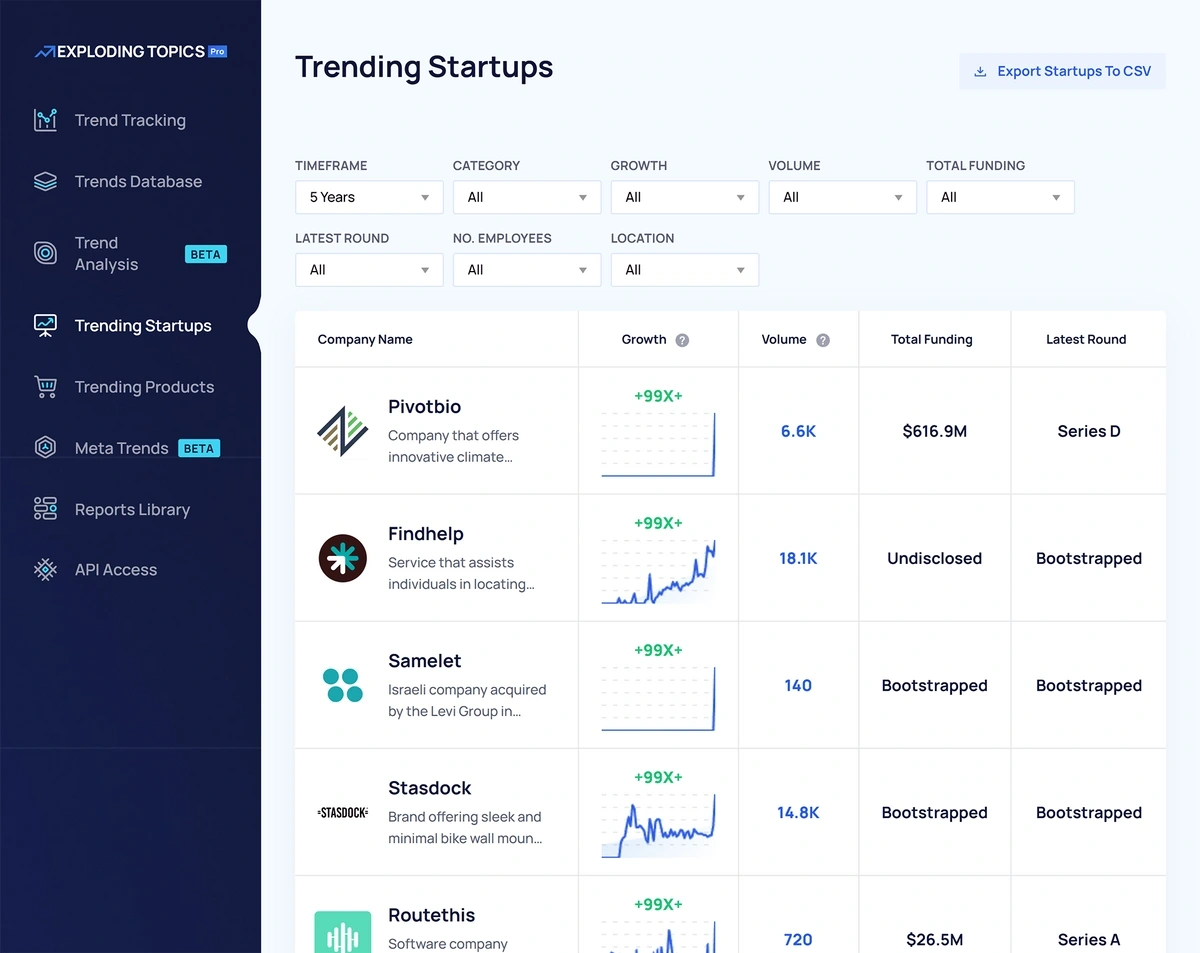
Plus, once Exploding Topics identifies brands that have shown compounding growth for at least a few months or years, we also pull in metrics you need to find the ideal startups for you, like total funding amount, funding round, employee headcount, founded date, and location.
Start by selecting the category and other filtering options that are the most relevant to your target market:
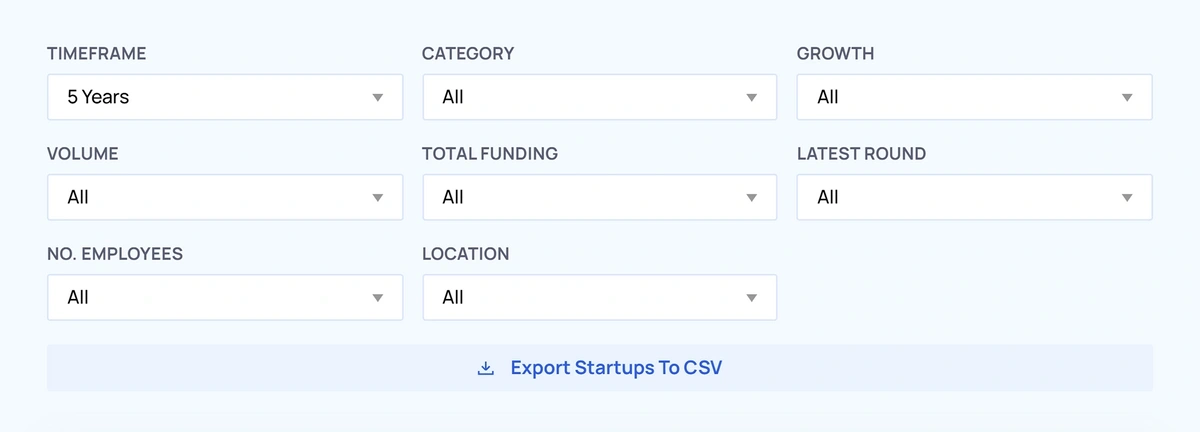
Once you find a startup you’d like to explore, click on it to get more specific information.
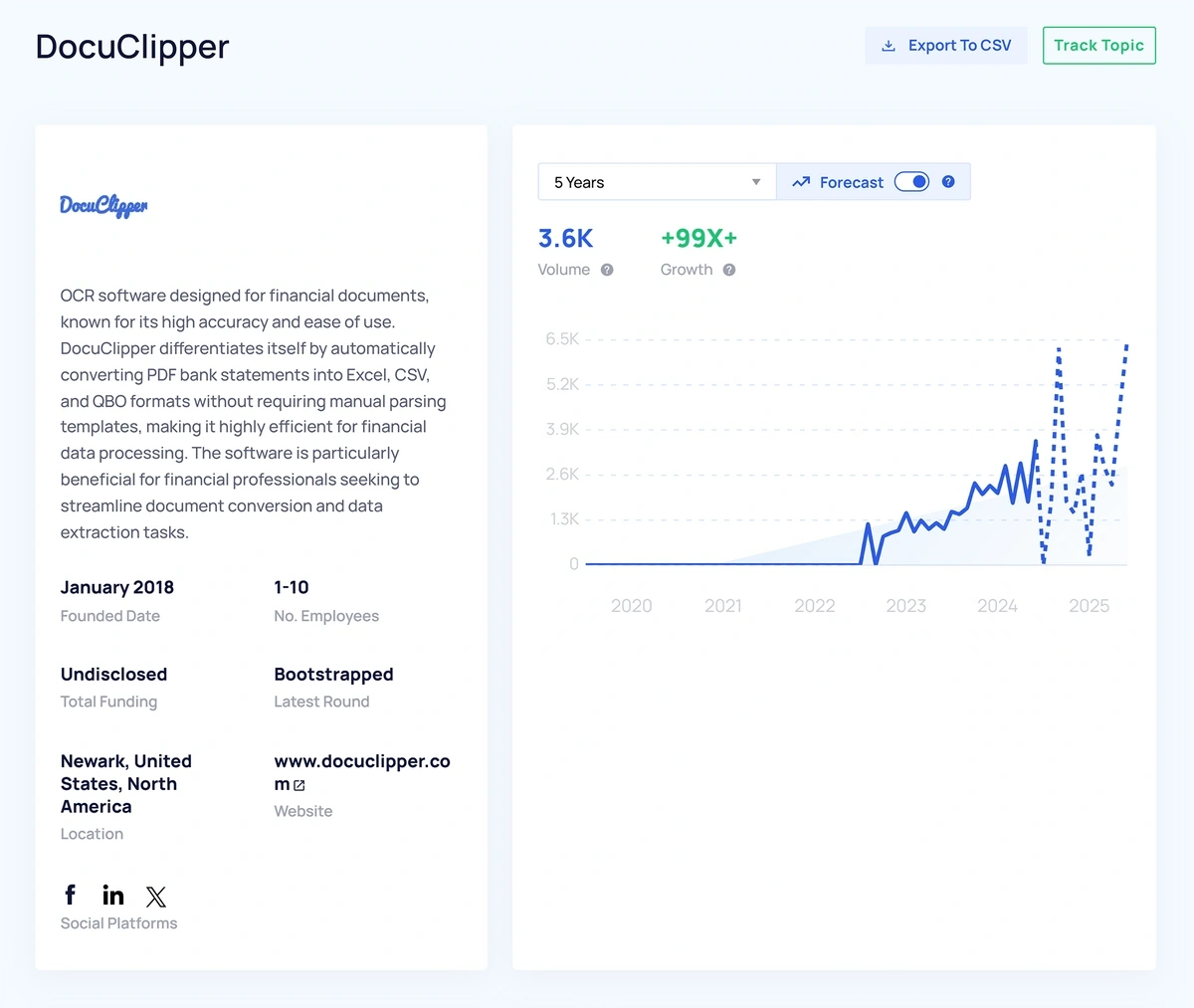
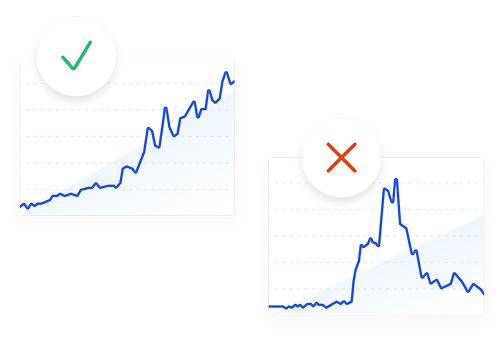
Each startup detail page shows its growth trajectory over time, which tells you whether a company is in steady early growth or experiencing a recent spike. The spike pattern is what most closely correlates with a recent funding event or the kind of momentum that precedes one.
The filters and growth curve combined give you a really powerful tool to find companies with the exact combination of factors you’re looking for.
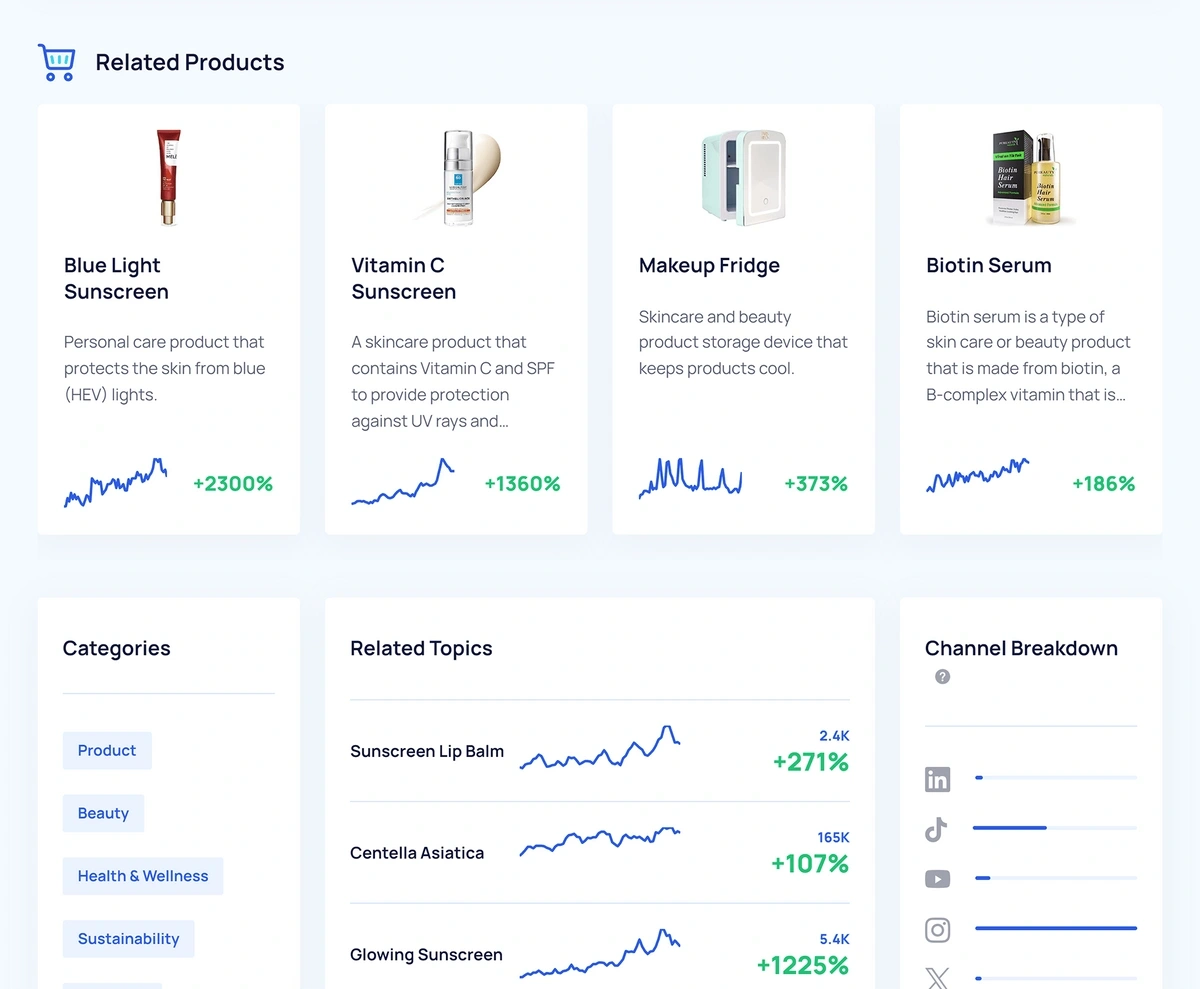
Once you find a company that fits your portfolio really well, scroll down for even more information, including which channels the startup is trending on, related products, and related trending topics:
Step 2: Check Meta Trends to Keep an Eye on Broader Trends
The “Meta Trends” report shows the macro-level topics that are trending on a category level. Rather than surfacing individual companies, this report shows the categories attracting the most collective interest right now. That interest tends to predict where venture capital flows next.
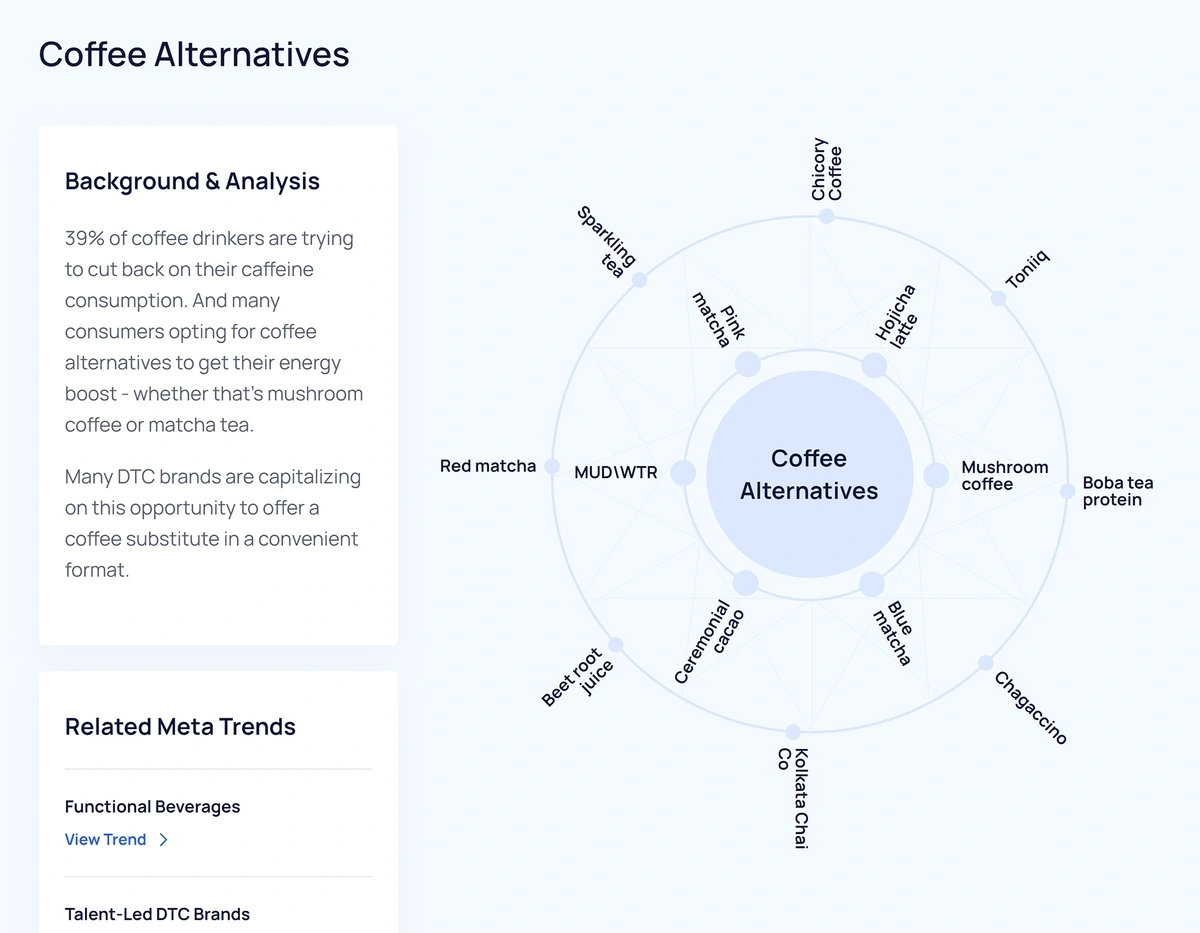
For example, if a meta trend around AI-powered legal tools is growing, that's a signal worth acting on before you've even identified a specific company. Use this report to validate a hunch before sourcing individual deals and to spot the sectors growing in popularity before valuations reflect it.
Step 3: Track the Companies You're Watching
When you've identified a company worth monitoring, add it to a project using the “Track Topic” button:
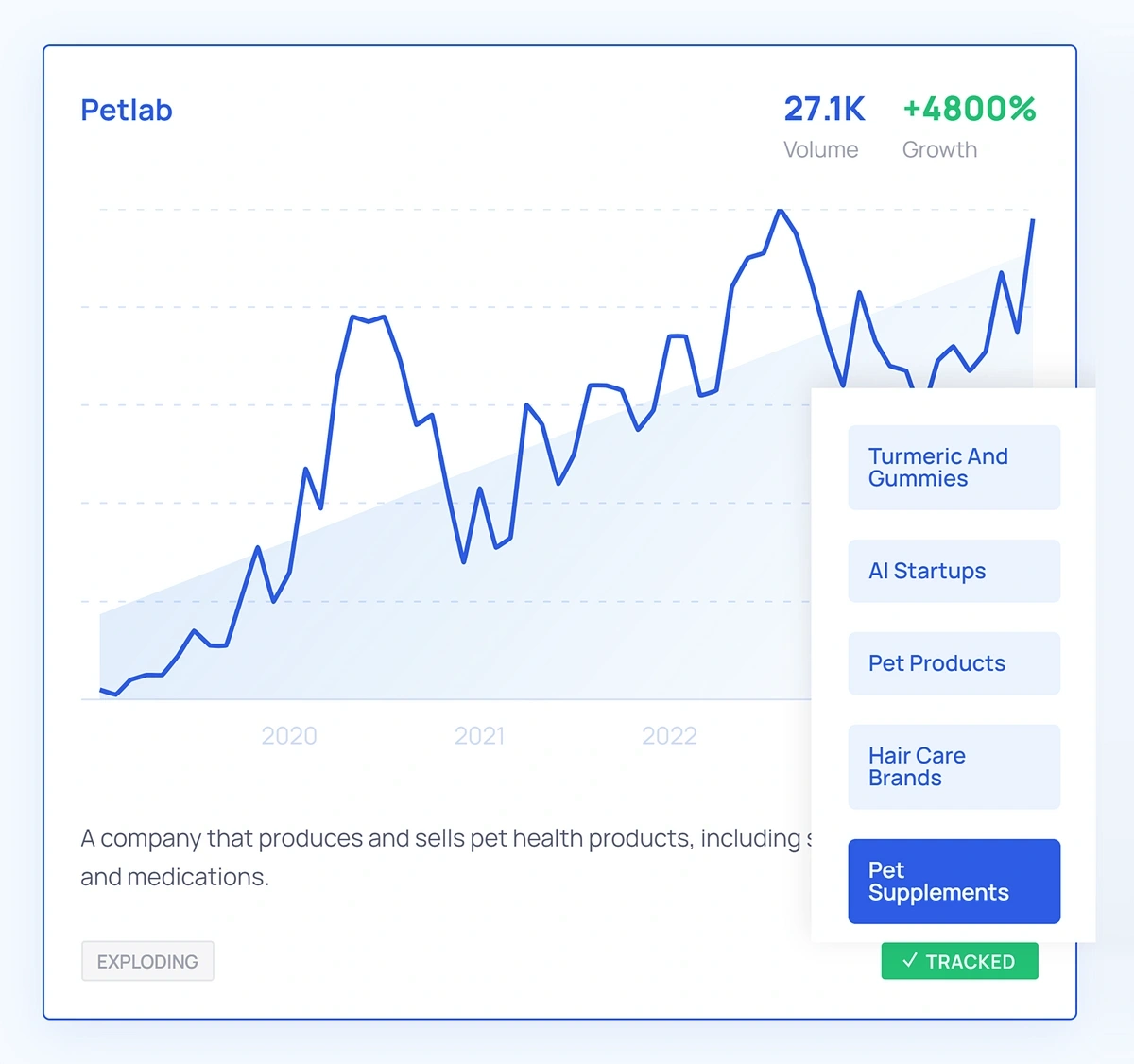
That’ll add the startup to your Trend Tracking database, where you can keep an eye on its growth week over week:
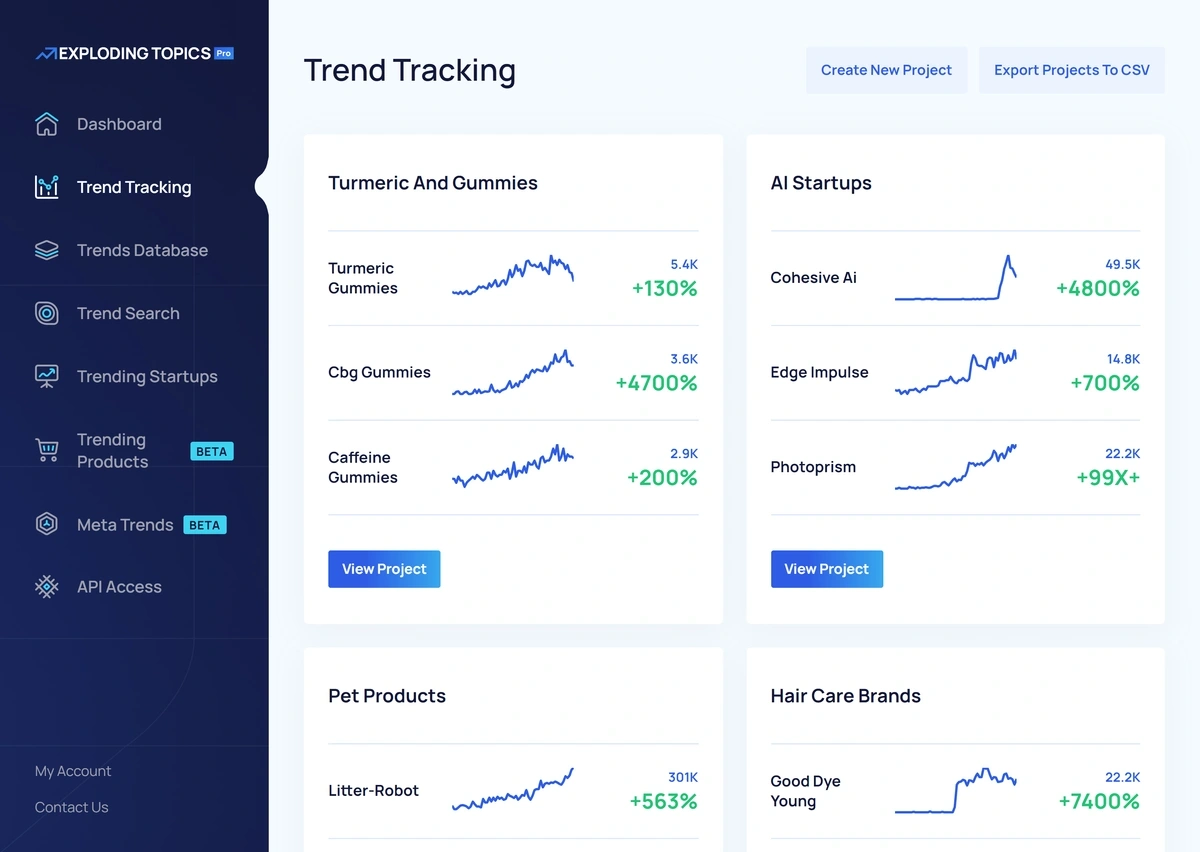
Use this dashboard when you’re already aware of a company but you’re waiting for the right moment to engage.
Read our Aiken House case study to see how a venture studio that has helped 21 companies raise over $200 million uses Exploding Topics to help shape investing decisions.
Other Tools for Confirming Startup Funding Status
Exploding Topics provides details like founded date, number of employees, latest round, and total funding. But if you need additional details and want to double up on your database of startups, these tools can work alongside Exploding Topics to help you confirm funding status and enrich your data.
- Crunchbase is useful for verifying funding details once you've identified a company worth investigating, like round size, lead investors, and investor history. The free tier covers basic lookups; the Pro plan adds alerts and bulk export for teams tracking high volumes of deals.
- Harmonic aggregates funding and hiring data into a single feed, which is useful for cross-referencing a company's headcount trajectory against its capital raises. It's better suited as a data enrichment layer rather than a discovery tool.
- PitchBook is the standard for institutional investors who need deep financial data such as valuations, investor history, and market sizing analytics. It's built for deal teams running formal due diligence, and the pricing reflects that scope.
- Tracxn covers industries and geographies that PitchBook sometimes underserves, particularly outside the US and Western Europe. A useful complementary tool when you’re extending into emerging markets.
- Venture capital websites and TechCrunch are worth monitoring for deal announcements that confirm what trend data already suggested.
How Do You Search Funded Startups Effectively?
To search funded startups effectively, try filtering by stage and sector, watching for signals before the funding announcement, and timing your approach to the funding cycle.
Let’s take a closer look at those tips:
1. Filter by Stage and Sector
Narrowing your search by funding stage and industry gives you a more targeted list than browsing broadly. So if you’re open to a higher risk, search for Seed or Series A companies for their earlier-stage opportunities.
For a lower risk, Series B and beyond companies are scaling a proven model, which tends to mean more established metrics and cleaner due diligence. However, they come with higher valuations and more competitive deal processes.
Filtering by sector keeps your research focused on the investment thesis you're evaluating. For example, a FinTech startup at the Seed stage carries very different market assumptions than an AI infrastructure company at Series B, even if both received funding in the same week.
2. Watch for Signals Before & Beyond the Funding Announcement
Funding announcements are public by definition, meaning everyone sees them at the same time. Hiring spikes and developer activity are earlier and less-watched signals that often indicate a startup has just closed a round or is preparing to.
For example, a sudden increase in engineering and sales job postings suggests a company has capital to deploy and is actively building. An uptick in a startup's search momentum in Exploding Topics (well before any press release) can reflect the same underlying activity. These pre-announcement signals give you a meaningful head start over anyone relying solely on something like Crunchbase alerts.
3. Get in at the Right Time
The best time to initiate a conversation with a founder is before a round closes, not after. By the time a round is announced, the lead investor is set and most of the allocation is spoken for, which limits flexibility for new participants.
Reaching out pre-announcement (based on your own conviction) positions you as proactive rather than reactive. Founders often remember who engaged early, especially if that outreach was thoughtful or helpful. That context can influence future rounds or opportunities to build a longer-term relationship.
Also, remember that the best opportunities don’t always look explosive. Some of the most successful startups show steady, compounding growth, not sharp spikes.
Get There Before the Announcement
Using Exploding Topics as the front end of your startup research workflow puts you in a favorable early position. Spot the trend, initiate a conversation before the round is front-page news, and secure a position before the competition finds out.
Stop Guessing, Start Growing 🚀
Use real-time topic data to create content that resonates and brings results.
Exploding Topics is owned by Semrush. Our mission is to provide accurate data and expert insights on emerging trends. Unless otherwise noted, this page’s content was written by either an employee or a paid contractor of Semrush Inc.
Share
Newsletter Signup
By clicking “Subscribe” you agree to Semrush Privacy Policy and consent to Semrush using your contact data for newsletter purposes
Written By


Jolissa Skow is a senior content writer and content strategist with a background in SEO, Google Analytics, and WordPress. She's be... Read more