


Get Advanced Insights on Any Topic
Discover Trends 12+ Months Before Everyone Else
How We Find Trends Before They Take Off
Exploding Topics’ advanced algorithm monitors millions of unstructured data points to spot trends early on.
Keyword Research
Performance Tracking
Competitor Intelligence
Fix Your Site’s SEO Issues in 30 Seconds
Find technical issues blocking search visibility. Get prioritized, actionable fixes in seconds.
Powered by data from
Latest Blog Posts
Featured Case Studies
See what's trending before everyone else
Each week, we'll send you our best Exploding Topics. Plus, expert insight and analysis.
Everything Google has (and hasn’t) said on optimizing for AI Overviews

 Add Exploding Topics on GoogleAdd Exploding Topics as your preferred source to see more of our stories on Google.
Google AI Overviews have transformed search. For better or worse, as a webmaster or SEO professional, they are impossible to ignore.
There’s no denying that organic traffic has suffered. Fewer than 1 in 5 people will always or usually follow the links presented in AI Overviews, fundamentally changing how users browse the internet.
But these top-of-page summaries are also the new “position one”. Even if it doesn’t directly result in a click, there is massive brand value in being the one to answer high-intent user queries. So how do you secure these coveted spots?
Until recently, SEOs (and indeed GEOs, a new wave of specialist generative engine optimizers) had been working off meticulous research, reverse engineering, experimentation, and a little bit of guesswork. There was no official guidance.
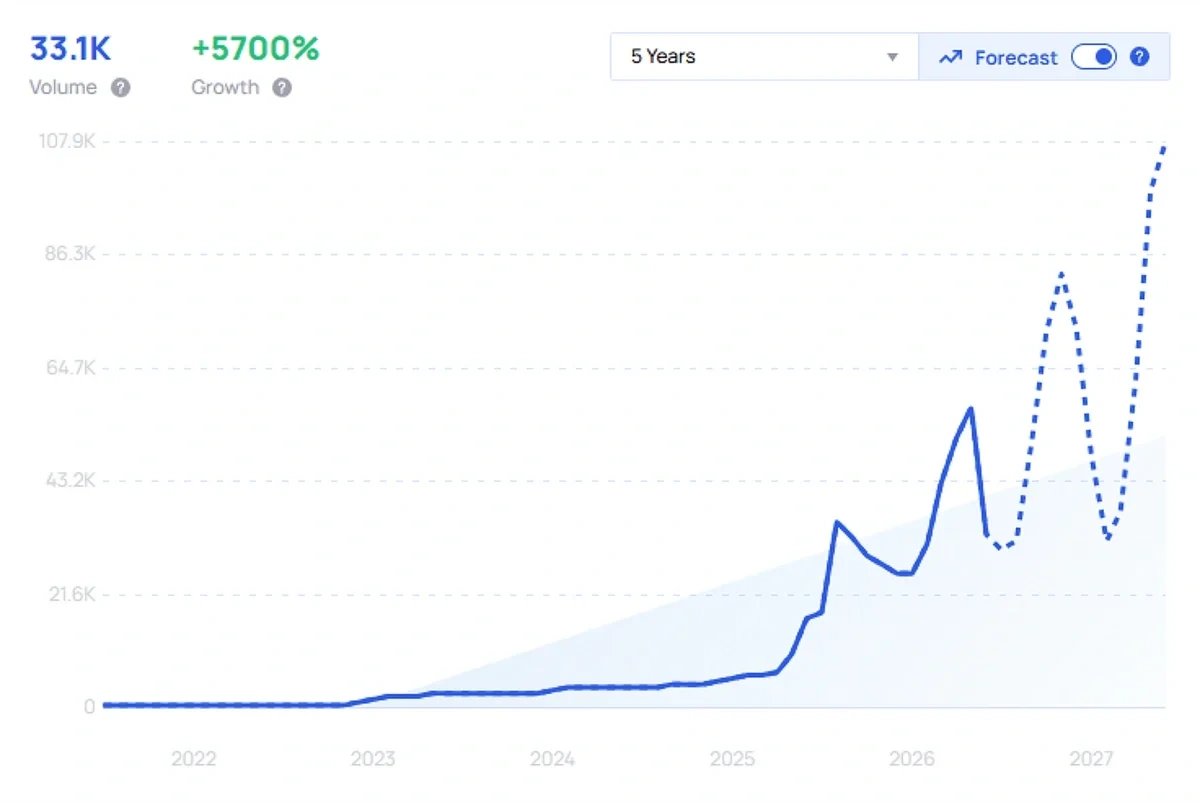
“AI SEO” searches are up by 5,700% in the last 5 years.
But Google has now produced a guide to optimizing for generative AI search features. There are reasons not to take everything completely at face value, but this latest documentation is another valuable puzzle piece for anyone concerned with improving their AI visibility.
Let’s take a look at what Google has said, and what you might still need to look for between the lines when optimizing for AI Overviews.
Google’s AI Overview Optimization Guidelines: Key Takeaways
- SEO is still relevant, and best practices carry over to optimizing for AI Overviews
- Create unique content that provides information gain
- Serve what your users are looking for
- Present information clearly
- AI-generated content is at higher risk of being ignored, both in search and AI Overviews
- Where relevant, it’s important to keep local business and E-commerce details up to date
- There are no special technical AI optimization hacks, and usual SEO guidance applies
SEO is dead, long live SEO
The seismic impact of AI, and particularly AI Overviews, has led some within the industry to wonder aloud if SEO is dead. After all, with the steep rise of zero-click searches, professionals are fundamentally optimizing for something different than they were before. (Some publishers are even wondering whether it's time to block Google crawlers.)
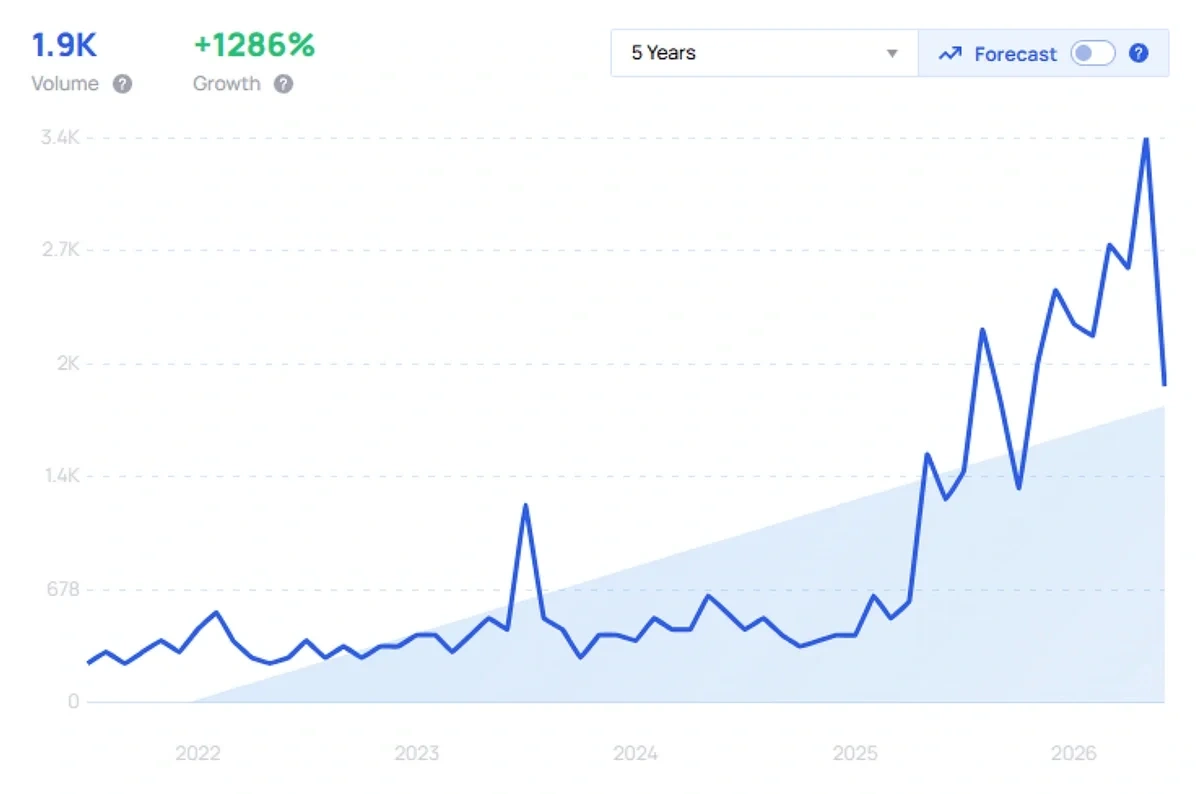
“Is SEO dead” searches have risen by 1,286% in 5 years.
However, the clear message from Google is one of continuity. It could not have put it much more plainly:
“From Google Search's perspective, optimizing for generative AI search is optimizing for the search experience, and thus still SEO.”
That is certainly up for debate. But while it is not unreasonable to suspect that Google may not be disclosing the entire truth, its guidance at the very least reveals its broad vision for AI Overviews, and the kind of content it ultimately wants the algorithm to display most prominently.
As a result, the published Google criteria for “AI-optimized” content will already be largely familiar to SEOs. Nevertheless, it’s worth considering them specifically through the lens of AI Overviews.
Unique, non-commodity content
There’s a really interesting tension that goes to the heart of AI Overviews: fundamentally, the AI prefers original human content. Even though the very function of Google’s summaries is to synthesize and repackage existing sources, it penalizes web content that takes the same approach.
As a result, you should think about how to add fresh insight and perspective to anything you publish. AI Overviews are designed to give a thorough picture of a topic, so if you’re saying something original (ideally with some kind of firsthand experience or expertise to back it up), then your chances of featuring are higher.
By extension, wholly or significantly AI-written content is less likely to be featured by AI Overviews, because it is unlikely to be adding anything new to the conversation. Google explicitly warns people using generative AI content creation tools that they should be aware of spam policies.
Here’s a rough guide to what non-commodity content looks like in practice:
Do publish:
- Reviews
- First-person accounts
- Original research
Be wary of publishing:
- Aggregator/commodity content (compiled entirely from publicly-available sources, with no added insight)
- AI-produced content
- Content that uncritically restates an existing viewpoint
Helpful, organized content
Google is very clear that you should be writing your content for a human audience. Every decision you make about subject matter and structure should stem from a simple premise:
“Focus on what your users want.”
The search algorithm has grown more sophisticated over time, and is now very effective at recognizing search intent and content relevance, rather than relying on word-for-word search term matches. And with AI Overviews, the model actually generates a set of “fan-out” queries related to the initial user search, so it casts a wide net.
If you’re serving your audience the content that they genuinely want to see, and making it easy to find key information, you are giving yourself the highest chance of success. That applies to SEO, AI Overviews, and even to broader principles of building brand trust, loyalty, and reputation.
This is where Exploding Topics is an invaluable tool.
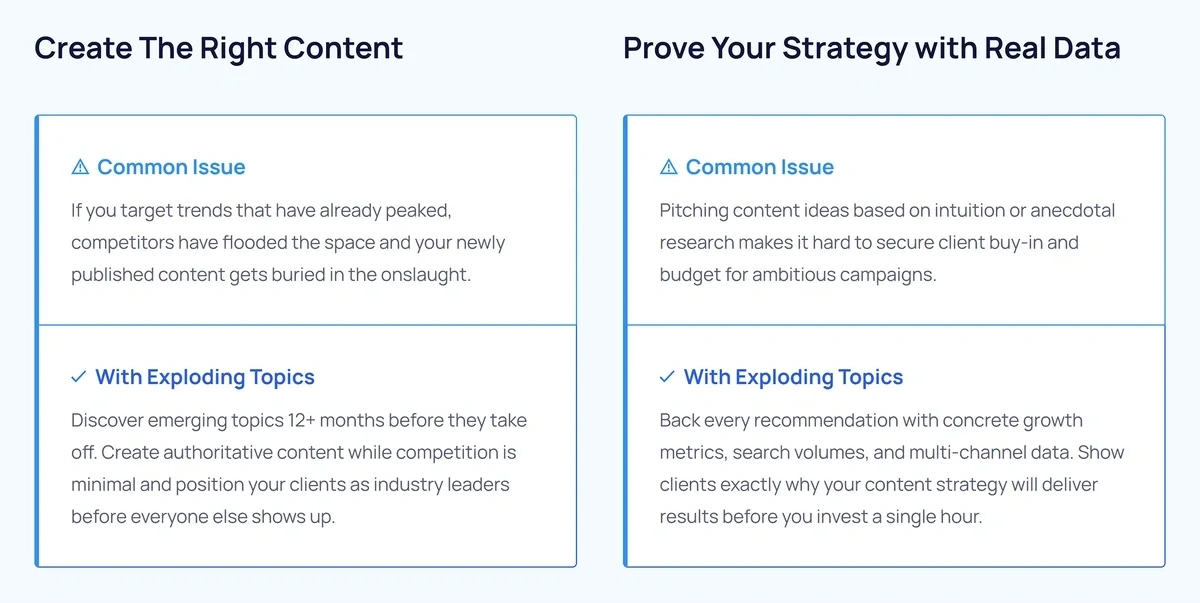
It scans multiple platforms in addition to Google search data (TikTok, YouTube, Reddit, etc.) to surface the topics that users are really talking about. Instead of getting bogged down in increasingly specific fan-out queries (what Google calls “overdoing it”), you’ll be finding the core trends around which to build your content.
You can track movements within your niche to ensure you’re meeting genuine audience needs, and doing so before your competition. On average, our predictive trend intelligence identifies emerging topics 12-15 months before mainstream awareness.
Sign up for a free trial of Exploding Topics to start finding data-backed content ideas that meet real audience needs, giving you the best possible chance of featuring in AI Overviews.
Aside from picking good topics, it’s important to keep content fresh and up-to-date. If you are running a business website, then the Merchant Center and Google Business Profiles can play a part in your AI Overviews visibility.
Technical SEO best practices
As well as topic choice and information gain, there are certain steps to take from a technical perspective that Google says will optimize your website for AI Overviews. Once again, it’s a matter of sticking to well-trodden SEO advice:
- Mobile optimization
- Low latency
- Minimal duplicate content
- High-quality images and video
- Human-readable semantic HTML
- Making the site crawlable
You may well have heard about LLMs.txt files and special markup, but Google insists that there are no AI-specific technical steps (more on that later).
Check your AI visibility
If you want to see how well you’re doing at implementing these approaches and actually showing up in AI Overviews, you'll need an AI Overview tracking tool. I recommend Semrush’s AI Visibility Toolkit.
It gives you an easy-to-understand score out of 100, which measures how often you are mentioned in LLM outputs compared to competitors. As well as AI Overviews, you can see how your website fares in ChatGPT, Gemini, and Google AI Mode.
The toolkit even provides a breakdown of the specific topics and prompts where your site is being mentioned (included by name in the response) and cited (used as a source).
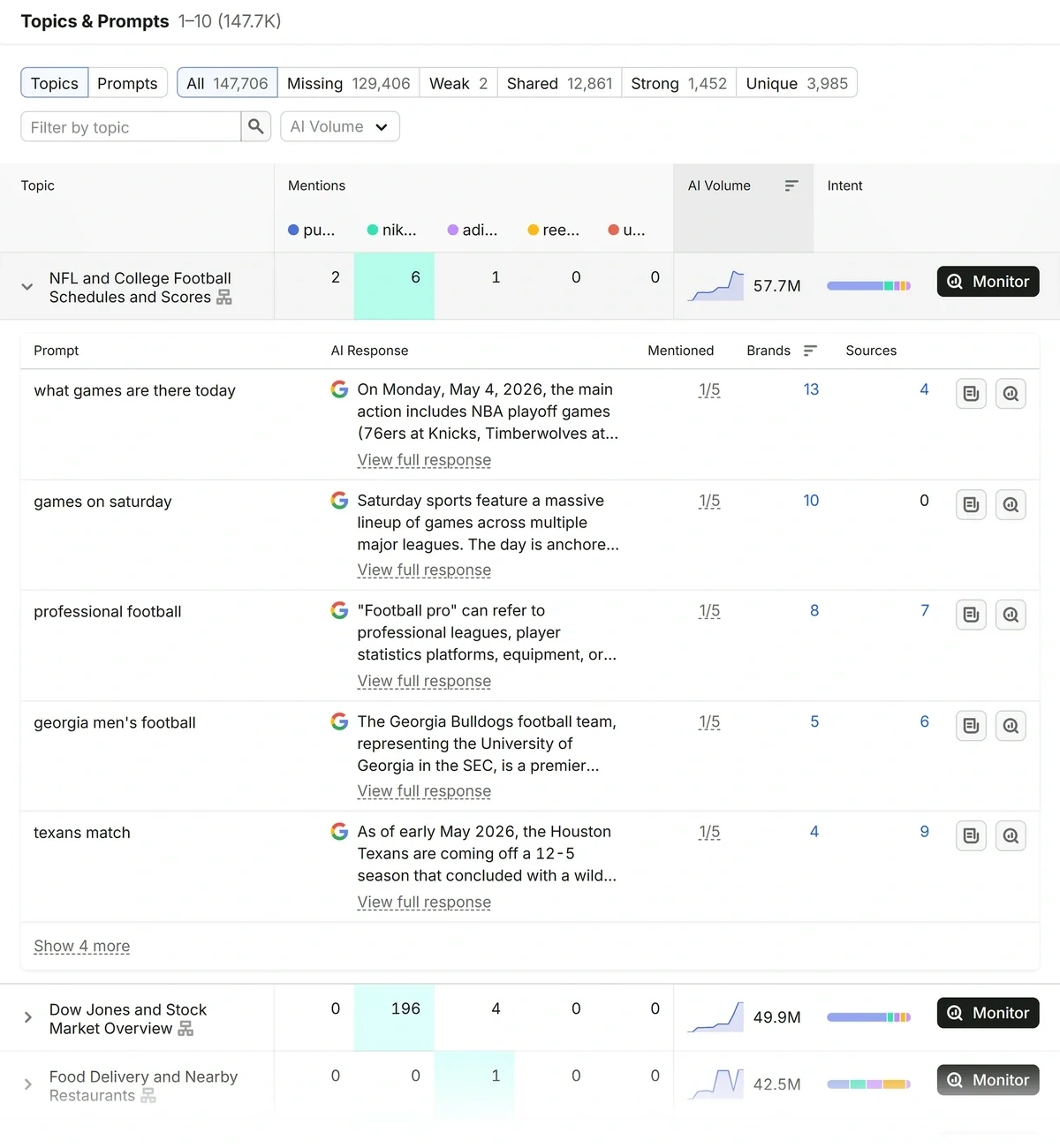
You’ll also be given clear next steps, including potential topic opportunities, insights into competitor strategies, and technical SEO/GEO tips.
[cta:custom type="button" heading="Get AI On Your Side" cta_label="Analyze Your AI Visibility Now" url="https://www.semrush.com/semrush-ai-toolkit"]
Generative AI performance reports in Google Search Console
Alongside third-party tools, there are certain limited AI analytics available directly from Google. Specifically, AI performance reports recently launched in Google Search Console.
These reports track your “impressions” within AI Overviews, AI Mode, and Google Discover. In this context, an impression refers to any time when a URL from your site appears in one of these AI search features.
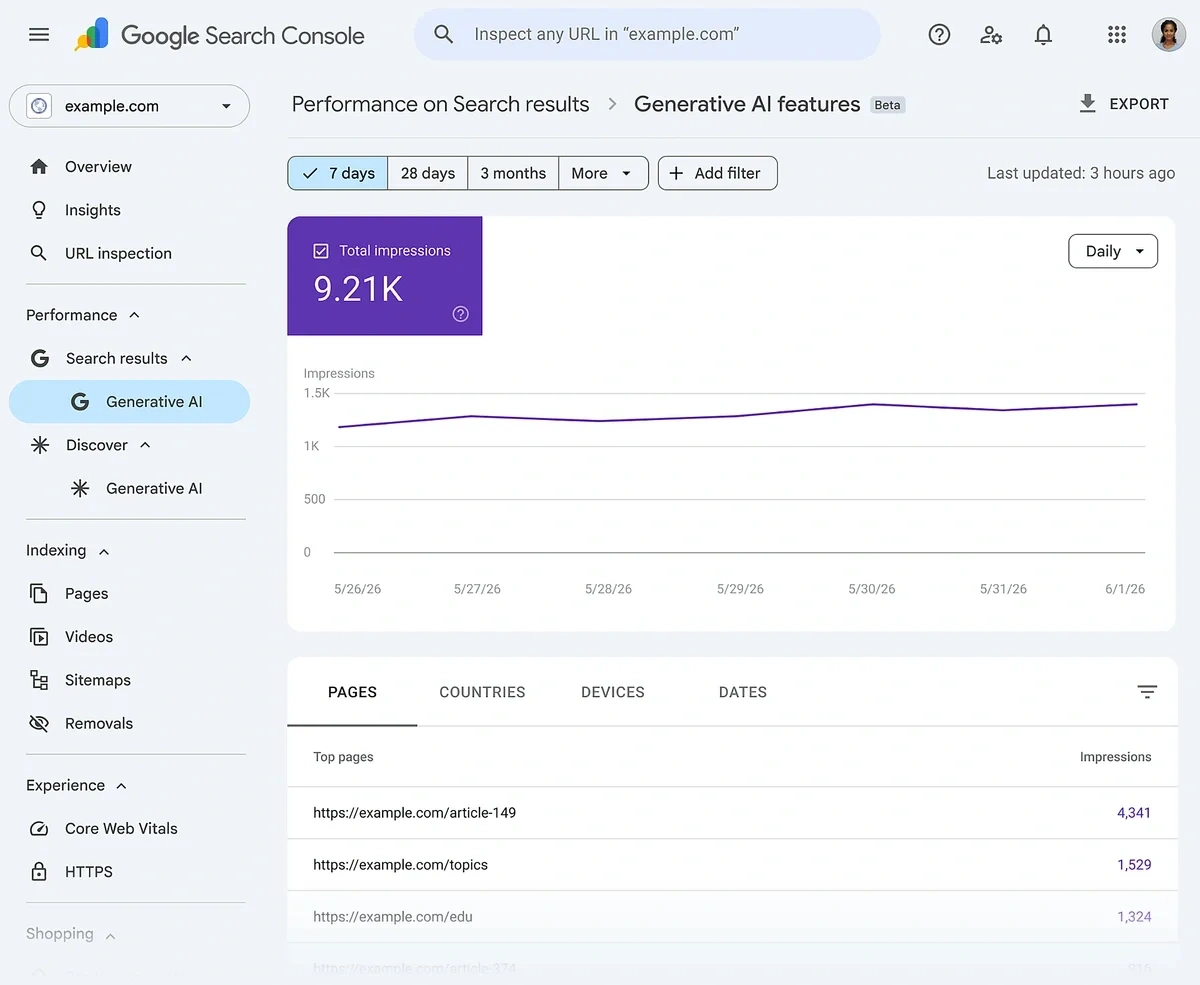
You’ll be able to see which pages earned impressions, which countries the impressions came from, and the devices from which the impressions originated. Crucially, you will also be able to monitor changes over time, so you can track the progress of your AI optimization efforts.
As yet, these reports are also only available to “a subset” of websites. Even when they roll out fully, Semrush still offers a more comprehensive look at AI visibility; Google’s analytics are naturally restricted to Google AI features, and therefore disregard performance in ChatGPT.
Nevertheless, the update to Google Search Console is a welcome and long-awaited development, and can certainly play its part in helping you to understand and improve your AI positioning. Meanwhile, there are third-party AI Mode tracking tools you may also wish to consider.
Google AI Overview optimization “myths”
One of the most interesting parts of Google’s AI optimization guide is the “mythbusting” section. It challenges some of the emerging consensus in the nascent GEO/AEO space.
For instance, Google insists that there is no need for chunking: the practice of breaking content down into bitesize pieces that are easy for AI to parse. Things like sub-headings and bulleted lists are useful up to a point, but only insofar as they improve readability and flow for human users.
“Chunking” searches have increased by 555% in the last 5 years.
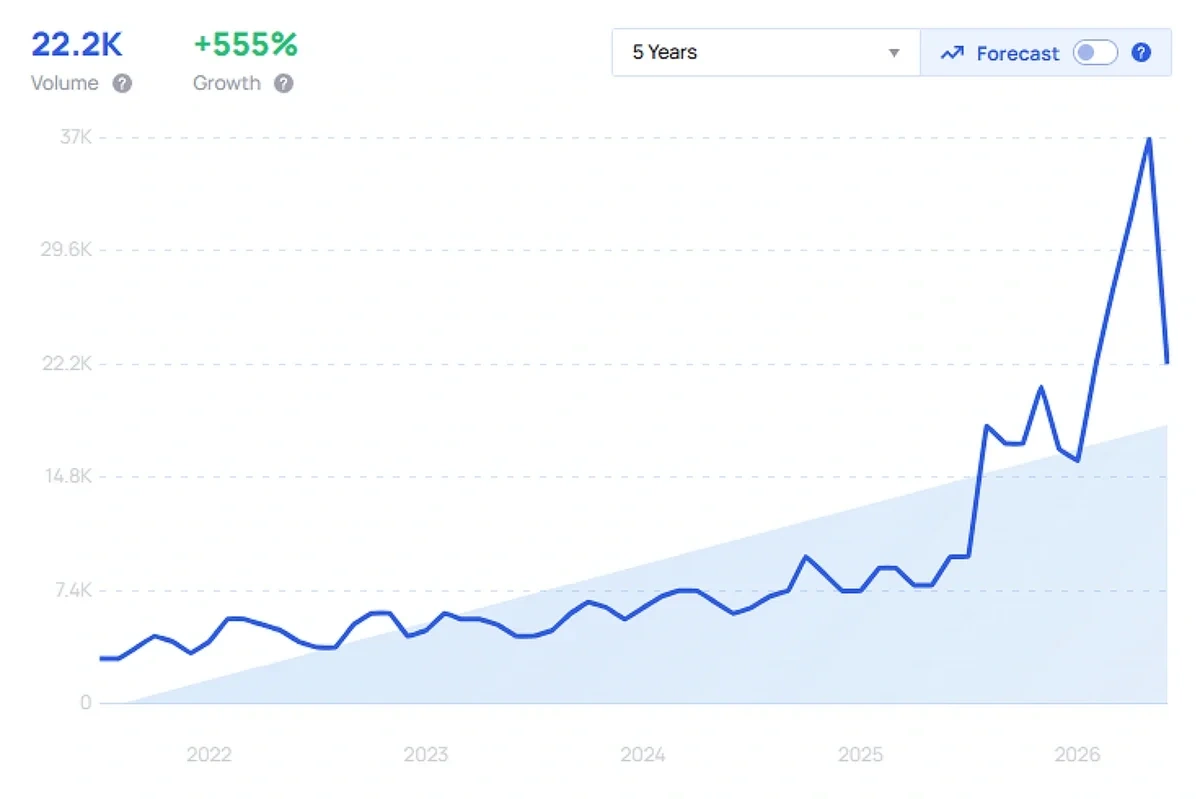
There’s an argument that this is something of a moot point, if Google is going to reward chunked content anyway for the sake of readability. But the guidelines claim that it’s all dependent on context, and that long passages of text will sometimes take priority.
There’s a similarly fine line in place when it comes to “mentions”.
Studies into AI behaviors have generally found that positive brand sentiment across various third-party platforms leads to more (and better) appearances in AI answers. However, Google says that seeking inauthentic mentions is “not as helpful as it may seem”, pointing to its high-quality content filters and spam-blocking technology.
The word “inauthentic” is doing much of the heavy lifting here. Actively courting legitimate user reviews remains a valid and sensible AI optimization strategy, but trying to cut corners could actually lead to penalization, and the best way to influence sentiment is by offering a product or service that users genuinely love.
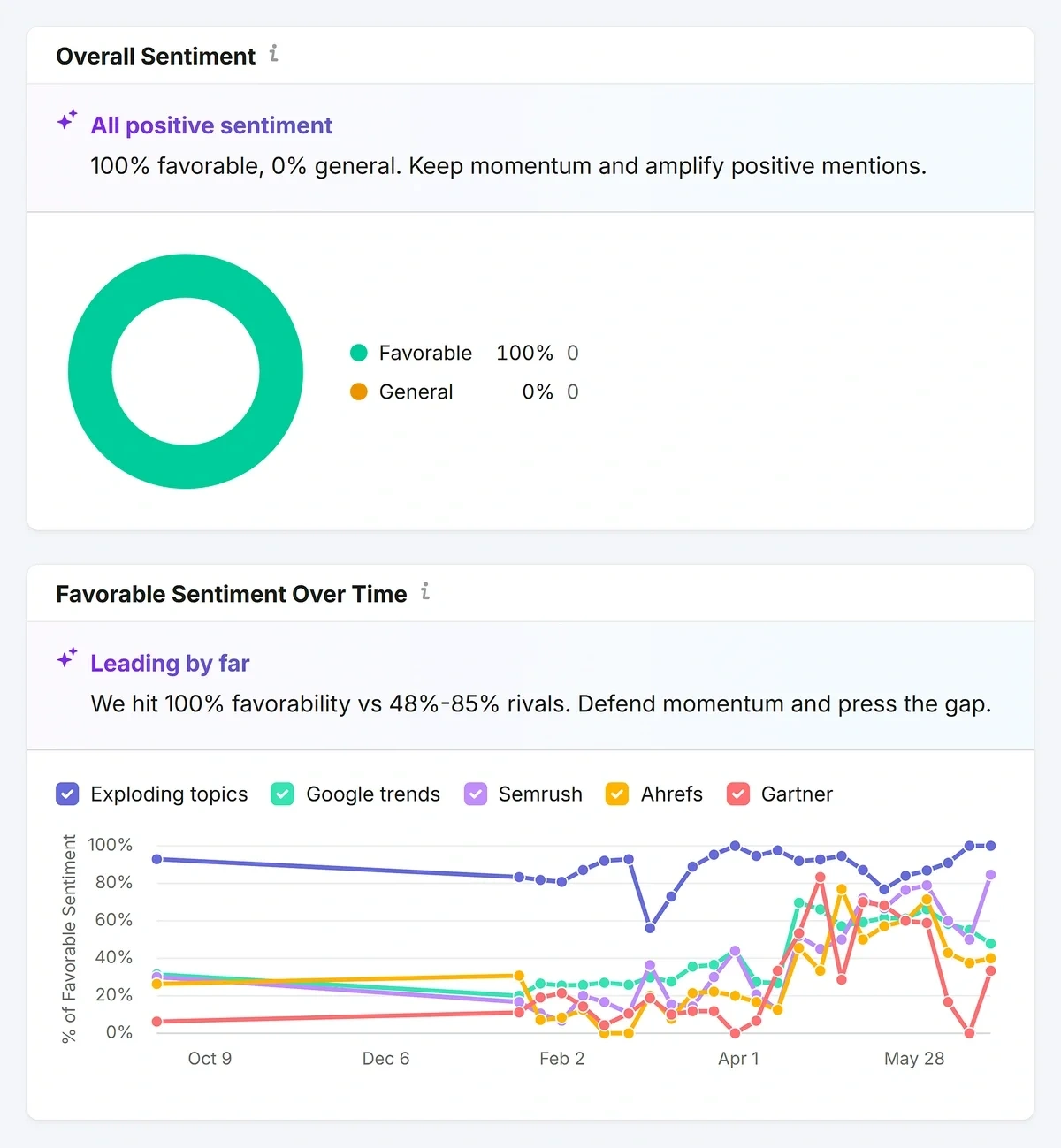
Semrush provides a great tool to track your authentic brand mentions. The “perception” tab of the AI Visibility Toolkit gives you powerful insights into how customers are talking about you compared to competitors, featuring specific strength factors and areas for improvement.
Google has also rejected the need for any special LLMs.txt files.
The idea behind these files is to provide content in an easily machine-readable format. In theory, this cuts out the “translation” stage and makes it easier for AIs to retrieve key information, which is in turn served to users.
But Google says that while it may discover, crawl and index LLMs.txt files, the format does not receive preferential treatment. Nor does any kind of structured data carry benefits unique to AI Overviews, although it remains advisable as part of a wider SEO strategy.
Why we can’t just take Google at their word
You’d need to be somewhat paranoid to believe that Google is actively misleading SEOs. However, there are legitimate reasons not to take their AI Overviews guidance as gospel.
We’ve already seen that it walks a tightrope in places: chunking is unnecessary but might be beneficial from a readability perspective, while mentions are important as long as they remain “authentic”.
But even more importantly, the guidelines do not account for unintended consequences. Google may very well want to avoid rewarding what they call "AEO/GEO hacks”, but algorithms have always been susceptible to a certain degree of manipulation.
Indeed, much of the history of search can be broken down into a series of reactive spam-fighting updates, as savvy SEOs worked out hidden criteria and how to profit from them.
So whatever kind of content Google is attempting to reward, it may be that there are ways of “gaming the system.” For instance, one recent analysis of leaked system prompts found that Google’s AI favors a confident, declarative writing style; this is presumably designed to limit the reach of aggregator content, but it inadvertently encourages an artificially authoritative tone.
However, one thing we know from SEO is that workarounds and shortcuts tend to be short-lived, and following Google’s guidelines for quality content is the most reliable long-term strategy. Even if the search giant’s “optimization guide” is currently more of a manifesto on what AI Overviews should be prioritizing, it’s still a pretty safe bet that the type of content it asks for will ultimately rise to the top.
Start optimizing for AI Overviews now
Following Google’s guidance, the picture on optimizing for AI Overviews is now clearer than ever. Even when taken with a pinch of salt, some very clear and actionable themes begin to emerge.
The biggest takeaway is to give your audience what they are looking for. In the past, that might have looked like answering every specific query they might type into Google; now it’s about finding the topics they really care about, using them as a basis for thorough and thoughtful content with an original perspective.
To that end, a trend discovery tool like Exploding Topics is definitely your friend when optimizing for AI Overviews. It takes the guesswork out of “focus on what your users want”, allowing you to become an authoritative source before competitors have even spotted the trend.
And you don’t have to guess whether your optimization efforts are working either. A suite like the Semrush AI Visibility Toolkit offers best-in-class AI analytics, with valuable insights on where you could improve.
Sign up to Semrush today and add Exploding Topics through the app center.
Stop Guessing, Start Growing 🚀
Use real-time topic data to create content that resonates and brings results.
Exploding Topics is owned by Semrush. Our mission is to provide accurate data and expert insights on emerging trends. Unless otherwise noted, this page’s content was written by either an employee or a paid contractor of Semrush Inc.
Share
Newsletter Signup
By clicking “Subscribe” you agree to Semrush Privacy Policy and consent to Semrush using your contact data for newsletter purposes
Written By


James is a Journalist at Exploding Topics. After graduating from the University of Oxford with a degree in Law, he completed a... Read more