Exploding Topics
Secops search volume grew from 2,475 to 9,900 monthly searches between October 2024 and September 2026.
Secops
+300%
Preply search volume grew from 822,581 to 1,500,000 monthly searches between December 2024 and November 2026.
Preply
+82%
Loop Earplugs search volume grew from 370,150 to 673,000 monthly searches between October 2024 and September 2026.
Loop earplugs
+82%



Get Advanced Insights on Any Topic
Discover Trends 12+ Months Before Everyone Else
How We Find Trends Before They Take Off
Exploding Topics’ advanced algorithm monitors millions of unstructured data points to spot trends early on.
Keyword Research
Performance Tracking
Competitor Intelligence
Fix Your Site’s SEO Issues in 30 Seconds
Find technical issues blocking search visibility. Get prioritized, actionable fixes in seconds.
Powered by data from
Latest Blog Posts
Featured Case Studies
See what's trending before everyone else
Each week, we'll send you our best Exploding Topics. Plus, expert insight and analysis.
35+ Amazing IoT Statistics (2026)

 Add Exploding Topics on GoogleAdd Exploding Topics as your preferred source to see more of our stories on Google.
There were an estimated 21.1 billion connected IoT devices worldwide at the end of 2025. That’s up 14% from 18.5 billion a year earlier.
IoT growth is set to continue. IoT Analytics expects 39 billion connected IoT devices by 2030.
In this article, we’ll cover the latest IoT statistics on devices, connections, regions, market size and security.
IoT Statistics (Top Picks)
- There were an estimated 21.1 billion connected IoT devices worldwide at the end of 2025
- IoT Analytics expects 39 billion connected IoT devices by 2030
- Ericsson counted 22.3 billion IoT connections at the end of 2025, and forecasts 47.1 billion by 2031
- China has 35% of all IoT connections
- Cellular IoT connections reached around 4.5 billion at the end of 2025
- Global cellular IoT module shipments rose 15% in 2025
How Many IoT Devices Are There?
There were an estimated 21.1 billion connected IoT devices worldwide at the end of 2025. That’s up 14% from 18.5 billion at the end of 2024.
IoT device counts depend on what each research firm counts. IoT Analytics counts active nodes, devices and the gateways that connect end sensors. It leaves out computers, phones, tablets and RFID or NFC tags.
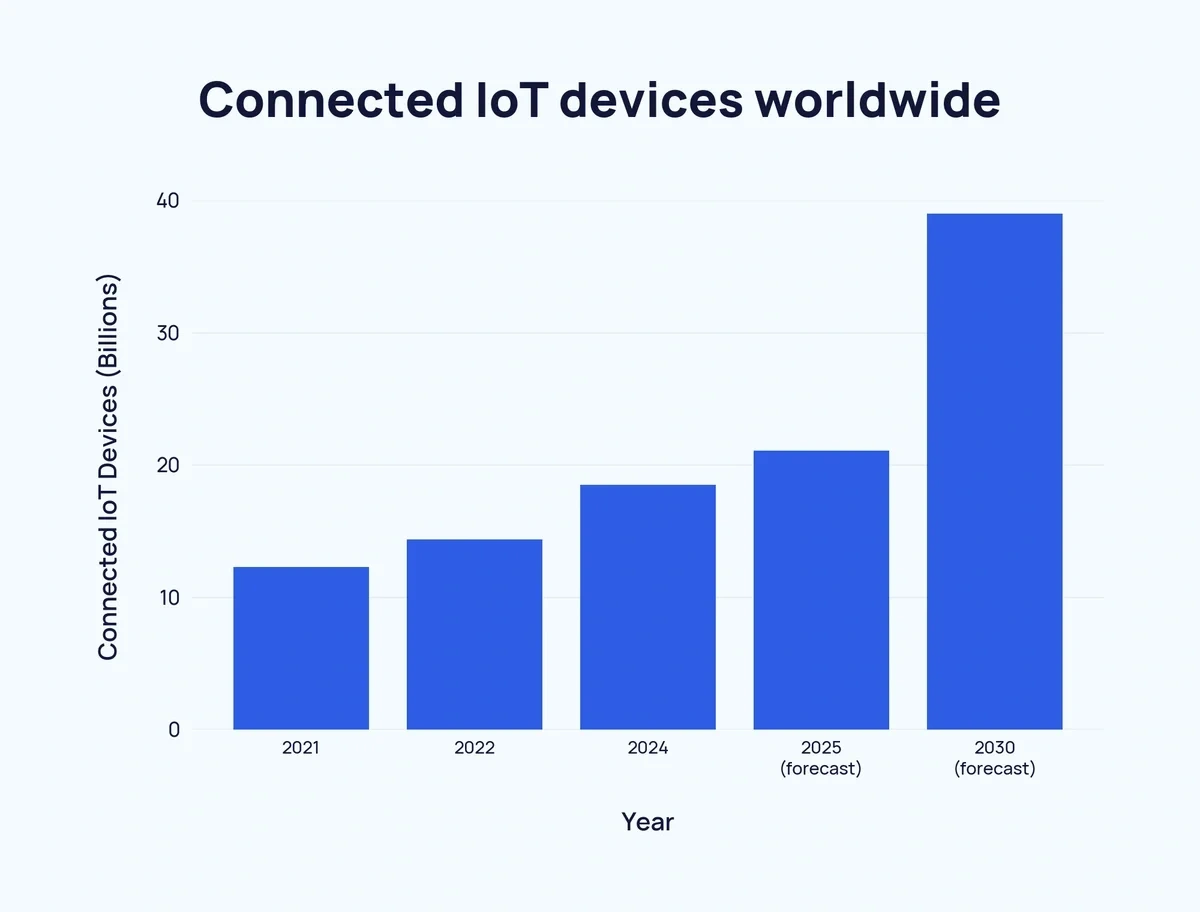
Connected IoT Devices by Year
IoT Analytics’ earlier State of IoT reported number of connected IoT devices was estimated at 12.3 billion in 2021 and 14.4 billion in 2022. These are the figures published at the time. It reached 18.5 billion at the end of 2024, up 12% from a year earlier.
IoT Analytics published its 21.1 billion figure for the end of 2025 in October 2025, so it is a forecast rather than a final count. IoT Analytics said the 2025 figure was about 300 million devices below its September 2024 forecast.
How Many IoT Devices Will There Be by 2030?
IoT Analytics forecasts 39 billion connected IoT devices by 2030 at a compound annual growth rate of 13.2%. It expects more than 50 billion by 2035.
How Many IoT Connections Are There, According to Ericsson?
The Ericsson Mobility Report puts the number of IoT connections around 22.3 billion at the end of 2025. Ericsson forecasts 47.1 billion IoT connections by 2031, a compound annual growth rate of 13%.
Short-range connections made up 17.5 billion of the 2025 total, and Ericsson expects 38.8 billion by 2031. Wide-area connections, which include cellular IoT, were 4.9 billion, with 8.3 billion expected by 2031.
How Many Active IoT Devices Are There, According to Transforma Insights?
Transforma Insights claims: “At the end of 2025 there were 21 billion IoT devices active globally”. The company expects 48 billion active IoT devices by 2035 at a compound annual growth rate of 9%.
Why Do IoT Device Counts Differ?
The three main counts for the end of 2025 range from 21 billion to 22.3 billion, because each firm counts something slightly different. Here’s how they compare:
| Source | What It Counts | End of 2025 | Forecast |
| IoT Analytics | Connected IoT devices and gateways (excludes phones, computers and tablets) | 21.1 billion (forecast) | 39 billion by 2030 |
| Ericsson | IoT connections (short-range and wide-area) | 22.3 billion | 47.1 billion by 2031 |
| Transforma Insights | Active IoT devices | 21 billion | 48 billion by 2035 |
For IoT and hardware businesses, the takeaway is the same across all three: the number of connected IoT devices is set to more than double by 2035. Ericsson alone expects 47.1 billion connections by 2031.
How Many IoT Devices Are There by Region?
China has 35% of all IoT connections worldwide. North America and Europe each have 20% to 21%.
China’s lead is even bigger in cellular IoT, where it has 54% of connections.
Ericsson’s figures point the same way. North East Asia accounts for around 70% of cellular IoT connections.
What Share of IoT Connections Are Cellular?
Most IoT connections use short-range technologies rather than cellular networks. Cellular IoT made up 11.3% of IoT connections in 2025.
That’s 2.4 billion cellular IoT connections. Short-range connections made up roughly four in five. Transforma Insights expects the cellular share to reach 14.1% by 2035, and the share of non-cellular low-power wide-area (LPWA) connections, such as LoRaWAN, to rise from 2.4% to 4.2%.
Ericsson counts more cellular IoT. “Total cellular IoT connections reached around 4.5 billion at the end of 2025,” according to the Ericsson Mobility Report. Ericsson forecasts 7.8 billion cellular IoT connections by 2031, a compound annual growth rate of 10%.
Cellular IoT Module Shipments Rose 15% in 2025
Counterpoint Research reports that global cellular IoT module shipments rose 15% year over year in 2025. Shipments grew 15% in China and 33% in India.
Cat-1 bis modules made up about one in two cellular IoT modules shipped in 2025, and 5G module shipments grew almost three times as fast as the market. Quectel led the market, ahead of China Mobile and Sunsea.
How Big Is the IoT Market?
Estimates of the IoT market’s size vary widely. Transforma Insights puts global IoT revenue at $368 billion in 2025.
Transforma Insights expects IoT revenue to reach $866 billion by 2035.
IoT Spending in Asia/Pacific Will Reach $355 Billion by 2029
IoT spending in Asia/Pacific (excluding Japan) will reach $241 billion in 2025, up 12.5% from 2024. IDC expects spending in the region to reach $355 billion by 2029, a compound annual growth rate of 12.6%.
Hardware makes up more than 60% of IoT spending in the region in 2025.
Build a winning strategy
Get a complete view of your competitors to anticipate trends and lead your market
IoT Security Statistics
Routers are the most attacked IoT devices. Routers accounted for more than 75% of IoT incidents in Zscaler ThreatLabz’s 2025 Mobile, IoT and OT Threat Report.
Three malware families, Mirai, Mozi and Gafgyt, made up 75% of malicious IoT payloads. Manufacturing was the industry most targeted by IoT malware.
Attacks on the Energy Sector Rose 387%
Attacks targeting the energy sector rose 387%, according to the same Zscaler ThreatLabz report. The report doesn’t state the period, and it covers mobile and OT as well as IoT. Attacks on transportation rose 382%, and attacks on healthcare rose 224%.
For strategy teams, these figures suggest attackers are increasingly targeting critical industries, not just homes and offices.
What’s Next for IoT?
Edge computing, which processes IoT data close to where it’s collected, is one of the technologies to watch.
Searches for “edge computing” are up 137% over five years and 171% over two years, according to Exploding Topics. They’re down 27% from a year ago.
For more on where the space is heading, see our important IoT trends and rising IoT startups.
How We Compiled These Statistics
We used research firm data and forecasts from IoT Analytics, Transforma Insights, IDC and Counterpoint Research, the Ericsson Mobility Report, security research from Zscaler ThreatLabz, and search data from Exploding Topics. Where firms count IoT devices differently, we say which count we quote. Figures are as of November, 2026.
Researching the IoT market? The Semrush Traffic & Market toolkit shows competitors’ website traffic, audiences and market share. Try Semrush free, and use Exploding Topics Pro to spot rising IoT technologies before they peak.
Stop Guessing, Start Growing 🚀
Use real-time topic data to create content that resonates and brings results.
Exploding Topics is owned by Semrush. Our mission is to provide accurate data and expert insights on emerging trends. Unless otherwise noted, this page’s content was written by either an employee or a paid contractor of Semrush Inc.
Share
Newsletter Signup
By clicking “Subscribe” you agree to Semrush Privacy Policy and consent to Semrush using your contact data for newsletter purposes
Written By


Fabio is a research associate at Exploding Topics. Since 2021, Fabio has researched, written, and edited articles for the Explo... Read more