Exploding Topics
Remineralizing Gum search volume grew from under 100 to 27,100 monthly searches between February 2024 and January 2026.
Remineralizing gum
+5100%
GLP 1 Supplement search volume grew from 5,920 to 74,000 monthly searches between February 2024 and January 2026.
GLP 1 supplement
+1150%
Soursop Bitters search volume grew from 9,900 to 110,000 monthly searches between March 2024 and February 2026.
Soursop bitters
+1011%



Get Advanced Insights on Any Topic
Discover Trends 12+ Months Before Everyone Else
How We Find Trends Before They Take Off
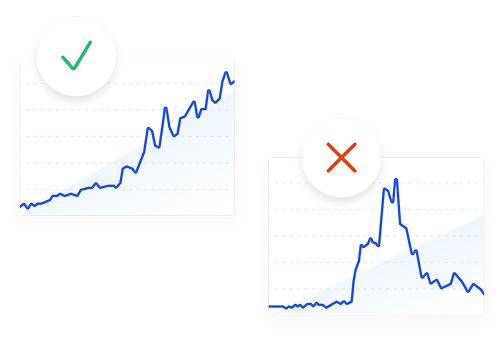
Exploding Topics’ advanced algorithm monitors millions of unstructured data points to spot trends early on.
Keyword Research
Performance Tracking
Competitor Intelligence
Fix Your Site’s SEO Issues in 30 Seconds
Find technical issues blocking search visibility. Get prioritized, actionable fixes in seconds.
Powered by data from
Latest Blog Posts
Featured Case Studies
See what's trending before everyone else
Each week, we'll send you our best Exploding Topics. Plus, expert insight and analysis.
How I Go From Trending Topic to Keyword Plan in One Claude Conversation

 Add Exploding Topics on GoogleAdd Exploding Topics as your preferred source to see more of our stories on Google.
Gaining visibility in organic search has always carried some level of difficulty, depending on how competitive your industry is.
But today?
It’s even harder.
AI Overviews are pushing traditional organic results further down the page, and research suggests LLMs are citing a shrinking pool of sources, returning just 4.3 sources on average per response to Google’s traditional 10.
If LLMs are drawing from a narrower set of sources, you have to work harder to make the cut.
What does that actually mean for marketers creating content to gain visibility?
Targeting the right topic and creating really good content matters more now than it ever has.
Plus, your research is probably spread across different tools. You’re canvassing social media to find trends, running keyword research in one platform, then content planning in another platform.
That’s…kind of messy. It might be working for you right now, but what if you could streamline the whole process to create the right content at the right time and ultimately capture more visibility in organic results and LLM answers?
I’m going to share a workflow with you that simplifies the entire process of growing your visibility. I’ll show you how to start in Exploding Topics to find a topic on a popularity upswing, then use Claude connected to Semrush to build a full keyword plan around it—all in a single conversation.
Build a winning strategy
Get a complete view of your competitors to anticipate trends and lead your market
Why Start a Keyword Plan With Trending Topics?
You’re probably most familiar with keyword research that starts with a keyword tool. You enter a seed term, pull volume data, assess difficulty, look at related terms and questions, then rinse and repeat.
While this gold standard for keyword research certainly isn’t wrong, it is missing something important: topics jumping in popularity but not on those lists of top keywords just yet.
Some keywords you find with a keyword research tool will be easy enough to work on building visibility for, but a lot of them will already be super competitive.
Starting with a trend, on the other hand, gives you more space and time to build your content and your topical authority. You get to publish content on the topic before most of your competitors even notice the trend.
That early, comprehensive content gives you a leg up not only in organic visibility, but also in LLMs. LLMs favor authoritative sources that cover a topic early and comprehensively. When fewer competitors have published content on the topic, yours is more likely to get cited.
How Exploding Topics Surfaces Super-Relevant Trending Topics
Now you know why you should cover trending topics. But how do you find the best ones in your niche?
With Exploding Topics.
Exploding Topics monitors data across search engines, social media, and consumer behavior to identify topics gaining popularity—often months before they peak.
You can browse by industry category or search specific topics to see their growth trajectory and current monthly search volume, so you can assess both momentum and existing demand at the same time.
Plus, you’ll also discover related trending topics so you can really round out your content plan.
Here’s how to find the best trending topics and then turn them into a content plan in a single Claude conversation.
From Trending Topic to Keyword Plan in 4 Steps
Step 1: Find a Trend Worth Building Around
Start by opening the Exploding Topics Trends Database and filter by the category most relevant to your industry:
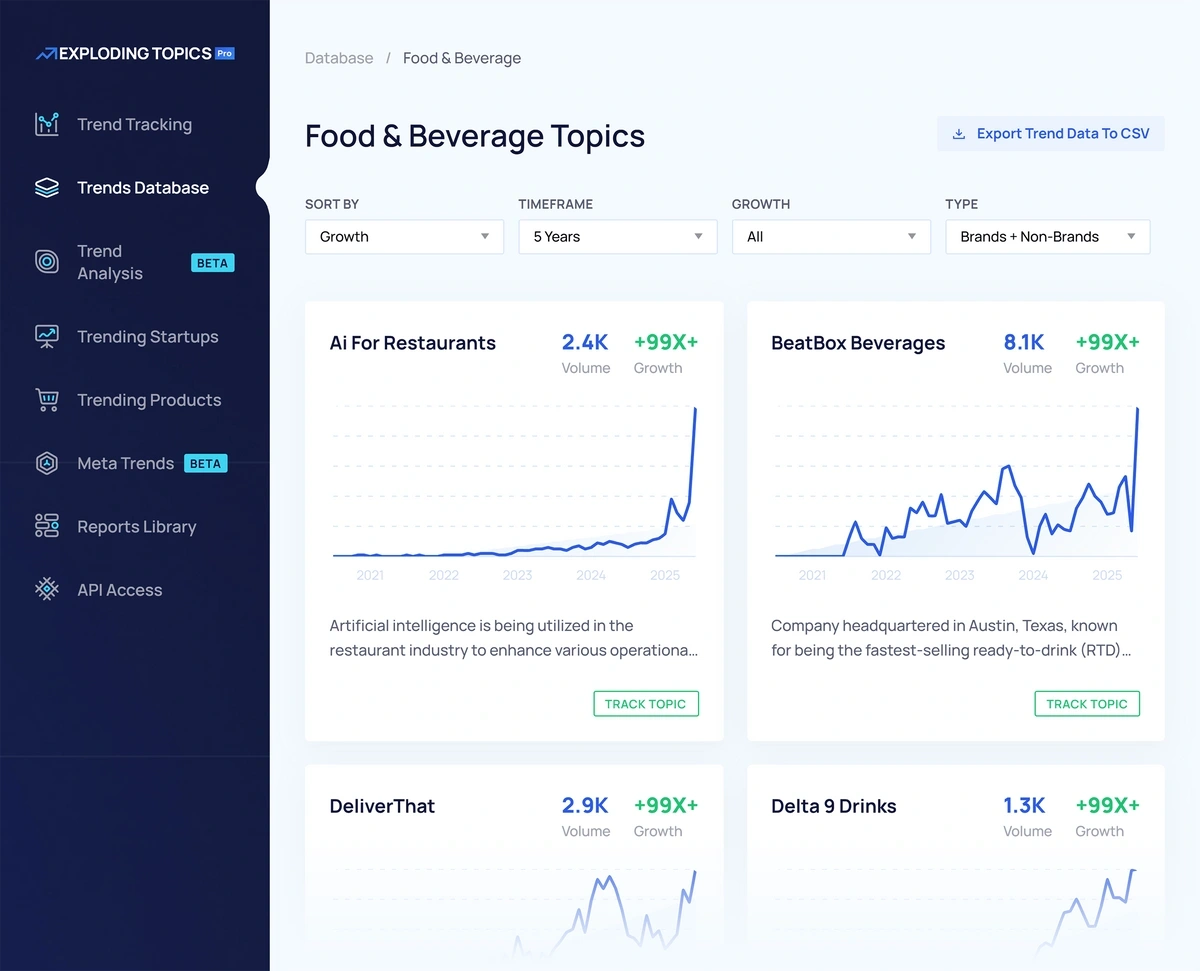
Go ahead and use the filters to hone in on the topics that’ll be the best fit for your site. For example, if you don’t want to name drop any brands, choose “Non-Brands” from the Type dropdown.
Click into a topic that catches your attention. On the topic detail page, you’ll see its full search volume history, related topics, which channels the topic is trending on, and more:

Use this data to help you decide whether the topic merits coverage on your site. In general, you want to spend time building out great content for topics that have been growing over time and have some staying power. Chasing short-lived trends with big, sudden spikes in interest could pay off some, but gets expensive when traffic drops.
When you find a worthy topic, take note of which channels it’s trending on to determine your distribution channels.
Also, take a look at related trending topics to plan out your content cluster:
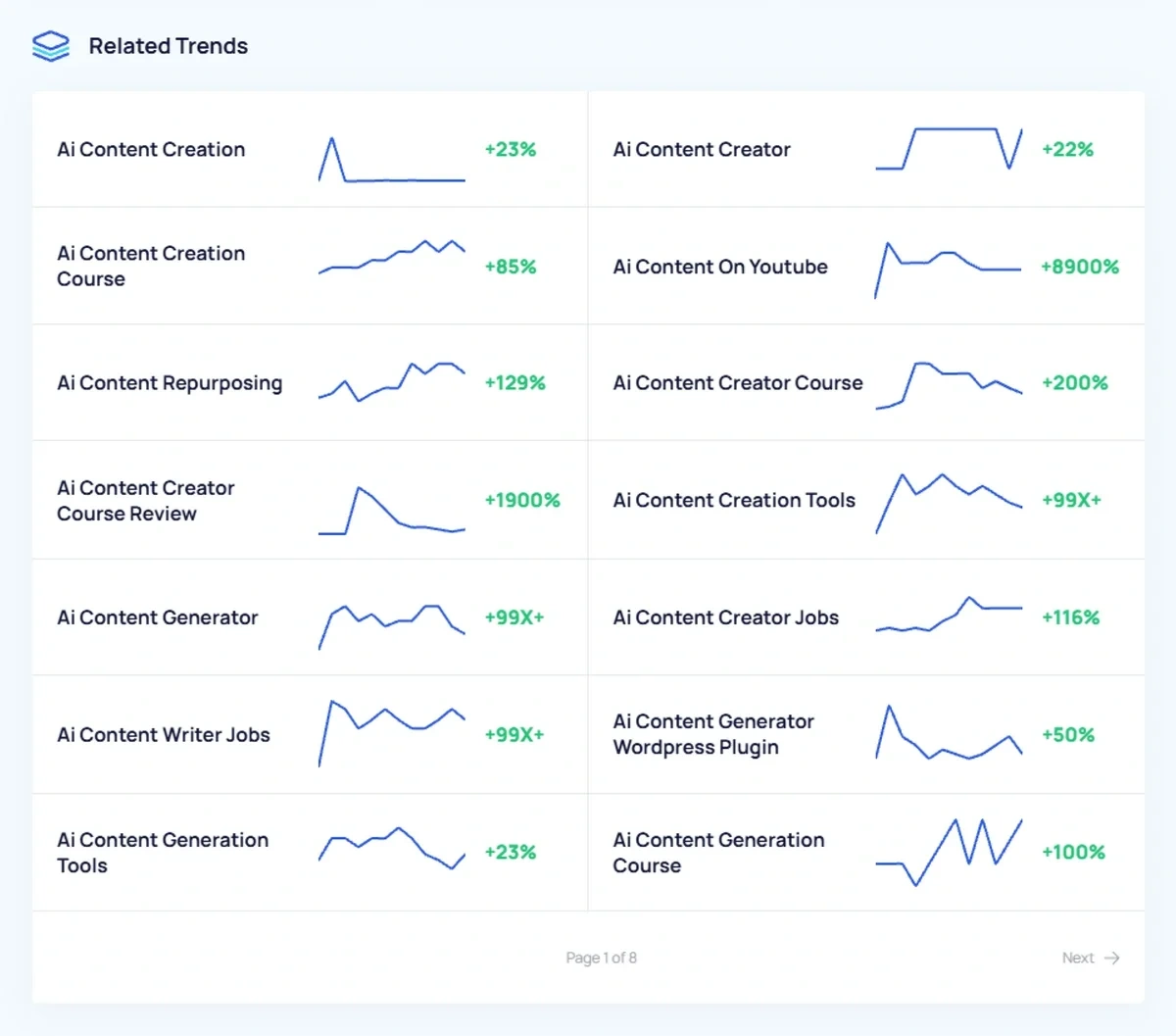
If you want to keep an eye on your strong candidate over the coming weeks, click “Track Topic” to add it to your trend-tracking dashboard.
Step 2: Connect Claude to Semrush
Before running keyword research, you'll need Claude connected to Semrush via MCP. MCP (Model Context Protocol) is what allows Claude to pull live Semrush data directly inside a conversation.
That means no exporting CSVs, no switching tabs, and no manually pasting data into a prompt. Once it's set up, Claude has access to live keyword, traffic, and competitive data from inside the conversation, so your research and your planning happen in the same place.
Setup takes about two minutes in Claude:
- Go to “Settings” → “Connectors” → “Add custom connector”
- Name the connector and paste the Semrush MCP server URL: https://mcp.semrush.com/v1/mcp
- Click “Add”
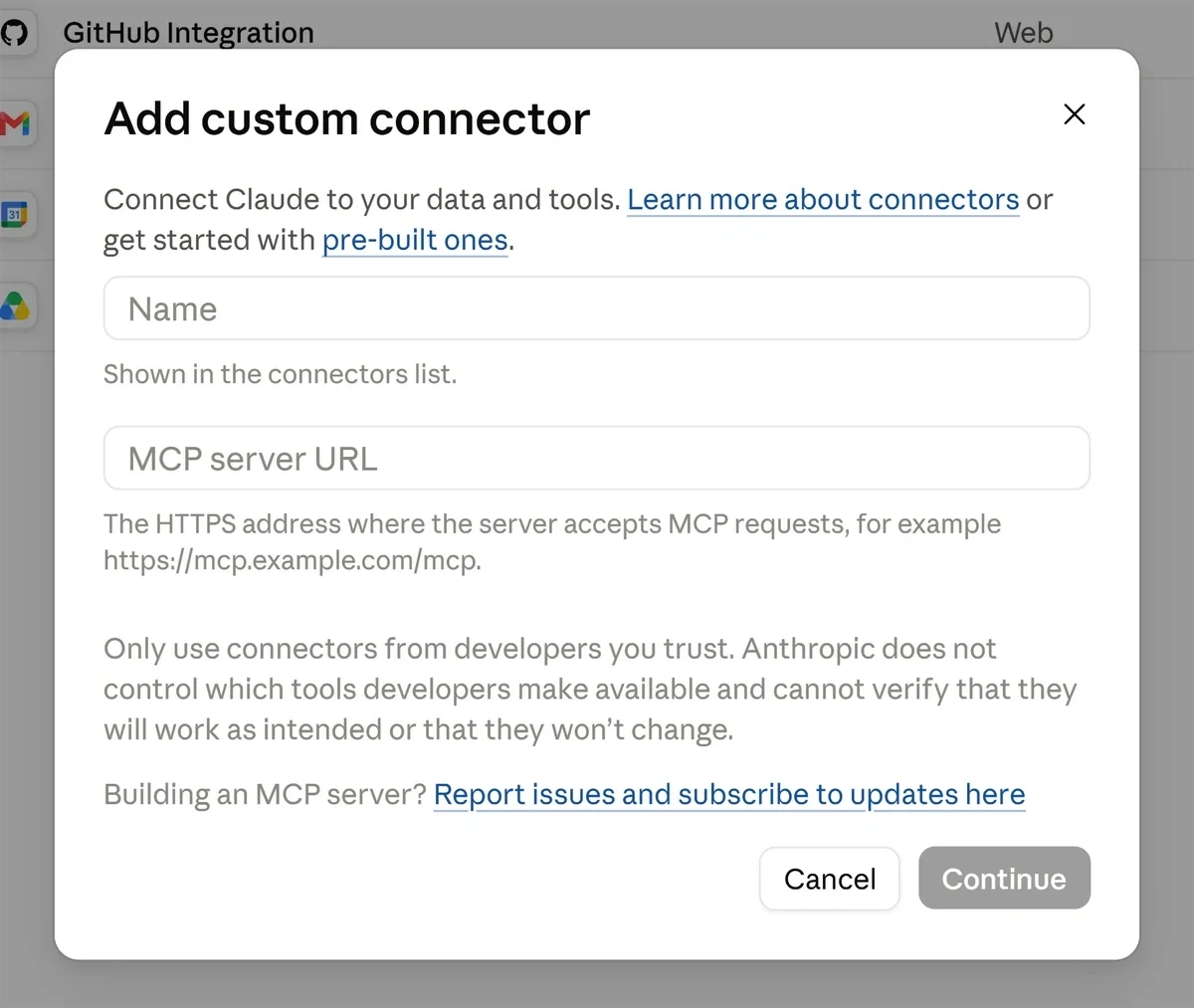
That's the entire setup. Claude will now have access to live Semrush keyword, traffic, and competitive data during your conversations.
One thing worth knowing upfront: MCP access requires a Semrush API subscription — either the Standard API (included with the SEO Business plan) or the Trends API. The Semrush MCP guide has full details on plans and what each one includes.
Step 3: Build Your Keyword Plan in a Single Conversation
With the connection active, it’s time to open a new Claude conversation and build out your content plan.
To get started, here's a prompt you can try:
"I'm building a content plan around the topic of [topic here] for a [descriptive word] audience. Use Semrush to pull keyword opportunities — I want to see search volume, keyword difficulty, and intent clusters. Focus on where there's growing demand but competition is still manageable, and flag any quick wins."
Claude pulls live data from Semrush and returns an organized analysis rather than a raw list. Here's what that looks like for the topic of “AI content” for a “marketing” audience:
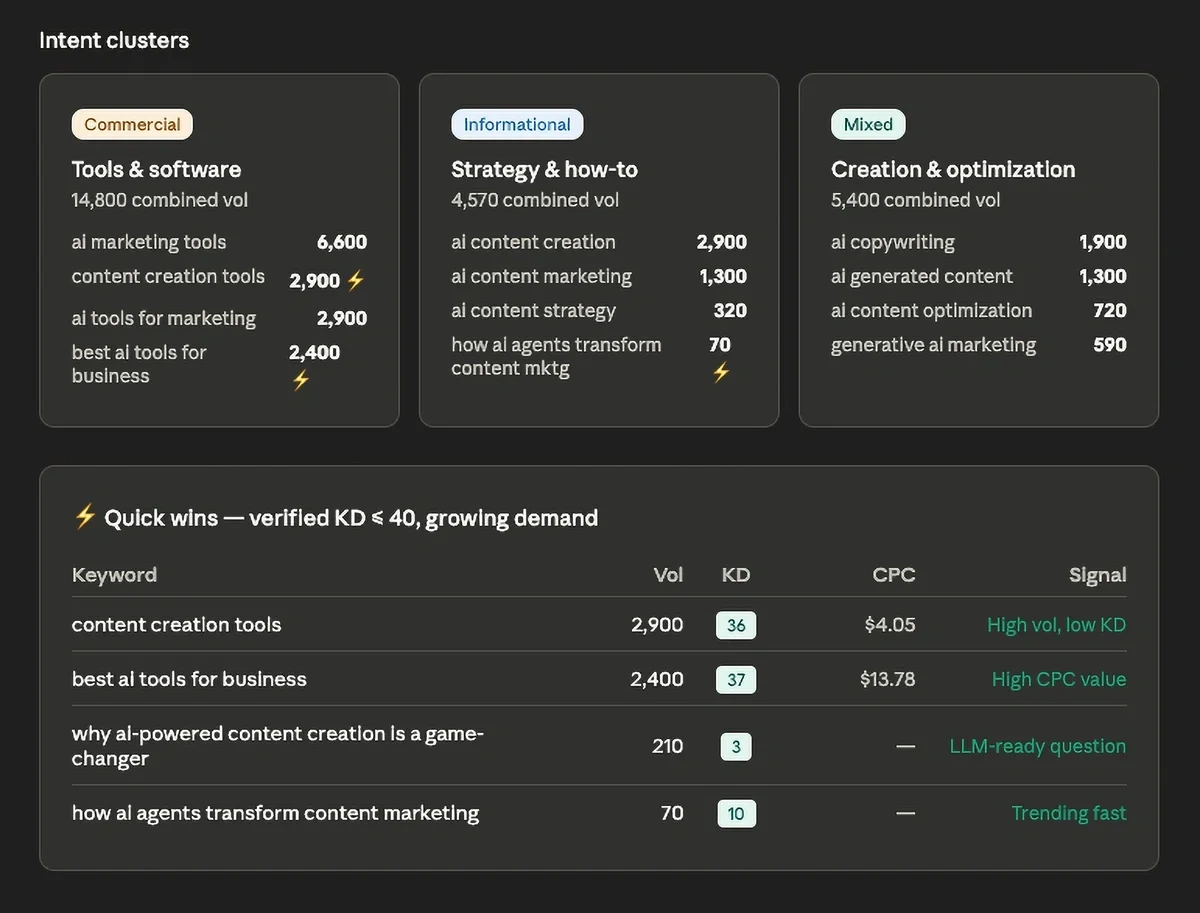
The tools & software cluster is the anchor. 14,800 combined monthly searches, all commercial intent, solid CPCs. This is your highest-priority cluster for content that can rank and convert. A comparison/roundup piece targeting "best ai tools for business" is probably your fastest path to organic traffic — KD 37 is very winnable for a well-optimized piece.
Two question-format quick wins worth grabbing immediately. "Why ai-powered content creation is a game-changer for marketers" (KD 3) and "How ai agents transform content marketing" (KD 10) both have barely any competition. Volume is modest, but these are exactly the types of long, specific queries that surface in AI overviews and ChatGPT answers — strong plays for LLM/GEO visibility beyond traditional SERP ranking.
Growing demand to watch. "Generative ai marketing" (590/mo), "ai content optimization" (720/mo), and "ai content strategy" (320/mo) all show strong upward trend lines — they're still relatively low volume now but growing fast. Getting in early on these pays off in 6-12 months.
What I'd prioritize first:
- Roundup post — "Best AI tools for content marketing in [year]" (anchors the tools cluster, hits two quick wins simultaneously)
- Thought leadership piece — "How AI agents are transforming content marketing" (KD 10, LLM-ready, trending)
- Explainer/guide — "AI content strategy: how to build one from scratch" (builds topical authority for the strategy cluster)
- Comparison piece — "AI copywriting vs. AI content creation: what's the difference?" (captures two mid-volume informational terms)
Look at all those data-backed ideas you just got!
A general AI chatbot can brainstorm keyword ideas, but as Semrush's research on using AI for keyword research found, most keywords AI chatbots suggest without live data access actually have zero registered search volume.
But with Claude connected to Semrush, you get brainstorming help backed by real data.
Step 4: Turn the Output Into a Content Plan
To take some of what Claude found and turn it into a content plan, let’s focus on one of the intent clusters it identified.
I followed up with a second prompt to dive further into the informational “Strategy & how to” intent cluster:
"Of the "strategy and how-to" keywords, which cluster together around the same searcher intent? Which would work as a pillar page versus supporting content?"
Claude went back and did more research first, then came back with a plan for a pillar page and supporting content, organized into different intent buckets:
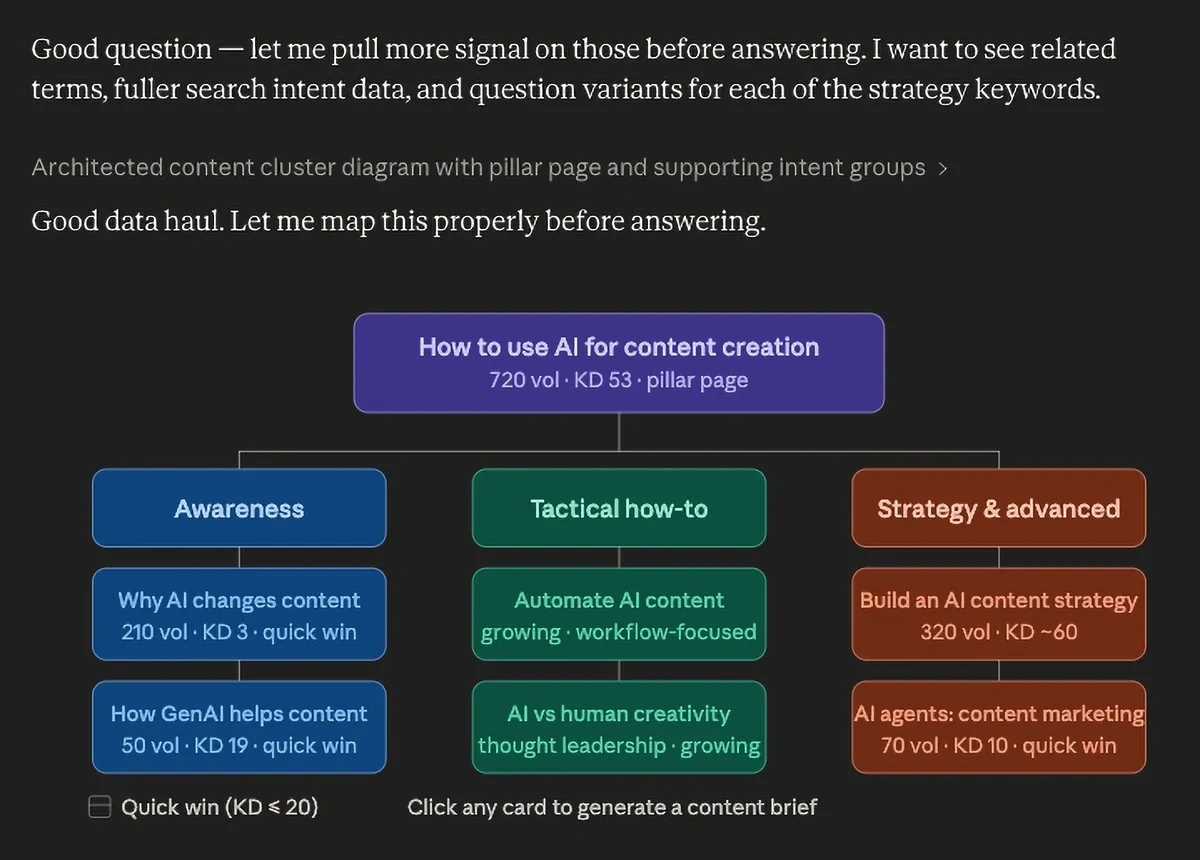
Below the map, Claude says:
Here's the breakdown from the keyword data:
The pillar is clear. "How to use AI for content creation" (720 vol, KD 53) is the right anchor. It's the highest-volume instructional head term, it sits at a KD that's winnable with a strong piece, and it naturally pulls in secondary terms like "ai for content creation" (1,900 vol) and "how to use ai for content marketing" — all clustering around the same searcher: someone trying to implement AI in their workflow, not just read about it.
Three distinct intent clusters feed it:
The awareness cluster is for searchers earlier in their journey — "why does this matter" rather than "how do I do this." Two quick wins live here: "why AI changes content" (KD 3) and "how GenAI helps content creation" (KD 19). These are low-effort pieces with LLM/AI overview visibility upside. They funnel readers toward the pillar.
The tactical how-to cluster maps to people already bought-in who want deeper specifics — automation workflows and the AI-vs-human creative balance question. These are supporting the pillar's broad strokes with single-focus depth. They're growing faster than they're ranking, which is a signal to move on them now.
The strategy & advanced cluster targets a slightly more senior searcher — someone building a program, not just a workflow. "Build an AI content strategy" (320 vol) sits alongside "AI agents: content marketing" (KD 10, genuinely trending) here. The agents piece is the one to write first in this cluster — lowest KD, fastest-growing query, and it positions you ahead of the curve on an emerging concept.
Publication sequence I'd recommend: Pillar first to establish topical authority, then the two awareness quick wins to build top-of-funnel reach, then the tactical how-tos to add depth. The "AI agents" piece can go whenever — it's low KD and has strong LLM citation potential regardless of timing. Want me to draft a brief for any of these?
Now, I have an entire content plan organized by intent cluster. Just from one Claude conversation.
Each piece I publish will reinforce my topical authority, which compounds over time in both organic rankings and LLM visibility. That's the advantage of starting with a trending topic and planning content around it systematically, rather than publishing one-off articles chasing individual keywords.
For a deeper look at modern keyword research, check out Why Keyword Research Doesn't Work in 2026 (And What to Do Instead).
Turn Trends + Semrush + Claude Into a Repeatable Process
Now, you have a system that you can use on a regular basis to consistently discover trending topics before they get too competitive, build structured content around them, and build your visibility before the trend takes off even more.
Every time a relevant trend surfaces in Exploding Topics, you have a starting point. And every Claude conversation with Semrush connected is a full keyword and content plan. And because you're building content clusters with topical depth, you're building the kind of topical authority that earns citations from both readers and AI.
Get started now with an Exploding Topics free trial.
Stop Guessing, Start Growing 🚀
Use real-time topic data to create content that resonates and brings results.
Exploding Topics is owned by Semrush. Our mission is to provide accurate data and expert insights on emerging trends. Unless otherwise noted, this page’s content was written by either an employee or a paid contractor of Semrush Inc.
Share
Newsletter Signup
By clicking “Subscribe” you agree to Semrush Privacy Policy and consent to Semrush using your contact data for newsletter purposes
Written By


Jolissa Skow is a senior content writer and content strategist with a background in SEO, Google Analytics, and WordPress. She's be... Read more