Exploding Topics
Remineralizing Gum search volume grew from under 100 to 27,100 monthly searches between February 2024 and January 2026.
Remineralizing gum
+5100%
GLP 1 Supplement search volume grew from 5,920 to 74,000 monthly searches between February 2024 and January 2026.
GLP 1 supplement
+1150%
Soursop Bitters search volume grew from 9,900 to 110,000 monthly searches between March 2024 and February 2026.
Soursop bitters
+1011%



Get Advanced Insights on Any Topic
Discover Trends 12+ Months Before Everyone Else
How We Find Trends Before They Take Off
Exploding Topics’ advanced algorithm monitors millions of unstructured data points to spot trends early on.
Keyword Research
Performance Tracking
Competitor Intelligence
Fix Your Site’s SEO Issues in 30 Seconds
Find technical issues blocking search visibility. Get prioritized, actionable fixes in seconds.
Powered by data from
Latest Blog Posts
Featured Case Studies
See what's trending before everyone else
Each week, we'll send you our best Exploding Topics. Plus, expert insight and analysis.
25+ Health Industry Stats 2026: Cost, Demographics, AI Adoption

 Add Exploding Topics on GoogleAdd Exploding Topics as your preferred source to see more of our stories on Google.
The US healthcare market is worth an estimated $5.15 trillion.
As such, healthcare makes up a significant portion of the biggest economy in the world. But in spite of its size, health is an industry that’s always on the move.
AI advances are already having a transformative effect. Meanwhile, payers and providers alike are coming to terms with the new reality of GLP-1 weight-loss drugs.
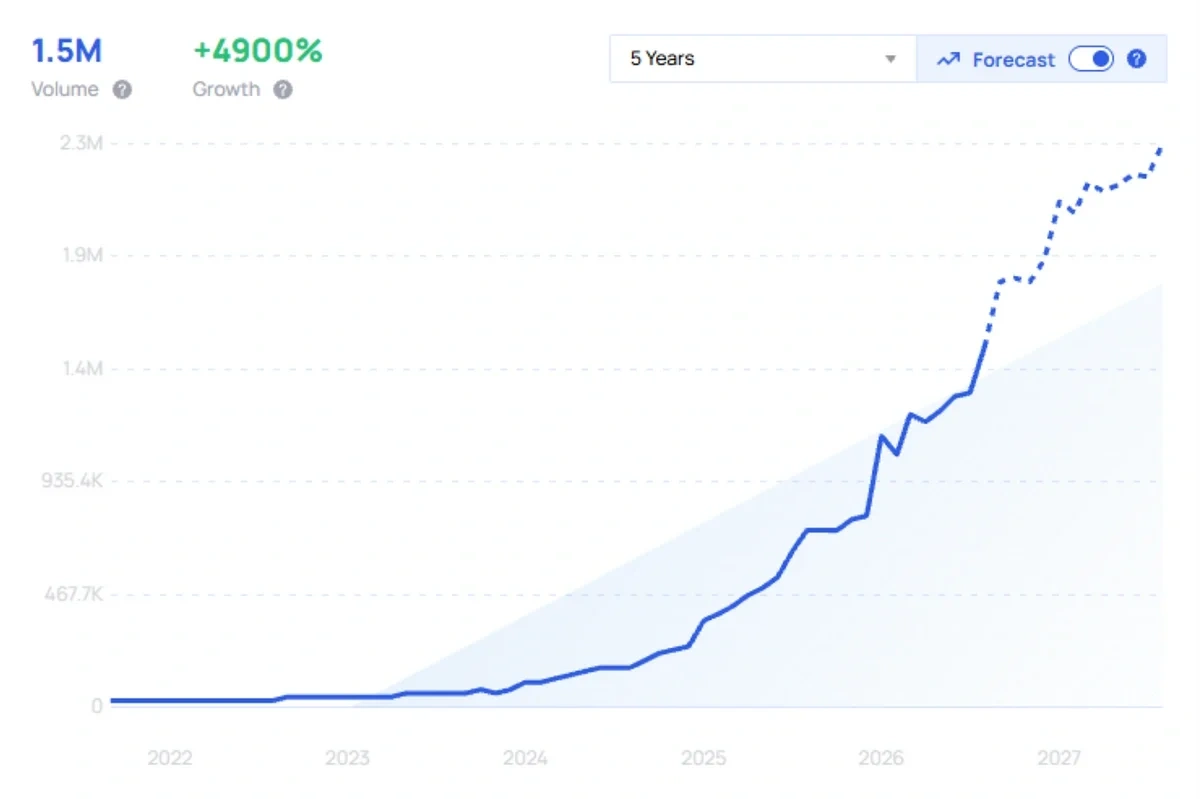
“GLP1” has seen astronomical search growth recently, and Exploding Topics forecasts further steep growth over the next year.
But people’s experiences with the healthcare system remain fundamentally affected by demographic factors like age, gender, and ethnicity, as well as economic realities.
I’ve put together some of the top health industry stats for 2026 and beyond, with a mix of original Exploding Topics data and third-party research.
Top Health Industry Stats
- Two-thirds of Americans have used AI for a health query
- 81% of US physicians use AI professionally
- Only 16% of Americans are satisfied with the cost of healthcare
- Workplace plans covering Ozempic dropped from 72% to 60% in 2026
- 37.24% of men always feel listened to by doctors, versus 24.05% of women
- Women in the US have an average life expectancy of 81.4, compared with 76.5 for men
AI in Healthcare Stats
AI is increasingly prevalent in all walks of life. But the topic of AI in healthcare is especially interesting and emotive: there is a natural reticence to automate care-giving, but also huge potential upsides to explore, both in terms of finances and quality of treatment.
From healthcare administration to drug discovery and patient-facing interfaces, AI is already making its mark on healthcare. Here are some of the top stats:
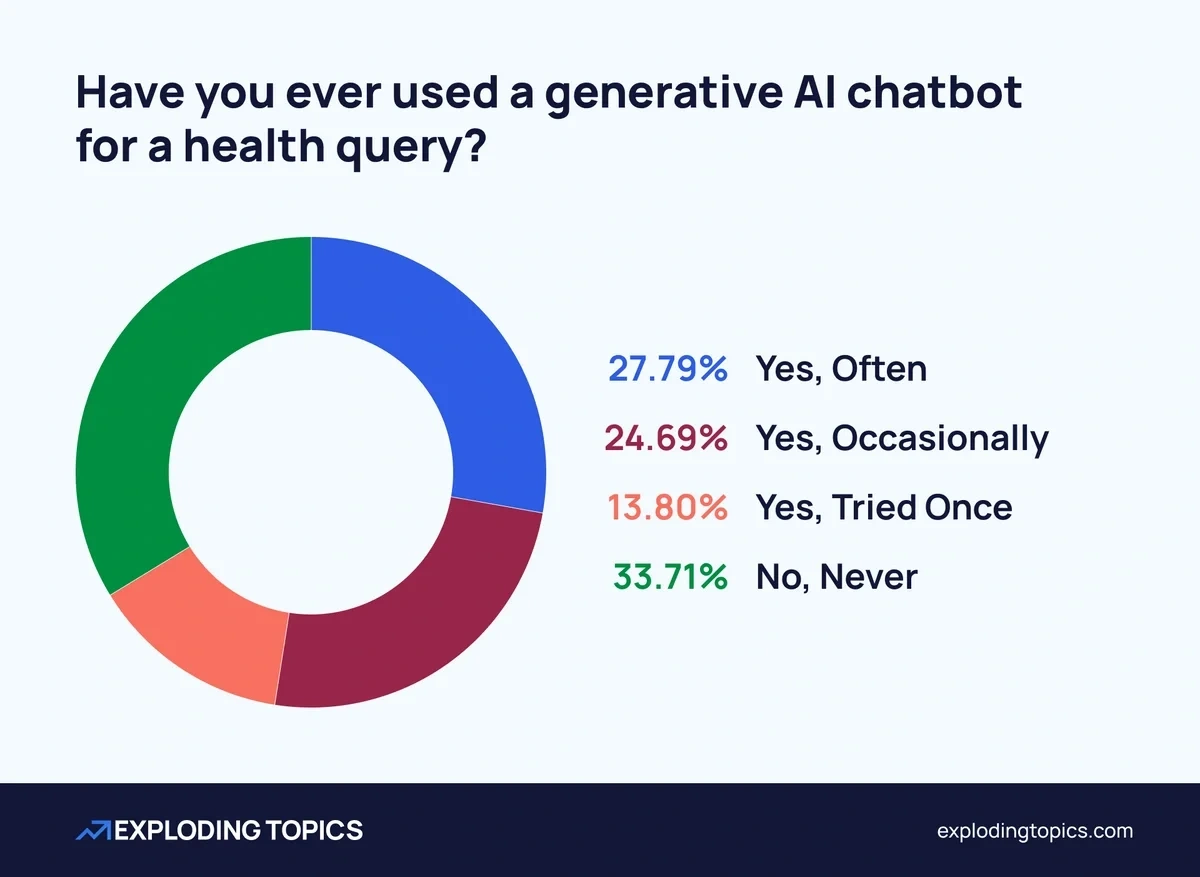
66.28% of US consumers have used AI for a health query (Exploding Topics)
More than a quarter of people in the US report “often” using generative AI for health queries, rising above a third in the 30-44 and 45-60 demographics. Among daily AI users, 96.9% have tried using the technology for health matters.
81% of US physicians are using AI professionally (American Medical Association)
The percentage of physicians using AI in their practice has more than doubled since 2023. More than three-quarters believe it improves their ability to care for patients, with summaries of medical research and standards of care the top use case.
Medicare is piloting AI for “wasteful and inappropriate service reduction” in 6 US states (BBC)
The WISeR program is a 6-year pilot of an AI claims system whereby doctors upload their justification for a treatment into an online portal for automated approval or rejection. But a report from a Democratic senator in Washington says the pilot is making patients wait 2-4 times longer for procedures.
72% of Americans think it’s very/extremely important for healthcare providers to disclose when they use AI (Pew Research)
Although patients are open to the use of AI in healthcare, they generally want to know if and when it is being used. Even when it comes to something as procedural as scheduling, 56% of people think the use of AI should be disclosed.
Only 9.8% of Americans aged 18-29 would be “very comfortable” being triaged by AI during a visit to a primary care physician (Exploding Topics)
Our original research consistently finds that AI skepticism is at its highest among the youngest and oldest consumers. More than 25% of Gen Z would be “very uncomfortable” with AI triage, higher than any other age group.
AI in healthcare is set to be a $222.9 billion industry in the US by 2033 (Grandview Research)
Last year, the US AI healthcare industry was worth an estimated $18.1 billion. It’s projected to grow at a 36.9% CAGR through 2033. Software solutions (44.3%) currently make up the largest single market segment, ahead of services and hardware.
AI drug discovery giant Isomorphic Labs raised a $2.1 billion Series B funding round in May 2026 (Isomorphic Labs)
AI drug discovery looks to automate the initial testing phase of novel treatments, digitally combining various organic structures and compounds and predicting how they will react. Isomorphic has raised billions of dollars, and its protein database has been used by more than 3 million researchers worldwide.
87% of healthcare leaders believe administration efficiency is one of the “domains of greatest potential” for generative AI in the industry (McKinsey)
Health leaders are most optimistic about AI applications to administration, followed by software infrastructure (cited by 64%) and patient/member engagement (63%).
The FDA has authorized over 1,500 AI-enabled medical devices for marketing (Food and Drug Administration)
The vast majority of AI medical devices approved by the FDA are in the area of radiology. Exploding Topics research found that 71.95% of US patients would be neutral, somewhat comfortable, or very comfortable if AI software was used to analyze their medical scans.
Health Insurance and Cost of Healthcare Stats
Health is recognized as a fundamental human right by the United Nations. That includes a right to medical care and necessary social services, as well as the right to security in the event of sickness or disability (Article 25).
In reality, however, many countries fail to guarantee universal access to healthcare, with economic barriers especially common. The US is particularly renowned for its expensive private system.
Here are a selection of statistics on the cost of healthcare, and the health insurance industry:
The US has the most expensive healthcare system in the world (Health System Tracker)
Annual health spending per capita in the US is $14,775. That’s significantly more than other nations with similar GDP per capita. For instance, the Netherlands has a near-identical GDP per capita to the US, but health spending per capita is only $8,436.
Medicare and Medicaid make up more than a quarter of the total federal budget (Center for Retirement Research)
Hospital visits under Medicare come from a dedicated trust fund, which is set to run out in 2033 at current rates. Other elements of the federal insurance schemes come from general federal funds. Medicare-covered doctors’ visits and outpatient services drew $498 billion from the Treasury’s general fund in 2024, versus $170 billion from premium payments.
28 million Americans under the age of 65 do not have health insurance (Center for Disease Control)
5.6% of US children are not covered by health insurance, rising to 11.6% among adults aged 18-64. Private insurance (66.2%) is more common than public insurance (26%).
Only 16% of Americans are satisfied with the cost of healthcare in the US (Gallup)
Almost 1 in 3 Americans believe the cost of healthcare is the most urgent national health problem. However, 57% of people are at least satisfied with the cost of their own healthcare.
Over a third of Americans have skipped or postponed healthcare in the last 12 months for cost reasons (KFF)
36% of people in the US have either delayed treatment or gone without it because of the expense attached. This rises to 75% among uninsured adults under the age of 65.
Almost 3 in 4 Americans with workplace health insurance have seen rising costs, worsening coverage, or other issues in the past 2 years (The Century Foundation)
36% of people with private insurance have reported increased premiums, 31% have reported increased co-pays for doctor’s visits or prescription drugs, and 27% have reported raised deductibles or out-of-pocked maximums. 18% have been designed a doctor-recommended treatment or medication, and 15% have experienced issues with facilities or specialists not being covered.
The share of US employers covering weight-loss drugs like Ozempic dropped from 72% in 2025 to 60% in 2026 (Reuters)
Pharmacy costs make up a quarter of US employers’ healthcare spending. With 10 million Americans on GLP-1 drugs in 2025, workplace health plans are starting to take a less permissive attitude.
The US healthcare market is worth $5.15 trillion (Market Data Forecast)
Healthcare in the US is set to be valued at more than $8 trillion by 2034. That covers everything from providers to insurers to technology innovators.
In March 2026, healthcare accounted for 43% of all new jobs added in the US (Financial Times)
The healthcare industry is projected to be the single largest driver of job gain through 2034, with an 8.4% projected gain.
Healthcare Demographics
At one time or another, everyone will come into contact with the healthcare industry. Yet not everyone can expect equal treatment.
The way we interact with and experience healthcare, and the outcomes we receive, can differ significantly based on factors like race, geography, age, gender, and income. This is a selection of the most interesting healthcare demographics statistics in 2026.
Premature death rates are 5x higher among American Indians/Alaska Natives than among Asians in the US (America’s Health Rankings)
There are significant demographic disparities in years lost to premature deaths (death below the age of 75) in the US. For instance, years lost per 100,000 people are 2.1x higher in Mississippi than Massachusetts.
18.4% of Hispanics under 65 in the US don’t have health insurance, versus 6.8% of their White counterparts (KFF)
Asians in the US are statistically most universally covered by health insurance, with an uninsured rate of just 5.7%. American Indians/Alaska Natives have the highest uninsured rate, at 18.9%.
White people have the highest cancer incidence of any racial or ethnic group in the US (KFF)
White people have a new cancer incidence rate of 458.6 per 100,000 people, compared to just 300.7 among Asians and Pacific Islanders. However, Black people have the highest rate of cancer death per 100,000 people.
Men (37.24%) are much more likely than women (24.05%) to feel “listened to” all the time when explaining their symptoms to a medical professional (Exploding Topics)
More than 8 in 10 men in the US feel that doctors listen to them at least most of the time. Only a little over two-thirds of women (67.94%) feel the same way. Both men and women were more likely to feel listened to by AI.
Only 31% of US voters think healthcare does a good job of meeting women’s needs (Center Forward)
92% of all voters agree that women have unique health needs that merit specific attention, but less than a third believe the system adequately delivers that care. Lower-income women are also more likely to feel overlooked.
Higher-income groups are more likely to use AI chatbots for health queries (Exploding Topics)
75.11% of people in the US with household incomes above $100,000 use AI chatbots for health queries at least occasionally. The same is true of just 40.5% of people with household incomes from $0-99,999.
Vermont is the healthiest state for adults aged 65+ (America’s Health Rankings)
Based on 36 measures across Social and Economic Factors, Physical Environment, Behaviors, Clinical Care, and Health Outcomes, Vermont ranks as the healthiest state in the US for senior citizens. Louisiana has the most room for improvement.
The average life expectancy for women in the US is 81.4, compared with 76.5 for men (Center for Disease Control)
The overall average US life expectancy is 79. The discrepancy between men and women is broadly in line with global averages (76.4 for women, 71.2 for men).
Build a winning strategy
Get a complete view of your competitors to anticipate trends and lead your market
Keep on top of industry trends
Whatever your industry, Exploding Topics helps you stay on top of the latest trends. We’ve run original surveys in the fields of healthcare, marketing, E-commerce and more.
And when you sign up for free, you’ll get a weekly report on the latest high-growth startups and trends, backed by our powerful trends database. Every newsletter is curated, researched, and written by our expert human analysts.
We’ve got a demonstrable record of finding huge trends before they go mainstream. If the newsletter is all you sign up for, you’ll be getting an invaluable resource.
If you want to unlock the full power of Exploding Topics, you can subscribe for on-demand access to our entire trends database. You’ll be able to browse and track millions of topics across 60+ categories, access dedicated trending startup and product databases, and even pull our data into your processes with API access.
Sign up through the Semrush App Center and get a 7-day free trial of the full Exploding Topics toolkit.
Stop Guessing, Start Growing 🚀
Use real-time topic data to create content that resonates and brings results.
Exploding Topics is owned by Semrush. Our mission is to provide accurate data and expert insights on emerging trends. Unless otherwise noted, this page’s content was written by either an employee or a paid contractor of Semrush Inc.
Share
Newsletter Signup
By clicking “Subscribe” you agree to Semrush Privacy Policy and consent to Semrush using your contact data for newsletter purposes
Written By


James is a Journalist at Exploding Topics. After graduating from the University of Oxford with a degree in Law, he completed a... Read more