Exploding Topics
Remineralizing Gum search volume grew from under 100 to 27,100 monthly searches between February 2024 and January 2026.
Remineralizing gum
+5100%
GLP 1 Supplement search volume grew from 5,920 to 74,000 monthly searches between February 2024 and January 2026.
GLP 1 supplement
+1150%
Soursop Bitters search volume grew from 9,900 to 110,000 monthly searches between March 2024 and February 2026.
Soursop bitters
+1011%



Get Advanced Insights on Any Topic
Discover Trends 12+ Months Before Everyone Else
How We Find Trends Before They Take Off
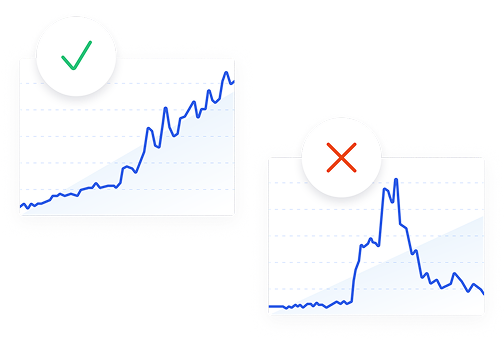
Exploding Topics’ advanced algorithm monitors millions of unstructured data points to spot trends early on.
Keyword Research
Performance Tracking
Competitor Intelligence
Fix Your Site’s SEO Issues in 30 Seconds
Find technical issues blocking search visibility. Get prioritized, actionable fixes in seconds.
Powered by data from
Latest Blog Posts
Featured Case Studies
See what's trending before everyone else
Each week, we'll send you our best Exploding Topics. Plus, expert insight and analysis.
How Many People Use AI? (Latest 2026 Data)

 Add Exploding Topics on GoogleAdd Exploding Topics as your preferred source to see more of our stories on Google.
About 2 billion people worldwide use AI as of 2026, according to Menlo Ventures' State of Consumer AI report.
In the US, 25% of adults used AI every day in July 2026, according to the same Menlo Ventures survey.
Microsoft data shows that 18.8% of the world's working-age population used generative AI in June 2026.
Generative AI tools such as ChatGPT, Gemini and Claude have brought AI into everyday work, study and search. But growth in new users is slowing, and how often people use AI varies widely by age, income and country.
In this article, we'll break down how many people use AI, how often they use it, which tools they use, and what the numbers mean for marketers planning for AI search.
Top AI Usage Statistics
- About 2 billion people worldwide use AI, up 11% from 1.8 billion a year earlier (Menlo Ventures, 2026)
- 25% of US adults use AI every day, up from 19% a year earlier (Menlo Ventures, July 2026)
- 18.8% of the world's working-age population used generative AI in June 2026, up from 17.8% in the first quarter of 2026 (Microsoft, September 2026)
- 49% of US adults use AI chatbots such as ChatGPT, Gemini or Copilot (Pew Research Center, February 2026)
- Google AI Overviews has more than 2.5 billion monthly active users (Google, May 2026)
- The United Arab Emirates has the highest AI use in the world, at 73.3% of its working-age population (Microsoft, June 2026)
- 23.8% of US businesses used AI in mid-September 2026, up from 17.7% in late December 2025 (US Census Bureau, October 2026)
How Many People Use AI in 2026?
About 2 billion people worldwide use AI in 2026, according to Menlo Ventures' estimate. That is roughly 24% of the world's population.
According to the same report, the number of AI users grew 11% in a year, from 1.8 billion to 2.0 billion. This figure is based on an estimate on its survey of US adults, adjusted down for internet access, age and regional differences.
Microsoft measures AI use a different way, from anonymized Microsoft telemetry data. The Microsoft AI Economy Institute found that 18.8% of people aged 15 to 64 worldwide used a generative AI product in June 2026.
Microsoft also found a large gap between richer and poorer countries. According to the Microsoft AI Diffusion Report, in June 2026 28.8% of the working-age population in the Global North used AI, compared with 16.2% in the Global South.
Survey-based figures are higher because they include people who use AI only occasionally. A KPMG and University of Melbourne study of 48,340 people in 47 countries found that 66% use AI at least every few months. Only 38% use it weekly or daily.
Here's a breakdown of the main global AI usage estimates:
| Source | What It Measures | Figure | Period |
| Menlo Ventures | People worldwide who use AI (estimate) | ~2 billion | 2026 |
| Microsoft AI Economy Institute | Share of working-age people (15 to 64) who used generative AI | 18.8% | June 2026 |
| Google and Ipsos (21 countries) | Adults who used an AI tool or app in the last 12 months | 66% | September to October 2025 |
| KPMG and University of Melbourne (47 countries) | People who use AI at least every few months | 66% | November 2024 to January 2025 |
| KPMG and University of Melbourne (47 countries) | People who use AI weekly or daily | 38% | November 2024 to January 2025 |
For marketers, the gap between "ever used" and "use every week" may matter more than the headline figure. A large share of the AI audience still uses these tools only occasionally.
How Many People Use AI Every Day?
About a quarter of US adults use AI every day. Menlo Ventures found that 25% of US adults used AI daily in July 2026, up from 19% a year earlier.
Daily use is growing faster than total use. According to the same report, 39% of US AI users now use AI every day, up from 31% a year earlier. The share of US adults who use AI at all rose only three percentage points, from 61% to 64%.
The Pew Research Center found a similar daily figure in February 2026. 24% of US adults use AI chatbots daily, including 4% who use them "almost constantly" and 12% who use them several times a day.
Exploding Topics' own 2026 survey found higher daily use among its respondents. Exploding Topics research shows that 36.34% of respondents use AI chatbots every day.
Daily users are the people most likely to see AI answers about your brand. A growing daily audience may make AI visibility a regular reporting metric rather than an occasional check.
How Many Americans Use AI?
About half of US adults use AI chatbots. The Pew Research Center found that 49% of US adults used AI chatbots such as ChatGPT, Gemini or Copilot in February 2026.
Other surveys put the figure higher because they ask different questions. Menlo Ventures found that 64% of US adults used AI in the past six months, and Elon University found that 65% used a large language model (LLM) chatbot such as ChatGPT in the past week.
Here's a breakdown of the latest US AI usage surveys:
| Source | Survey Dates | What It Measures | Share of US Adults |
| Pew Research Center | February 2026 | Ever use AI chatbots | 49% |
| Pew Research Center | February 2026 | Use AI chatbots daily | 24% |
| Menlo Ventures | July 2026 | Used AI in the past six months | 64% |
| Menlo Ventures | July 2026 | Use AI every day | 25% |
| Elon University | May 2026 | Used an LLM chatbot in the past week | 65% |
| West Health and Gallup | October to December 2025 | Have ever used an AI tool or chatbot | ~70% |
Microsoft's telemetry gives a lower figure for the US. According to Microsoft, 33.0% of the US working-age population used AI in June 2026, which ranks the US 21st in the world.
For more on chatbot adoption, see our AI chatbot statistics.
The spread of figures shows that "AI user" has no single definition. When you compare AI usage statistics, check whether each one measures daily, weekly or any use.
How Many People Use Each AI Tool?
Google AI Overviews has the most users of any AI tool, with more than 2.5 billion monthly active users, according to Google in May 2026.
Google's other AI products have also passed 1 billion users. Google says that more than 1 billion people use the Gemini app every month, and Google AI Mode had more than 1 billion monthly active users as of July 2026.
ChatGPT had 900 million weekly active users in February 2026, according to OpenAI, as reported by TechCrunch. In September 2026, OpenAI said it reaches 1.2 billion weekly users, according to TechCrunch, but this may include more than one OpenAI product.
Here's a breakdown of the most popular AI tools by official user figures:
| AI Tool | Users | What It Measures | As Of |
| Google AI Overviews | 2.5 billion+ | Monthly active users | May 2026 |
| Google Gemini app | 1 billion+ | Monthly users | August 2026 |
| Google AI Mode | 1 billion+ | Monthly active users | July 2026 |
| Meta AI | 1 billion+ | Monthly active users | October 2025 |
| ChatGPT | 900 million | Weekly active users | February 2026 |
| Microsoft Copilot apps | 150 million+ | Monthly active users across Microsoft's own Copilot apps | October 2025 |
| Grok | 117 million | Monthly active users of Grok's AI features | March 2026 |
Each company measures users differently, so these figures aren't directly comparable. AI Overviews and Meta AI appear inside products people already use, while ChatGPT users visit the tool directly.
Anthropic doesn't publish a user count for Claude. Pew found that 6% of US adults use Claude, compared with 44% for ChatGPT.
Here's a breakdown of the share of US adults who use each AI chatbot, from Pew's February 2026 survey:
| AI Chatbot | Share of US Adults Who Use It |
| ChatGPT | 44% |
| Gemini | 24% |
| Microsoft Copilot | 17% |
| Meta AI | 14% |
| Grok | 8% |
| Claude | 6% |
| Character.ai | 3% |
For more on ChatGPT's growth, see our ChatGPT user statistics, or compare the most popular AI tools by traffic.
AI Chatbot Website Traffic
ChatGPT is still the most visited AI chatbot website by a wide margin. chatgpt.com had 5.32 billion visits in June 2026, up 12.8% from June 2025, according to Semrush Traffic Analytics.
Claude grew fastest. claude.ai had 967.9 million visits in June 2026, up 733.4% from 116.1 million in June 2025. gemini.google.com had 1.14 billion visits, up 323.3% from the year before.
Here's a breakdown of visits to the biggest AI chatbot websites:
| Website | Visits (June 2025) | Visits (June 2026) | Change |
| chatgpt.com | 4.72 billion | 5.32 billion | +12.8% |
| gemini.google.com | 268.7 million | 1.14 billion | +323.3% |
| claude.ai | 116.1 million | 967.9 million | +733.4% |
| perplexity.ai | 144.5 million | 140.7 million | -2.6% |
| copilot.microsoft.com | 83.0 million | 92.7 million | +11.8% |
Figures above are for June 2025 and June 2026.
For the latest monthly figures, see Exploding Topics' chatgpt.com website traffic analytics.
Website visits show where people actively choose to use AI. For brands, a fast-growing chatbot such as Claude may be worth adding to AI visibility tracking alongside ChatGPT and Gemini.
Want to Spy on Your Competition?
Explore competitors’ website traffic stats, discover growth points, and expand your market share.
How Many People Use AI for Search?
Most people meet AI through search. Google AI Overviews has more than 2.5 billion monthly active users, and AI Mode has more than 1 billion, according to Google.
Google shared both figures at its I/O 2026 conference in May 2026.
In the US, 60% of adults say they read AI summaries at the top of search results, according to the Pew Research Center. Pew also found that searching for information is one of the most common uses of chatbots: 42% of US adults use them to look things up.
AI chatbots still handle far fewer requests than Google. Users sent ChatGPT 2.5 billion prompts a day in July 2025, according to OpenAI figures reported by Axios. That is the latest official figure, so today's total is likely higher. By comparison, Exploding Topics research estimates that Google handles about 16.4 billion searches a day.
AI chatbots are also becoming a news source. The Reuters Institute Digital News Report 2026 found that 10% of people across 48 markets use AI chatbots for news each week, up from 7% a year earlier.
Because AI answers now sit on top of search results, a brand can reach searchers without a click. That makes citations in AI Overviews and AI Mode worth tracking alongside rankings.
AI Usage by Age, Gender, Income and Race
AI chatbot use in the US varies most by age and income. Pew found that 66% of adults aged 18 to 29 use AI chatbots, compared with 23% of adults aged 65 and older.
Here's a breakdown of AI chatbot use by demographic group in the US, from Pew's February 2026 survey:
| Group | Share Who Use AI Chatbots |
| All US adults | 49% |
| Men | 50% |
| Women | 47% |
| Ages 18 to 29 | 66% |
| Ages 30 to 49 | 61% |
| Ages 50 to 64 | 42% |
| Ages 65 and older | 23% |
| Upper income | 66% |
| Middle income | 49% |
| Lower income | 41% |
| Asian (English speakers) | 70% |
| Black | 49% |
| Hispanic | 49% |
| White | 46% |
AI Usage by Age
Younger adults are the most likely to use AI chatbots. According to the Pew Research Center, AI chatbot use falls with each age group, from 66% of 18 to 29-year-olds to 23% of adults aged 65 and older.
Daily use peaks a little older. Exploding Topics' 2026 survey found that 46.79% of adults aged 30 to 44 use AI chatbots every day, more than any other age group.
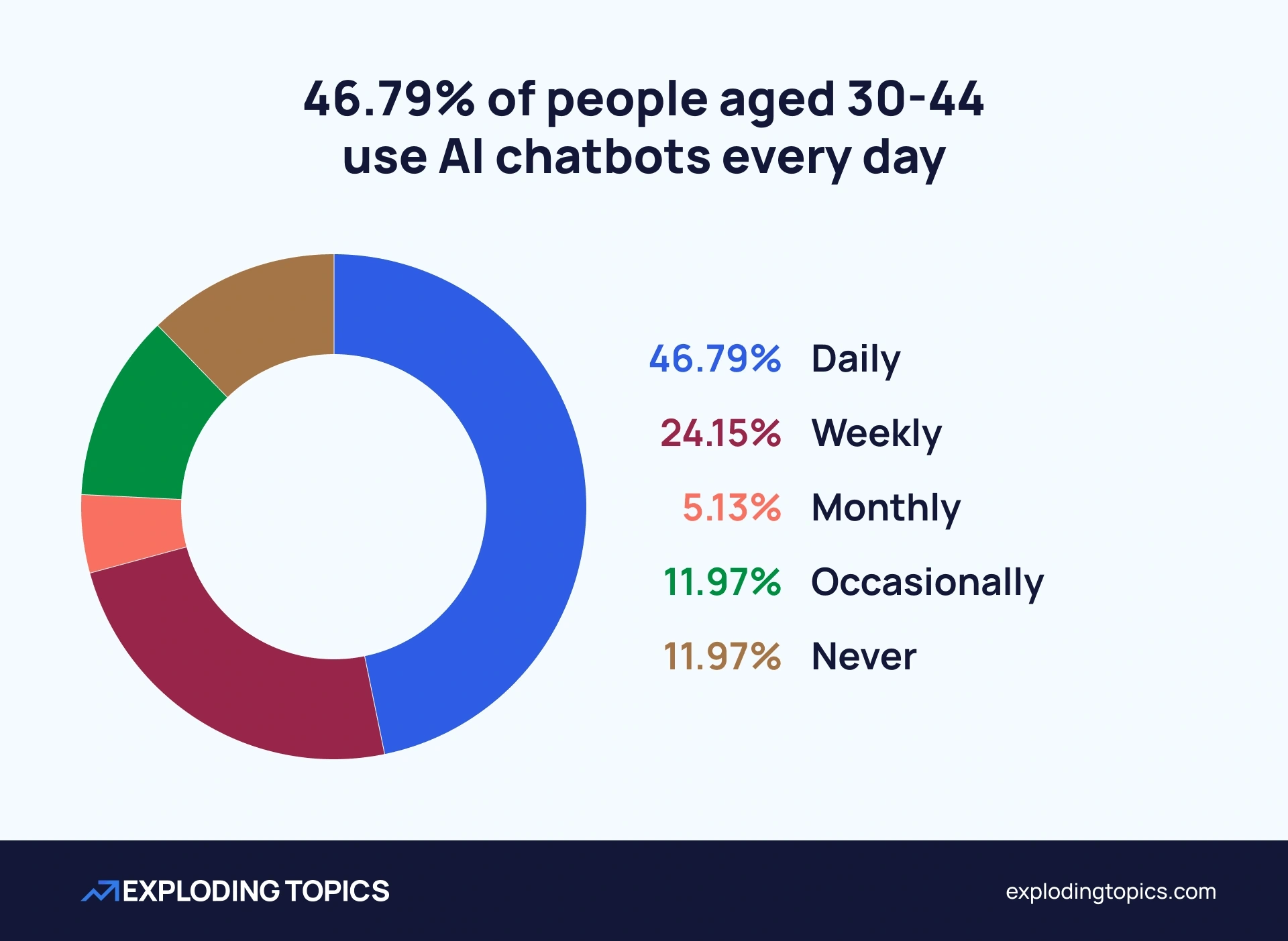
Here's a breakdown of daily AI use by age, from Exploding Topics' AI user demographics research:
| Age | Daily AI Users | Non-AI Users |
| 18 to 29 | 30.07% | 16.34% |
| 30 to 44 | 46.79% | 11.97% |
| 45 to 60 | 38.08% | 11.92% |
| 60 and older | 15.70% | 36.36% |
Menlo Ventures found the same pattern. Gen Z has the highest overall AI adoption, at 81%, but millennials lead daily use, at 37%.
AI Usage by Gender
The gender gap in AI chatbot use is small. According to Pew, 50% of men and 47% of women use AI chatbots.
The gap is wider for daily use. Pew found that 27% of men use AI chatbots daily, compared with 20% of women. Men and women use ChatGPT at the same rate, at 44% each. But men are more likely to use Gemini (29% vs 20%), Copilot (22% vs 13%), Grok (11% vs 4%) and Claude (9% vs 4%).
AI Usage by Income
AI use rises with household income. Pew found that 66% of upper-income US adults use AI chatbots, compared with 41% of lower-income adults.
Menlo Ventures found the same gap. 77% of households earning $100,000 or more use AI, compared with 56% of households earning under $50,000.
The gap is even wider for daily use. Exploding Topics' 2026 survey found that 66.9% of people in households earning at least $150,000 use AI daily, compared with 23.24% of people in households earning under $75,000.
AI Usage by Race and Ethnicity
Asian Americans are the most likely to use AI chatbots. According to Pew, 70% of English-speaking Asian adults use AI chatbots, compared with 49% of Black and Hispanic adults and 46% of White adults.
For marketers, these figures suggest that AI search reaches younger, higher-income audiences first. Brands that serve older or lower-income customers may still see most of their discovery through traditional search.
AI Usage by Country
The United Arab Emirates has the highest AI use in the world. Microsoft found that 73.3% of the UAE's working-age population used AI in June 2026, followed by Singapore at 64.3%.
Here's a breakdown of the countries with the highest AI use, from the Microsoft AI Diffusion Report:
| Rank | Country | Working-Age Population Using AI (June 2026) |
| 1 | United Arab Emirates | 73.3% |
| 2 | Singapore | 64.3% |
| 3 | Ireland | 49.9% |
| 4 | France | 49.6% |
| 5 | Norway | 49.4% |
| 6 | Spain | 45.1% |
| 7 | New Zealand | 44.1% |
| 8 | United Kingdom | 43.7% |
| 9 | Netherlands | 43.5% |
| 10 | Qatar | 43.5% |
| 21 | United States | 33.0% |
Microsoft's data shows that South Korea had the biggest rise of any country in the second quarter of 2026, up 3.5 percentage points to 40.6%. The US ranked 21st, at 33.0%.
Surveys that count occasional use show a different picture, with emerging economies at the top. The KPMG and University of Melbourne study found that 92% of people in India and Nigeria use AI at least every few months, compared with 53% in the US.
Here's a breakdown of AI use in selected countries, from the KPMG study:
| Country | People Using AI at Least Every Few Months |
| India | 92% |
| Nigeria | 92% |
| United Arab Emirates | 91% |
| Egypt | 90% |
| China | 89% |
| South Africa | 83% |
| Brazil | 82% |
| Turkey | 81% |
| Mexico | 77% |
| Singapore | 73% |
| United States | 53% |
| United Kingdom | 52% |
| Germany | 51% |
| Japan | 50% |
| Sweden | 49% |
| Netherlands | 43% |
The two sources disagree because they measure different things. Microsoft counts the share of working-age people using generative AI in each quarter, while KPMG asked people how often they use AI, even every few months.
How Many Companies Use AI?
About 1 in 4 US businesses use AI. The US Census Bureau found that 23.8% of US businesses used AI in the two weeks to September 20, 2026, up from 17.7% in late December 2025.
Here's a breakdown of AI use by US businesses, from the US Census Bureau Business Trends and Outlook Survey:
| Survey Period | US Businesses Using AI |
| December 15 to 28, 2025 | 17.7% |
| April 6 to 19, 2026 | 19.8% |
| Mid-August 2026 | 23.2% |
| September 7 to 20, 2026 | 23.8% |
The Census Bureau also found that 27.7% of US businesses expect to use AI in the next six months.
Surveys of organizations find higher use. McKinsey's State of AI 2026 found that nearly nine in ten respondents say their organizations use AI regularly in at least one business function. 44% say AI is scaling across their enterprise, up from 38% a year earlier.
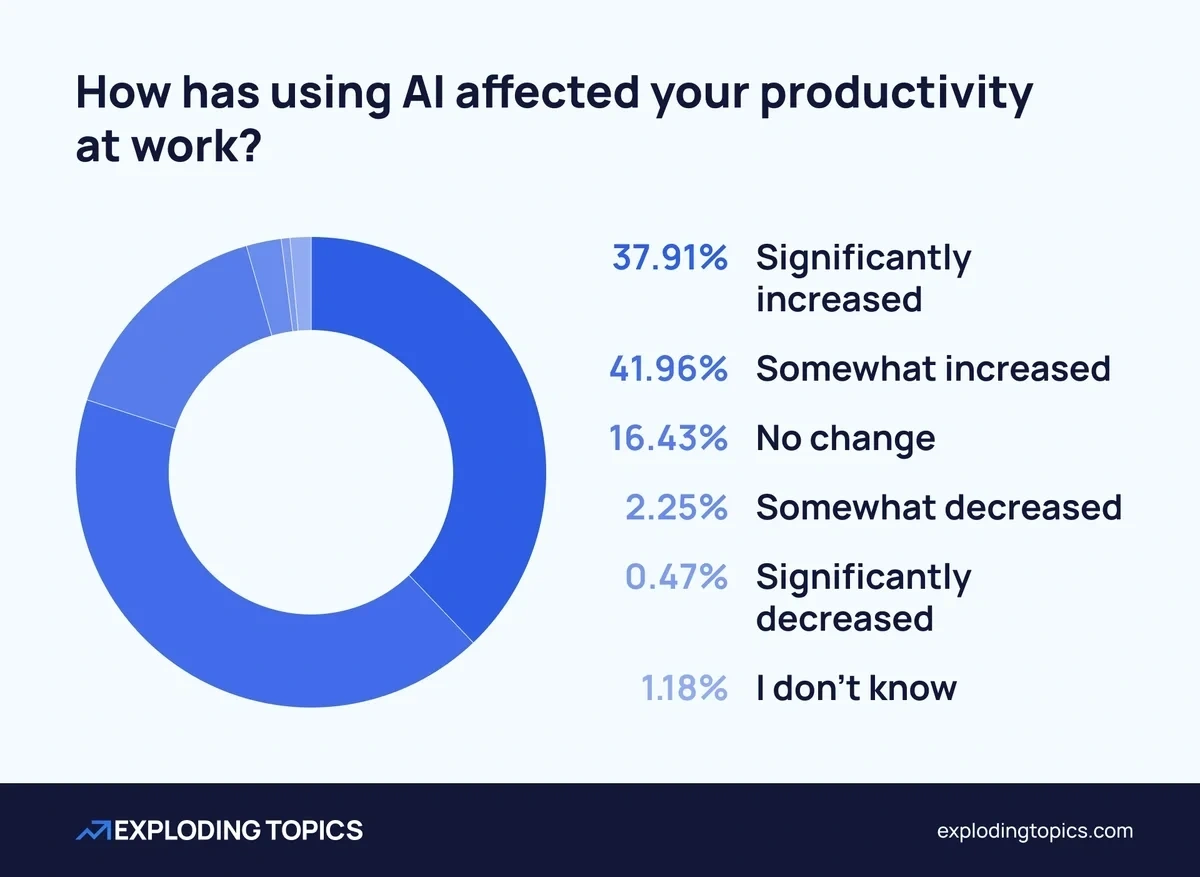
Many employees use AI at work whether or not their company has a plan for it. An Exploding Topics survey of more than 1,000 AI users found that 83.13% use AI at work, and 79.67% say it has increased their productivity.
For more on business adoption, see how many companies use AI.
What Does Search Data Say About AI Tools?
Exploding Topics data shows that searches for "Claude AI" grew 300% between September 2025 and September 2026, from 11.4 million to 45.5 million a month.
Searches for "Google AI Mode" also doubled over the same period, while searches for "Perplexity AI" fell 63%.
Here's a breakdown of monthly searches for AI tools, according to Exploding Topics:
| Search Term | September 2025 | September 2026 | Change |
| Claude AI | 11.4 million | 45.5 million | +300% |
| Google AI Mode | 741,000 | 1.5 million | +103% |
| ElevenLabs | 6.3 million | 5.0 million | -21% |
| Perplexity AI | 9.1 million | 3.4 million | -63% |
Search interest shows which AI tools people are actively looking for, not only which ones they already use. That makes it an early signal of which AI platforms may matter next for brand visibility.
See how SEOs and agencies use Exploding Topics to find rising topics before competitors do.
Case study: How Naturecan Found New Supplement Markets With Exploding Topics
Naturecan started out selling only CBD products, and search interest in CBD stalled after COVID-19. The company needed new product lines that weren't already crowded.
The team used Exploding Topics to confirm that searches for longevity supplements such as NMN, spermidine and berberine were growing in the US, then checked demand in each market with Semrush. "By spotting longevity-related trends early, we can identify markets that aren't too competitive yet," said Alexander Rinn Ortiz, e-commerce managing director at Naturecan.
What's Next for AI Usage?
AI use is still growing worldwide, but new users are arriving more slowly than existing users are increasing how often they use AI.
Microsoft found that the share of working-age people using AI rose from 16.3% in the second half of 2025 to 18.8% in June 2026.
But Menlo Ventures found that the number of AI users grew only 11% in a year, while daily use grew faster. That suggests the next phase of AI growth may come from existing users using AI more often, rather than from new users.
Business use is likely to keep rising. The US Census Bureau found that 27.7% of US businesses expect to use AI in the next six months, compared with 23.8% using it now.
How We Compiled These Statistics
We used official company figures for tool user counts, and named surveys from the Pew Research Center, Menlo Ventures, Elon University, Gallup, KPMG, Google and Ipsos for usage rates. Where sources disagree, we show each figure with what it measures. Country figures come from the Microsoft AI Diffusion Report and the KPMG study. Business figures come from the US Census Bureau and McKinsey. Website visits come from Semrush Traffic Analytics, and search volumes come from Exploding Topics. Figures are as of October 19, 2026.
For more AI statistics, take a look at:
With 2 billion people using AI, your brand's visibility in AI answers is becoming as important as its search rankings. The Semrush AI Visibility Toolkit tracks how your brand appears in AI search tools such as ChatGPT and Google AI Mode, and how you compare with competitors. Try Semrush free to check your AI visibility, and use Exploding Topics Pro to spot the next AI trends before they peak.
Stop Guessing, Start Growing 🚀
Use real-time topic data to create content that resonates and brings results.
Exploding Topics is owned by Semrush. Our mission is to provide accurate data and expert insights on emerging trends. Unless otherwise noted, this page’s content was written by either an employee or a paid contractor of Semrush Inc.
Share
Newsletter Signup
By clicking “Subscribe” you agree to Semrush Privacy Policy and consent to Semrush using your contact data for newsletter purposes
Written By


Josh is the Co-Founder and CTO of Exploding Topics. Josh has led Exploding Topics product development from the first line of co... Read more