


Get Advanced Insights on Any Topic
Discover Trends 12+ Months Before Everyone Else
How We Find Trends Before They Take Off
Exploding Topics’ advanced algorithm monitors millions of unstructured data points to spot trends early on.
Keyword Research
Performance Tracking
Competitor Intelligence
Fix Your Site’s SEO Issues in 30 Seconds
Find technical issues blocking search visibility. Get prioritized, actionable fixes in seconds.
Powered by data from
Latest Blog Posts
Featured Case Studies
See what's trending before everyone else
Each week, we'll send you our best Exploding Topics. Plus, expert insight and analysis.
5 Tools that Get AI Sentiment Analysis Right: My Top Choices

 Add Exploding Topics on GoogleAdd Exploding Topics as your preferred source to see more of our stories on Google.
The pursuit of AI rankings is an important marketing objective for most websites competing for online visibility.
That said, visibility alone in AI answers doesn’t guarantee the ideal outcome for your business.
You also need positive portrayal in the eyes of LLMs in order to win favorable mentions and visibility that actually benefits you in a meaningful way.
But the first step is knowing the sentiments different LLMs hold for your brand or product in the first place.
This is an impossible task to perform manually.
You’d have to run tons of different prompts across all major LLM platforms, read the responses, and extract the general theme of sentiments for each.
I’ve had occasion to use various AI sentiment tracking tools that solve this problem.
All of the tools on my list handle sentiment analysis really well. I don’t have a clear favorite, but I think some are better suited for certain use cases than the others, as I’ll explain in my review.
My 5 Favorite AI Sentiment Tracking Tools
| Tool Name | Starting Price (Monthly) | Primary Focus/Best For | Key Features |
| Semrush AI Visibility Toolkit | $165.17 | All-in-one SEO/Marketing Suite | Sentiment analysis, competitive benchmarking, historical tracking, feature category breakdowns |
| Peec AI | $95 (Brands) / $205 (Agency) | Market prominence by feature associations | Brand shape graphs, attribute comparisons |
| Rankscale | $99 | Intuitive sentiment breakdowns | Keyword clouds, engine-specific breakdowns |
| LLM Pulse | $100 | Rule-based sentiment classification | Custom sentiment rules, time-series charts |
| ZipTie | $69 | Budget-conscious sentiment tracking | Citation/mention tracking, sentiment classification |
Build a winning strategy
Get a complete view of your competitors to anticipate trends and lead your market
1. Semrush AI Visibility Toolkit: The Most Well-Rounded Sentiment Breakdowns
Semrush has a dedicated Perception report that’s a key part of the AI Visibility Toolkit.
The report starts with a simple but illuminating graph that concisely packs a lot of information.
It reveals how favorably you’re seen by top AI models compared to your main competitors.
If you want to know which brands LLMs are favoring more, this simple graph is all you need to look at.
I also like the strategic insights listed on the left of the graph. These are AI-generated, but the quality of the insights would have you believe they were suggested by a human expert.
It’s important to remember that AI responses, and sentiments as a result, are always changing. An AI talking enthusiastically about you today might take a more critical view a month later.
Semrush lets you monitor these changes in perception over time with a historical time series chart.
I particularly like that you can select any one of the four supported LLM models to track their perception of your brand historically.
In addition, you can go beyond surface-level sentiment assessments to how LLMs are speaking about different features and aspects of your brand or product:
- See the positive and negative attributes LLMs associate with your brand during conversations
- Measure the percentage of favorable sentiment for your brand vs your competitors across feature categories relevant to your industry
- Check how frequently you’re mentioned in different feature categories compared to your competitors
- Identify detailed feature descriptions AI uses for brands in your industry and how frequently and favorably you appear for these.
These insights are incredibly valuable. They enable you to find the weaknesses and negative attributes AI associates with you.
They also reveal your strengths and the strong descriptions different LLMs are using in your favor.
Semrush goes into much greater depth in terms of exact descriptive sentiments LLMs hold for your brand.
Combined with excellent visualizations and charts that illustrate sentiment, along with an excellent set of AI visibility-tracking features, Semrush AI Visibility Toolkit offers everything you can expect from a top-quality tool for AI search strategy.
The Semrush SEO + AI Search plans starting at $165.17/mo offer incredible value.
You get features for keyword analysis, backlink reports, and SEO audits, along with AI search monitoring like sentiment analysis, prompt research, and mentions in a single suite.
2. Peec AI: Good for Competitive Market Prominence by Feature Associations
Peec AI’s sentiment analysis focuses on identifying attributes different AI models are associating with your brand.
It looks at your strongest attributes and scores them from 0-100. But beyond analyzing associations of your brand, you also need to evaluate how you’re competing against other brands for the same attributes.
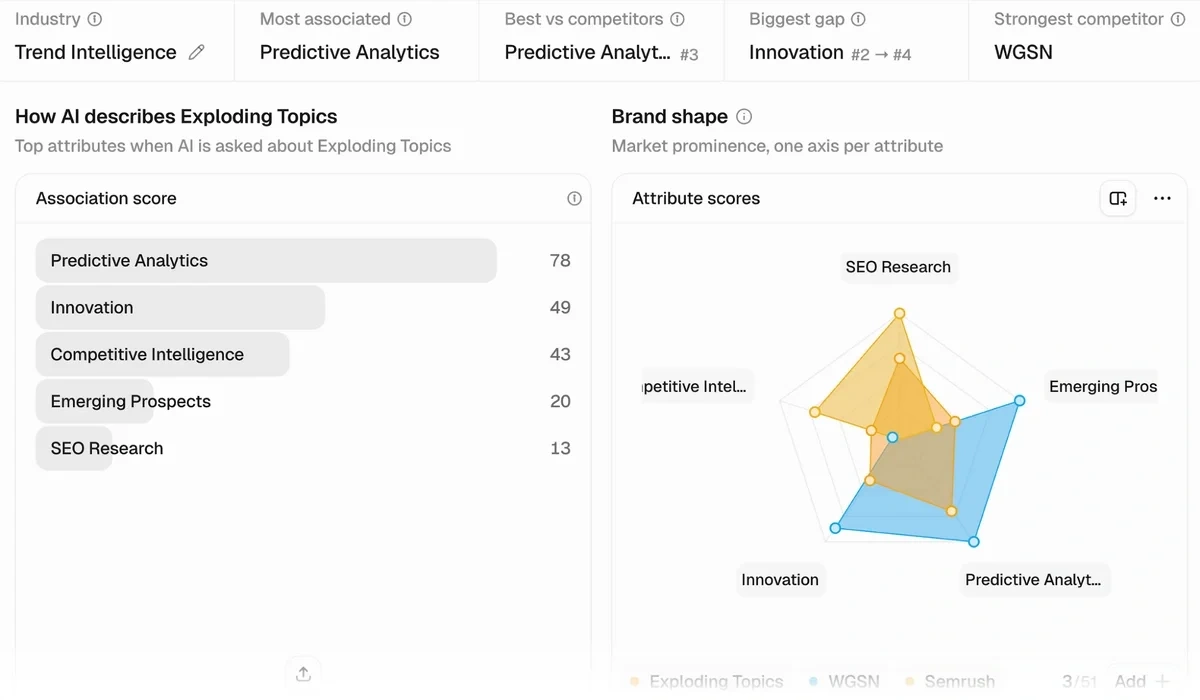
For that, Peec AI gives you an insightful graph called brand shape that shows the leaders of your industry for key attributes also associated with you.
It’s a good way to compare how far ahead, or behind, you are in the eyes of different AI models.
While these assessments are based on branded queries, Peec AI also performs brand attribute comparisons for non-branded, industry-level queries.
This breakdown heat map indicates how prominently you’re named when AI is asked about attributes it associates with relevant brands.
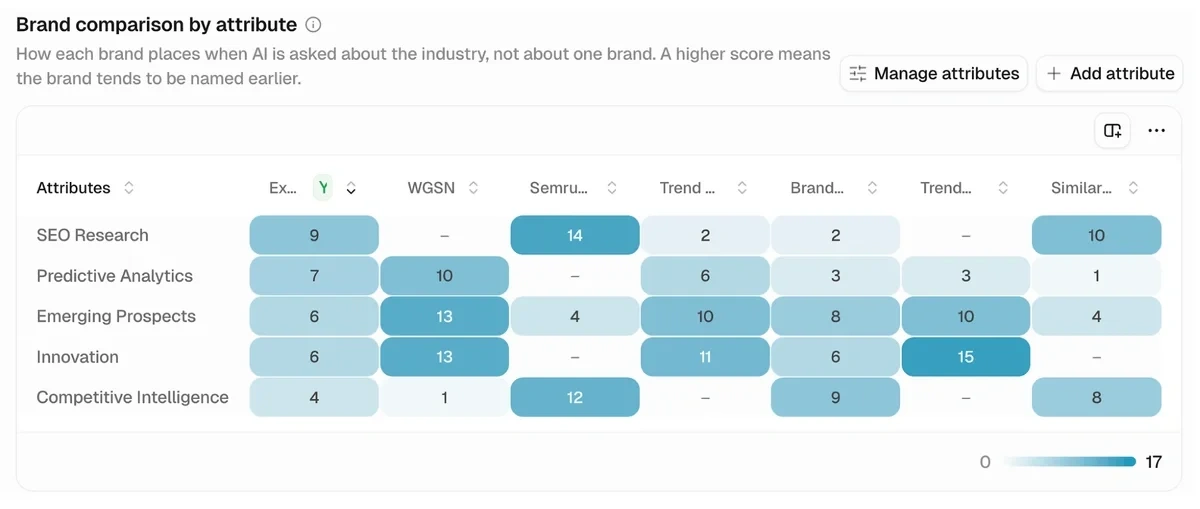
A high score means you always show up first for a given attribute.
It’s not my favorite approach to comparing sentiment differences between brands – I think Semrush’s feature category tables handle this more intuitively – but it’s still good to have this information at all. Not many AI brand monitoring tools do.
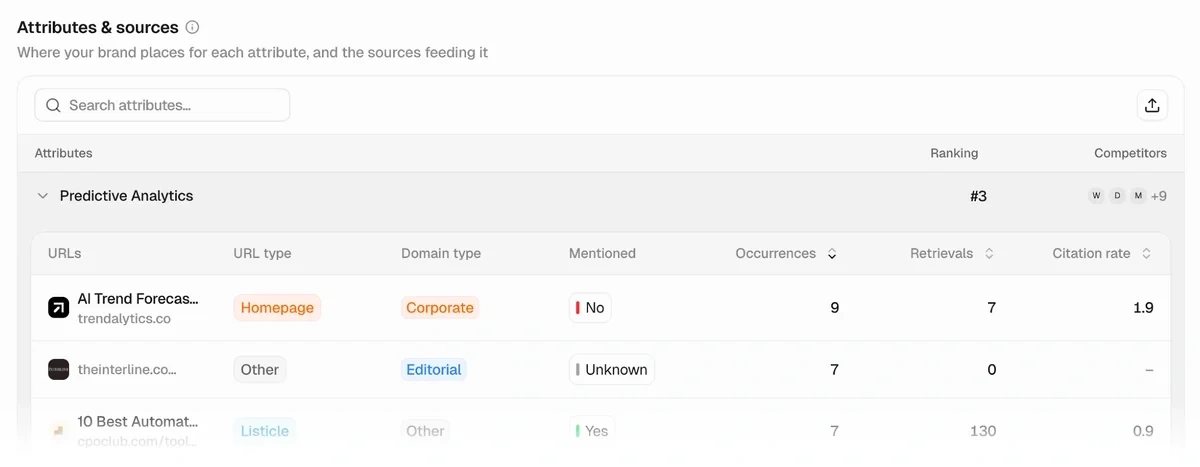
I like that you can see the sources that are shaping AI sentiment and associations for your brand.
If you want to see the websites AI tools are frequently citing when describing attributes for brands in your industry, you’ll find this feature quite useful.
Peec AI offers different pricing structures for brands and agencies. For brands, it starts at $95/month, while the agency plans start at $205/month.
I think Peec AI is good at identifying attribute associations for your brand, but its focus on market prominence over exact sentiment means there’s limited nuance here.
That’s an area where other tools like Semrush edge out Peec AI.
3. Rankscale: Insightful Sentiment Breakdowns by Model
Rankscale impressed me greatly with its simple, intuitive, and insightful sentiment analysis reports.
It does a good job of summarizing what your brand’s overall AI perception is and giving a nice breakdown of the positive and negative sentiments associated with your brand.
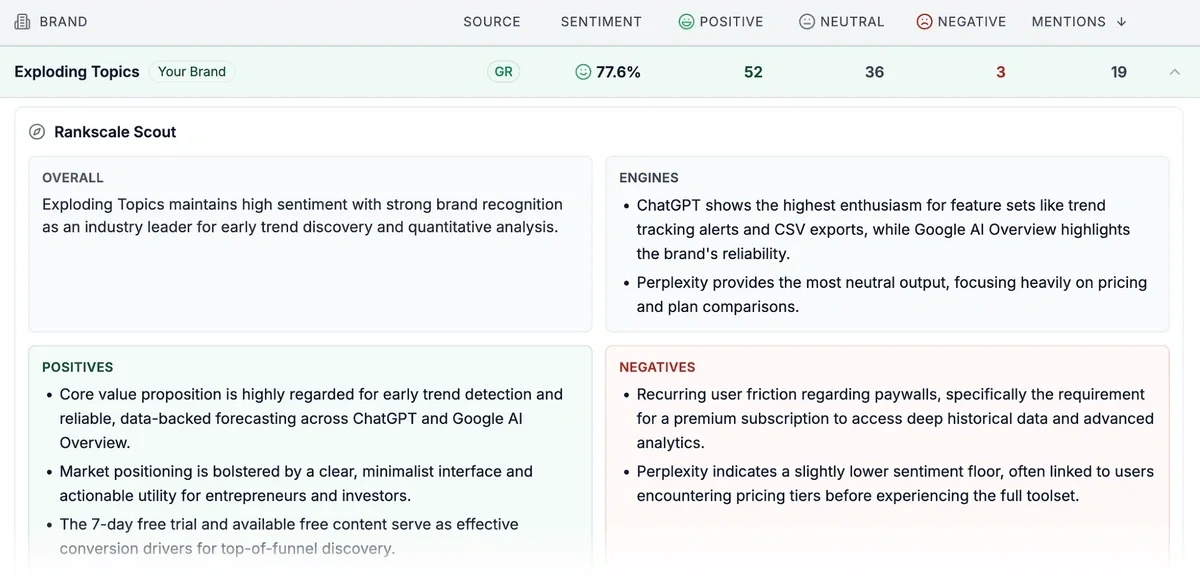
I like that the summary also includes a block focused on which models speak most favorably of you and why, and which LLMs are less enthusiastic about you.
It goes one step further to also show you the overall sentiment score (as percentages) for each model you’re tracking.
The score is broken down into a bar chart that shows the distribution of sentiment, focusing on total occurrences of outputs with positive, neutral, and negative sentiments.
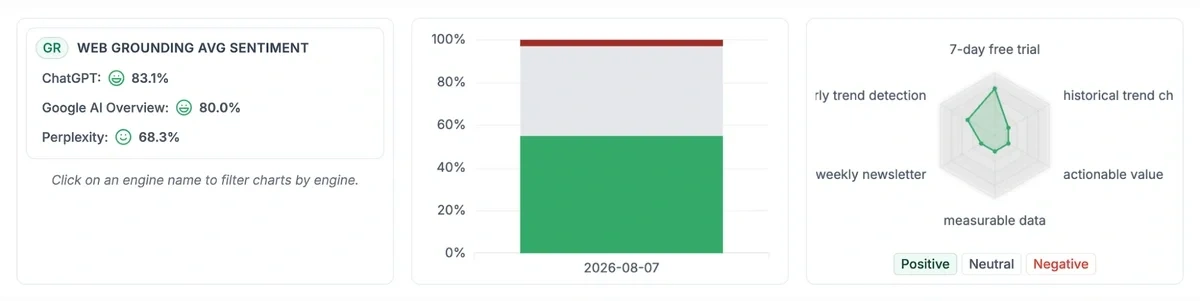
The actual attributes associated with your brand appear in a spider web graph. You can see this graph as an aggregate of all selected models, or filter it by specific models.
There are toggle buttons that you can press to switch the graph view to display positive, neutral, or negative sentiments. It’s a thoughtful feature that makes the analysis structured for ease.
To see the full list of descriptions and attributes LLMs are associating with your brand, you can scroll down to the keyword cloud section.
This, once again, is broken down into positive, neutral, and negative keyword clouds for each model you’re tracking.
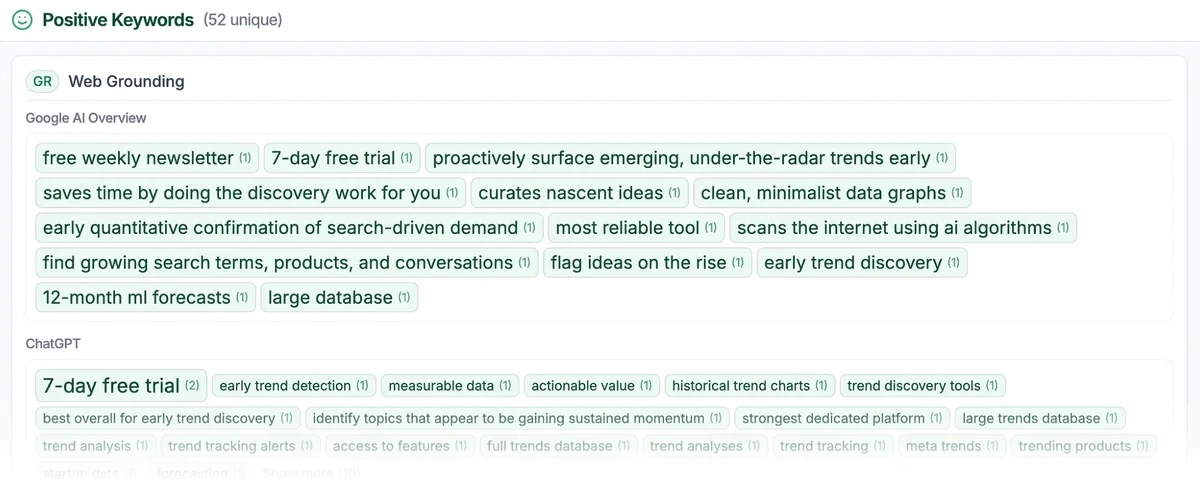
Clicking any keyword executes a query and reveals the generated response where your brand is mentioned with the same description reflected by the term.
Even though Rankscale doesn’t go into the same depth as Semrush for feature categories and perception comparisons between brands, it’s a remarkably well-designed tool for sentiment analysis.
Plans start at $99/month, similar to what most AI brand tracking tools cost.
4. LLM Pulse: Powerful Sentiment Classification with Custom Rules
LLM Pulse offers similar features for sentiment tracking as others on this list, but it also has a few interesting unique innovations of its own.
The basic metrics reveal your sentiment distribution across a spectrum running from very positive to very negative responses.
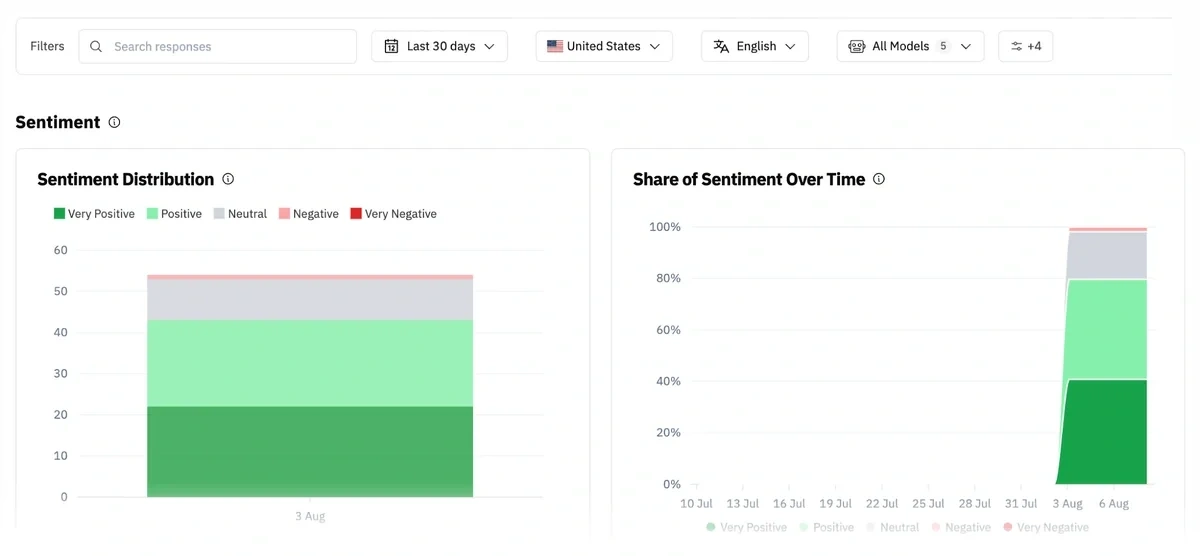
There’s also a stacked chart for tracking how your share of sentiment is evolving over time.
I haven’t seen other tools show a breakdown of sentiment changes in a time series chart, and I think it’s a useful way to understand the evolution of your sentiment classification.
For competitive analysis, LLM Pulse gives you a ranked table displaying sentiment by brand.
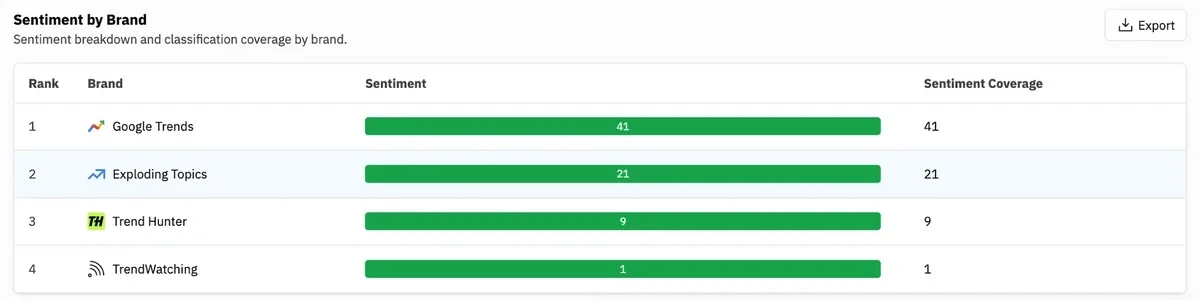
It's a fairly simple chart, and it only gives you sentiment scores for each brand you’re tracking in your industry.
I’d find it more useful if the chart compared sentiment changes for your brand vs competitors over time, but this is still insightful despite the limitations.
Another really good piece of insight is the breakdown of sentiment by topics or attributes.
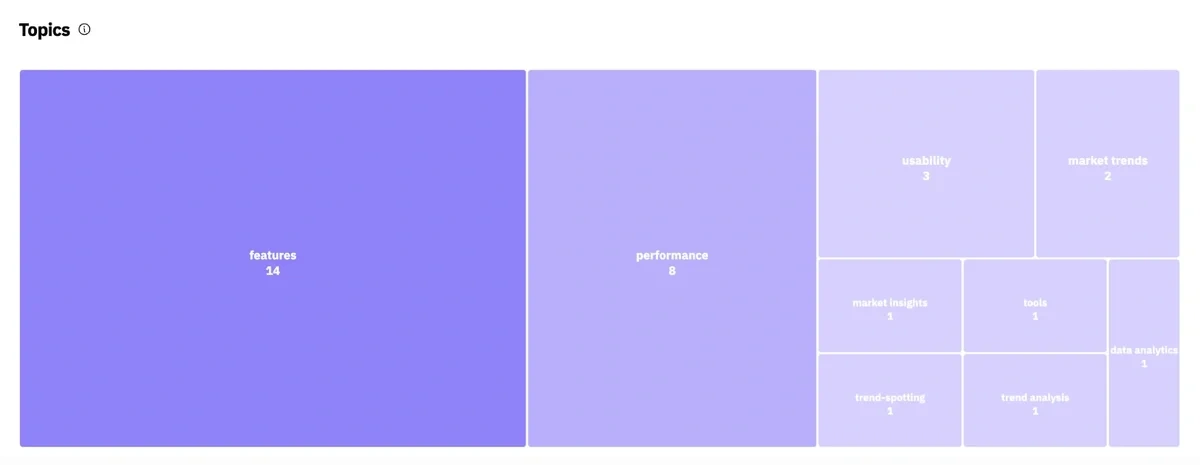
With these tiled charts, you’ll know which attributes are frequently referenced by LLMs in association with you.
These charts are accompanied by a breakdown of frequently discussed topics with sentiment scores for each.
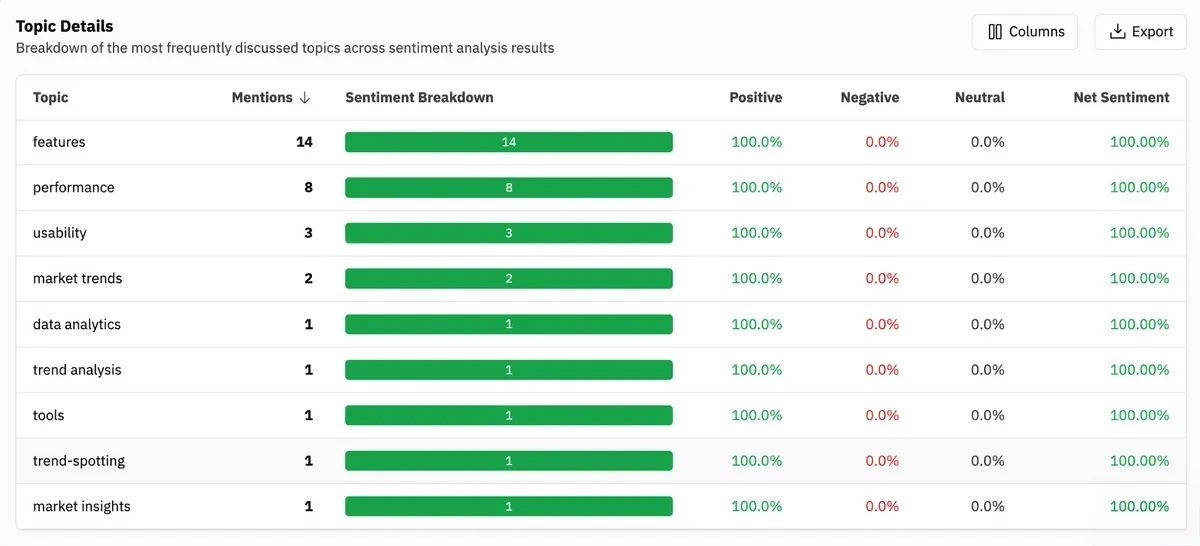
I also like the filters that allow you to see the results for specific LLM models, change the types of prompts to analyze (own brand, other competitors, non-brand/generic), as well as topics you want included or excluded in your analysis.
I was most impressed by the ability to add your own sentiment rules.
These are simple plain-text instructions you can use to mark an attribute as positive or negative, even if the surrounding context suggests otherwise.
It’s a simple feature that adds a lot more control over how an LLM classifies your brand.
Sentiment analysis is included in Growth and above plans, starting at $100/month. The base price includes Google AI Mode, AI Overview, Gemini, ChatGPT, and Perplexity.
But you can add more models like DeepSeek, Grok, and Claude as paid add-ons.
5. ZipTie: Budget-friendly and Simple
ZipTie takes a much simpler approach than other tools on my list.
Primarily, ZipTie tracks mentions and citations of your brand across Google AI Overviews, ChatGPT, and Perplexity.
While you won’t get advanced sentiment-related insights, ZipTie still measures the percentage of your brand’s positive, neutral, and negative sentiments.
You get these metrics as an overall percentage, which combines your individual scores across different LLMs into one.
In addition, you can see the breakdown of your brand portrayal by LLM.
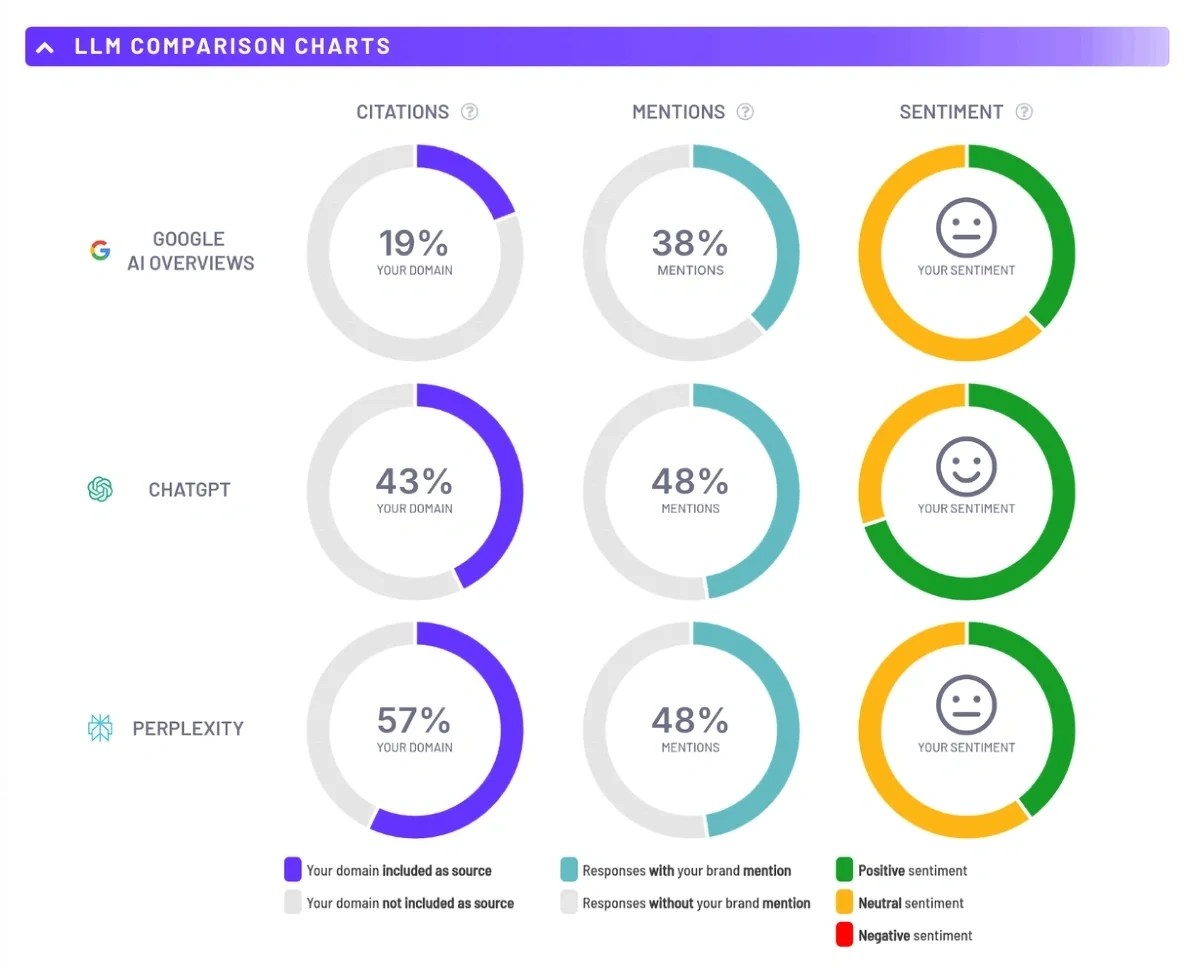
And finally, the tool also evaluates the sentiment of AI-generated responses to your brand at the prompt level.
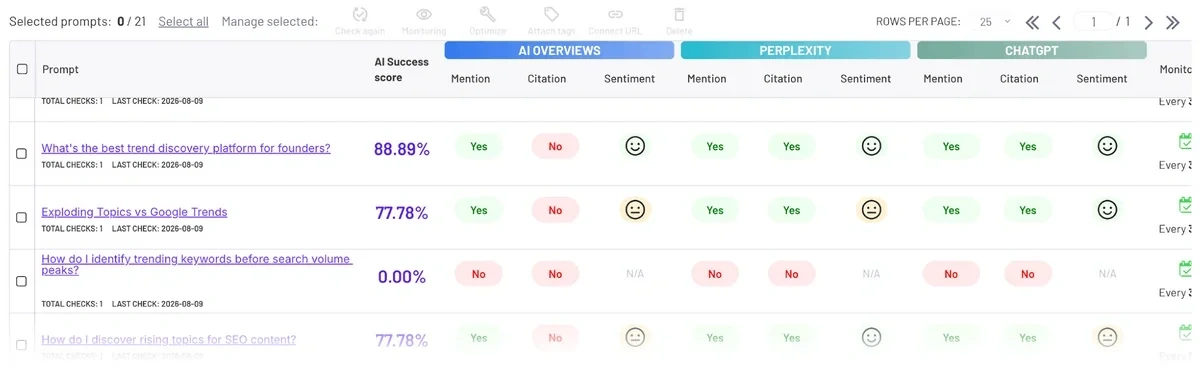
Note: Speaking of prompts, ZipTie’s auto-prompt generation feature turned out to be broken during my testing. That meant that, unlike other tools that automatically generate clusters of prompts to scan your AI search performance against, I had to manually type in each prompt I wanted tracked. This well might have been a temporary glitch, but it was a frustrating one.
None of these features are ground-breaking. You won’t get thematic analyses about feature categories or attributes that AI is associating you with.
Despite these limitations, ZipTie is worth your consideration because it’s one of the cheapest options on the market.
If you’re tight on budget and just need simple sentiment classifications, ZipTie is a good option starting at $69/month with a generous 14-day free trial.
That said, it’s not my top choice for brands seeking nuances and contextual understanding of how different LLMs portray them, with actionable insights.
How I Chose AI Sentiment Tracking Tools
Here are the key features I looked at when testing sentiment tracking tools for my list:
- Sentiment Analysis Capabilities: Evaluated how effectively each tool summarizes overall AI perception and categorizes positive, neutral, and negative sentiments.
- Competitive Benchmarking: Looked for features that compare brand sentiment and market prominence against industry competitors, such as competitive perception or brand shape graphs.
- Feature and Attribute Association: Prioritized tools that identify specific descriptive attributes or product features that LLMs associate with a brand.
- Historical Tracking: Considered the ability to monitor changes in perception over time through time-series charts and historical data across different AI models.
- Pricing and Value: Compared the cost-effectiveness of each platform, ranging from budget-friendly options like ZipTie to comprehensive SEO suites like Semrush.
Get More Search Traffic
Use trending keywords to create content your audience craves.
Which AI Sentiment Tracking Tool Should You Use?
I prefer Semrush for two reasons.
First, it has a fantastic sentiment analysis report that drills down into feature classifications and extracts attributes LLMs associate with your brand.
It also tracks how AI sentiment about your brand stacks up against competitors.
These features offer more practical value than simply seeing the percentage of your positive and negative sentiments.
Second, Semrush is already a powerful SEO tool too, with one of the largest keyword and backlink databases in the industry.
The combination of a classic SEO toolkit and a comprehensive AI visibility toolkit with sentiment analysis, AI search citation and mention tracking, prompt research, and more produces a uniquely valuable suite of search marketing intelligence.
Peec AI is ideal for marketers focused on market prominence. Its brand shape and attribute comparison graphs are highly effective for visualizing how you position against competitors across specific industry attributes.
Rankscale is a solid choice for businesses that prioritize simple sentiment breakdowns and keyword clouds to find thematic patterns in how AI describes your brand.
LLM Pulse is great for strategists who require precise control. The ability to add custom sentiment rules allows you to manually define how an AI classifies your brand, regardless of generative context.
ZipTie is an accessible option for those needing the bare essentials. It provides simple sentiment classification and citation tracking at a lower price point than more advanced suites.
Stop Guessing, Start Growing 🚀
Use real-time topic data to create content that resonates and brings results.
Exploding Topics is owned by Semrush. Our mission is to provide accurate data and expert insights on emerging trends. Unless otherwise noted, this page’s content was written by either an employee or a paid contractor of Semrush Inc.
Share
Newsletter Signup
By clicking “Subscribe” you agree to Semrush Privacy Policy and consent to Semrush using your contact data for newsletter purposes
Written By


Osama is an experienced writer and SEO strategist at Exploding Topics. He brings over 8 years of digital marketing experience, spe... Read more